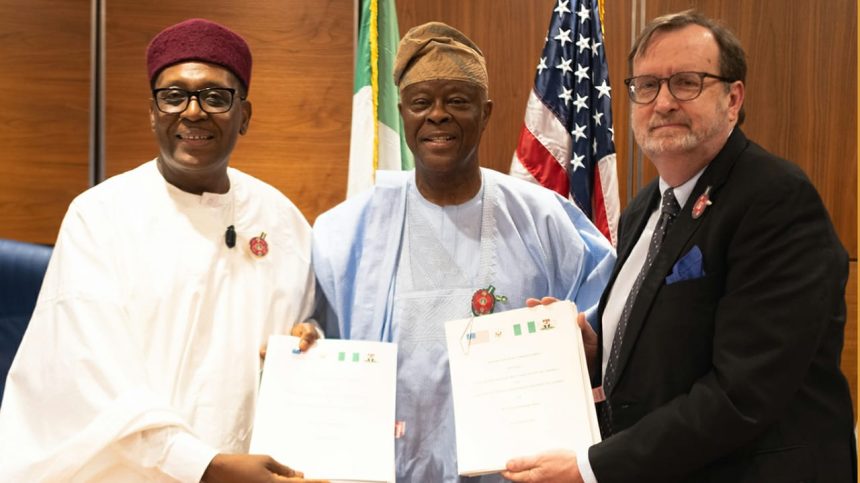
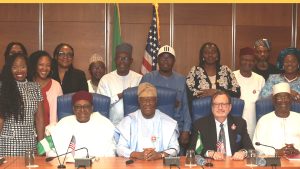
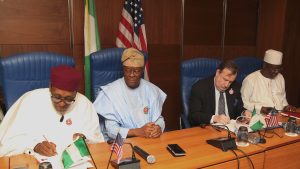
Nigeria’s health sector has received a significant boost with the signing of a five-year, $5.1 billion bilateral health cooperation Memorandum of Understanding (MoU) with the United States (US).
The US Embassy in Nigeria announced the agreement on Sunday. Framed under the America First Global Health Strategy, the deal goes beyond routine donor support. It signals a shift toward co-investment, accountability, and national ownership in a sector long constrained by underfunding, weak systems, and heavy donor dependence.
that united fan could've had two haircuts 💇♂️
— Aston Villa (@AVFCOfficial) December 21, 2025
At its core, the MoU reflects a recalibration of Nigeria–US health relations: from aid-driven interventions to a partnership built around shared responsibility, domestic investment, and system-wide resilience.
A Shift From Aid Dependence To Co-Investment
EKO HOT BLOG gathered that one of the most consequential aspects of the MoU is its financial architecture. The US intends to commit nearly $2.1 billion in health assistance over five years, while Nigeria is expected to invest almost $3.0 billion in new domestic health expenditures within the same period. This makes Nigeria’s commitment the largest co-investment by any country under the America First Global Health Strategy.
For Nigeria’s health sector, this is both an opportunity and a test.
Historically, donor-funded programmes, especially in HIV/AIDS, malaria, and tuberculosis, have outpaced domestic financing, raising concerns about sustainability. The new MoU pushes Nigeria toward greater fiscal responsibility and long-term planning, reinforcing the idea that durable health systems cannot be built on external funding alone.
If effectively implemented, this co-investment model could strengthen primary healthcare, improve supply chains for health commodities, and reduce the volatility that often follows donor exit or funding cuts. It also places pressure on federal and state governments to ensure that budgeted health expenditures translate into real services rather than remaining paper commitments.
According to the 2026 budget President Bola Tinubu submitted to the National Assembly last Friday, ₦2.48 trillion was allocated to the health sector.
Strengthening Health Systems Amid Persistent Burdens
The agreement comes at a time when Nigeria faces some of the world’s most severe health indicators. The country records one of the highest maternal and child mortality rates globally and carries about 27 percent of the global malaria burden and 31% of deaths. These challenges are compounded by periodic disease outbreaks, workforce shortages, and fragile data and surveillance systems.
Under the MoU, US support will continue for surveillance and outbreak response, laboratory systems, health commodities, frontline healthcare workers, and health data systems. Importantly, the scope covers both preventive and curative services across HIV/AIDS, tuberculosis, malaria, polio, and maternal and child health.
Rather than focusing solely on disease-specific outcomes, the agreement emphasizes system strengthening — an approach that could improve Nigeria’s capacity to respond to both endemic and emerging health threats. If aligned with ongoing reforms such as the Basic Health Care Provision Fund and state-level primary healthcare revitalisation, the MoU could help close long-standing gaps between policy intent and service delivery.
Faith-Based Providers and Security Conditions
Perhaps the most politically sensitive and distinctive feature of the MoU is its strong emphasis on Christian faith-based healthcare providers. This comes as the US has alleged Christian persecution in Nigeria and accused the federal government of not doing enough to combat terrorism.
Against this backdrop, the health financing agreement allocates approximately $200 million in dedicated support to strengthen Christian clinics and hospitals, enhance workforce capacity, and expand integrated services in HIV, TB, malaria, and maternal and child health.
These facilities, more than 900 nationwide, serve over 30 percent of Nigeria’s estimated 230 million people, often in rural or underserved areas where public healthcare infrastructure is weak or nonexistent. From a service-delivery standpoint, the investment acknowledges an existing reality: faith-based providers are indispensable to Nigeria’s health ecosystem.
However, the MoU also explicitly links health cooperation to reforms aimed at protecting Christian populations from extremist violence. The US says that it retains the right to pause or terminate programmes if they no longer align with its national interests, and it expects measurable progress in combating religiously motivated violence against Christian communities.
This conditionality introduces a new layer of accountability that goes beyond health metrics. How the federal government manages this balance, ensuring equitable health access while addressing security concerns without deepening religious fault lines, will shape both the success of the MoU and the credibility of Nigeria’s broader reform agenda.