- Former Chinese Premier Zhu Rongji has died at 97
- He was known for bold economic reforms and blunt criticism
- Zhu played a major role in China’s WTO entry
Former Chinese Premier Zhu Rongji, remembered for his outspoken style and sweeping economic reforms, has died at the age of 97.
Zhu, who served as China’s premier from 1998 to 2003 after spending several years as vice premier, became known for his direct language and willingness to publicly criticise corruption, poor governance and economic mismanagement, Eko Hot Blog gathered.
A collection of his speeches published in 2011 drew widespread attention, particularly for his colourful descriptions of substandard infrastructure and officials who failed to perform their duties. The four-volume publication contained more than 2,000 pages of speeches and remarks from his years in senior government positions.
His blunt assessments resonated with many Chinese readers, particularly at a time when public statements by senior officials were often viewed as cautious and restrained.
Reform-minded academics and former officials also regarded the collection as an important record of Zhu’s approach to governance and economic management.
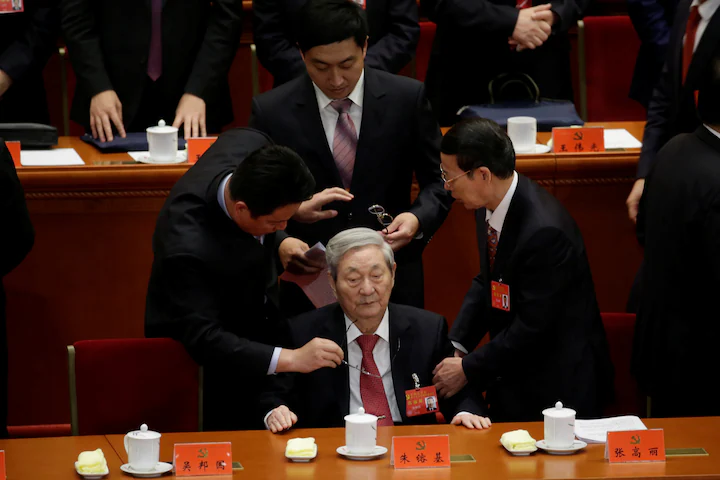
Among the issues he repeatedly highlighted were local government debt, weak banking practices, inflation, rapid urban expansion and corruption.
In one speech delivered in 1998, Zhu warned that China faced several potential crises, pointing to public dissatisfaction, corruption among officials, widening inequality and abuses of power by some local authorities.
Zhu was born in 1928 and graduated from Tsinghua University in Beijing. He joined the Chinese Communist Party in 1949, the year Mao Zedong established the People’s Republic of China.
His political career was interrupted during the Cultural Revolution, when he was sent to work in the countryside. After his political rehabilitation, he gradually returned to public service and rose through the government ranks.
Zhu became mayor of Shanghai in 1987 and played a significant role in the city’s early transformation into a major international economic and financial centre.
He moved to Beijing in 1991 to serve in the central government, where he became closely associated with China’s economic restructuring during a period of rapid change.
As a senior economic official, Zhu helped contain overheating in the Chinese economy during the early 1990s. As premier, he pursued reforms that reduced the role of many state-owned enterprises, including the closure or restructuring of inefficient firms.
The reforms resulted in significant job losses but were presented as necessary steps towards building a more market-oriented economy.
Zhu also strengthened the central government’s control over taxation and introduced reforms to the housing sector. Those changes contributed to the expansion of private home ownership and helped lay the foundation for China’s rapidly growing property market.
One of the defining achievements of his tenure was China’s entry into the World Trade Organization in 2002.
Zhu personally played a major role in the lengthy negotiations, despite concerns among some Chinese officials that the concessions required for membership could expose domestic industries to excessive competition.
The WTO agreement nevertheless marked an important milestone in China’s integration into the global economy and was followed by years of rapid expansion in trade and investment.
Zhu’s record was not without controversy. Some observers criticised aspects of his economic policies, including decisions involving agricultural production, taxation and the restructuring of state-owned enterprises.
They argued that some of the consequences of those policies created challenges that later administrations had to address.
Nevertheless, supporters of Zhu’s reform agenda regarded his time in government as one of the most consequential periods in China’s economic transformation.
Former People’s Daily senior editor Zhou Ruijin said in a 2011 interview that China’s leaders could learn from Zhu’s willingness to pursue difficult reforms.
Zhu’s political legacy has therefore remained closely linked to China’s transition towards a more market-driven economy and its growing engagement with the international economic system.
His death marks the passing of one of the country’s most prominent economic reformers of the post-Mao era.