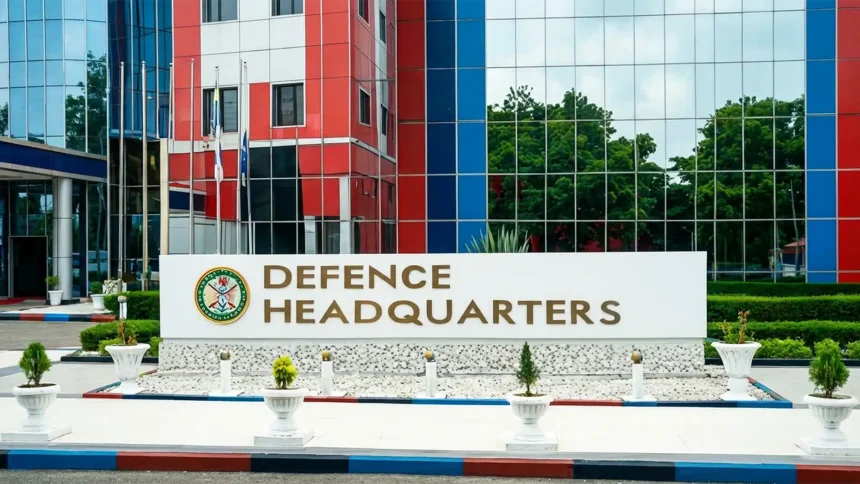
- DHQ Denies Recruiting Repentant Terrorists, Clarifies Operation Safe Corridor
- Operation Safe Corridor focuses on rehabilitation and reintegration only.
- Army says strict rules bar anyone with criminal record from enlistment.
The Defence Headquarters (DHQ) has dismissed reports alleging that repentant terrorists and bandits are being recruited into the Nigerian military, describing the claims as false and misleading.
In a statement issued on Tuesday in Abuja, the Coordinator of Operation Safe Corridor, Brigadier General Yusuf Alli, said there was no basis for the reports suggesting that former insurgents were being secretly enlisted into the armed forces.
“We are not recruiting any killers into the army, and we can never do that,” he said.
EDITOR’S PICKS
- Teenagers Attempt Bomb Attack At Maiduguri Teaching Hospital
- APC Elects New National Executives, Full List Emerges
- Why I Resigned As Kano Deputy Governor – Gwarzo
EKO HOT BLOG reports that Alli also rejected claims that rehabilitated ex-combatants are acting as informants for Boko Haram or ISWAP, noting that such individuals would face severe consequences if they attempted to return to terrorist groups.
“There is no way the repentant terrorists, who are low-risk terrorists, who were conscripted, forced to join the Boko Haram insurgency against their will, and many who escaped from the terrorists’ dens when the opportunity came, can go back to the terrorists’ group. They will be killed. The high-risk terrorists believe they are now government spies who have benefitted and will sell them out,” he added.
He stressed that Operation Safe Corridor is strictly a rehabilitation and reintegration initiative and not a recruitment channel. According to him, the Nigerian Army maintains strict recruitment standards that automatically disqualify individuals with criminal records from joining the military or any security agency.
“Once you have any criminal record, you cannot join the military or any security agency,” he said.
Alli explained that the programme is not a physical camp but a framework designed to manage surrendered insurgents through a structured process. He noted that a multi-agency screening system involving the Ministry of Justice and other stakeholders classifies participants into low-risk, medium-risk, and high-risk categories.
He said only low-risk individuals, identified as those without prosecutable offences, are admitted into the programme for rehabilitation. These participants undergo de-radicalisation, trauma counselling, and vocational training to support their reintegration into society.
“Participants receive de-radicalisation, trauma counselling, and vocational training to prepare them for civilian life. Many arrive suffering from psychological trauma and drug dependency. Skills training such as tailoring, carpentry, and farming helps ensure they can contribute positively to society,” he added.
The coordinator further clarified that the initiative does not replace the criminal justice system, as captured high-risk terrorists are prosecuted in accordance with the law.
“Hardcore terrorists captured during operations are prosecuted and, if convicted, imprisoned. The programme operates on a dual-track system: criminal justice for offenders and rehabilitation and reintegration for victims,” he said.
He reiterated that Operation Safe Corridor is focused on preventing a return to violence and promoting long-term stability.
“The military’s message is clear: Operation Safe Corridor is about rehabilitation, not recruitment, and its purpose is to prevent a return to violence,” he added.