It is a familiar Nigerian tragedy playing out again — a national team stranded between glory and disgrace, not because of lack of talent or will, but because of the incompetence and irresponsibility of those entrusted with its management.
Just days before the Super Eagles face Gabon in a high-stakes playoff that will decide whether Nigeria remains in contention for the 2026 FIFA World Cup, players and officials have boycotted training in Morocco over unpaid bonuses and allowances.
BREAKING NEWS;
Super Eagles players & officials boycott training today in Morocco because of unresolved issues with outstanding payments.
This is really sad.
— POOJA!!! (@PoojaMedia) November 11, 2025
EDITOR’S PICKS
The protest, confirmed by multiple reports, including sports journalist Oluwashina Okeleji, who revealed that players have been owed match bonuses for over 30 international matches dating as far back as before the 2019 Africa Cup of Nations, exposes a chronic rot that continues to undermine Nigerian football.
Players owed bonus since 2019.
None of the Super Eagles players has received their allocated allowances or bonus for reaching the 2025 AFCON and 2026 World Cup playoff
Nigeria players & staff boycott Tuesday training ahead of Thursday’s game vs Gabon.
Tired of empty promises. pic.twitter.com/UoE64OVnTK
— Olúwashínà Òkélèjì (@oluwashina) November 11, 2025
That such a scandal is unfolding at this critical juncture — with the eyes of the continent fixed on Rabat, where the Super Eagles are camped ahead of Thursday’s playoff — is nothing short of disgraceful. The players are not demanding favours; they are simply asking for what they are owed. Yet, the Nigeria Football Federation (NFF) has once again failed to honour even the most basic obligations. This is not a new pattern. It has become an institutional habit, one that recurs every few years like a sickness the NFF refuses to cure.
During his tenure as captain, John Obi Mikel once had to dip into his own pocket to pay hotel and travel bills to save the team from international embarrassment. Before him, other generations endured similar indignities — unpaid bonuses, cancelled flights, and ill-timed protests that overshadowed competitions. Each time, the NFF’s defence was the same: bureaucratic delays, government bottlenecks, or unforeseen logistics. Yet, this narrative falls apart under scrutiny. The Federal Government has long made it clear that funds for player bonuses and logistics are allocated to the NFF ahead of matches. The problem, therefore, is not lack of money, it is lack of accountability.
For years, Nigerian footballers have been treated as pawns in a cycle of mismanagement and political patronage. Administrators live large while players, who carry the nation’s pride on their shoulders, are left to beg for entitlements that should have been paid without prompting. Each generation of Eagles inherits not only the jersey but also the burden of unpaid debts. And now, at a time when every training session counts, the team’s focus has been broken by a crisis entirely of the NFF’s making.
The stakes could not be higher. The new CAF qualification format for the 2026 World Cup allows only group winners to qualify automatically, while the best runners-up — like Nigeria — must navigate a tense playoff route. The Super Eagles’ clash with Gabon on Wednesday in Rabat is a single-leg, do-or-die encounter. Win, and they advance to face either Cameroon or DR Congo in the final playoff round. Lose, and Nigeria’s World Cup dream evaporates. There will be no second leg, no time for redemption. Every minute of preparation is precious, yet the NFF’s negligence has forced players to abandon training in protest.
This is not merely an administrative lapse; it is sabotage of national interest. The Super Eagles are not just athletes, they are symbols of national unity, one of the few institutions that still inspire collective pride. To have their morale shattered on the eve of a defining match because of unpaid entitlements is unforgivable. The NFF’s failure to manage its finances transparently or prioritize player welfare amounts to an institutional betrayal of trust.
There are wider implications. Beyond the embarrassment, this chaos sends the wrong signal to younger players, to sponsors, and to Nigerians in the diaspora who invest emotionally in the team. It tells them that patriotism is a one-way street, that while players bleed for the flag, administrators profit from the system’s decay.
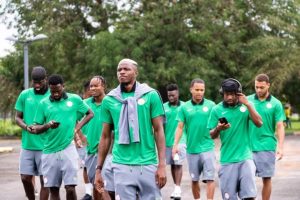
In the coming days, the focus should rightly shift to Wednesday’s clash against Gabon, where Victor Osimhen, Alex Iwobi, Wilfred Ndidi, Ademola Lookman, and others will attempt to overcome not only their opponents but also the weight of their own federation’s incompetence. Yet, no matter the result, this episode must force a reckoning. Nigerian football cannot continue on this path of dysfunction.
The NFF must be held accountable, not with polite admonitions but with structural reform and oversight. It is intolerable that a federation which receives government allocations and FIFA funds can still fail to pay its players for years. Football is not just entertainment; it is national representation. And when those representing the nation are humiliated and demoralized by their own administrators, the entire country is diminished.
FURTHER READING
Nigeria’s World Cup hopes now hang in the balance, not because Gabon are formidable, but because the NFF has once again failed to meet the simplest test of responsibility. If the Super Eagles falter in Rabat, the defeat will not belong to the players; it will belong squarely to the NFF.
Philip Ibitoye is a Special Correspondent with EKO HOT BLOG. Click here to find daily analysis and critical insight on trending issues in Lagos and other parts of Nigeria.
Click here to watch the video of the week below: