- Tinubu Seeks Global Support for Nature Protection, Climate Resilience
- …calls for a boost in global financing to restore, protect nature
- Shettima warned that neglecting nature comes at a steep cost
Nigeria has called on the international community to significantly scale up global financing to protect and restore nature’s economic value through predictable, equitable, and accessible funding mechanisms.
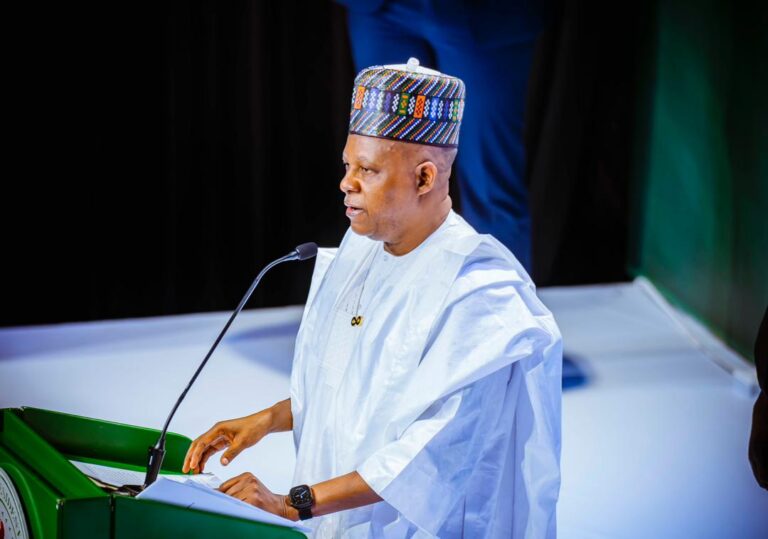
Eko Hot Blog reports that Vice President Kashim Shettima, who represented President Bola Ahmed Tinubu at a high-level thematic session titled “Climate and Nature: Forests and Oceans” in Belem, Brazil, made the call on the sidelines of the ongoing United Nations Climate Change Conference (COP30).
EDITOR’S PICK
- We are Monitoring Nigeria – Russia Declares
- NSCDC Warns Officers Against Misconduct During Anambra Poll
- Tinubu, Sierra Leone’s President Julius Bio Hold Closed-Door Meeting in Abuja
According to a statement by his spokesman, Stanley Nkwocha, Shettima emphasized that forests, landscapes, and oceans being shared global resources require collective action and global solidarity for their protection.
He lamented that nature, despite being the world’s most essential infrastructure, has long been exploited as a commodity rather than treated as an investment-worthy asset.
“Nigeria is integrating nature-positive investments into its climate finance architecture,” he said.
“Through our National Carbon Market Framework and Climate Change Fund, we aim to mobilize up to $3 billion annually in climate finance. These resources will be reinvested in community-led reforestation, blue carbon projects, and sustainable agriculture.
“We call on our global partners to recognize the economic value of nature and channel significant finance toward protecting and restoring it,” Shettima stated.
The Vice President stressed that countries in the Global South, which have contributed the least to climate change, are now paying the highest price. For true climate justice, he said, nations that have benefited from centuries of resource extraction must now lead the way in restoration.
He urged developed countries and international institutions to scale up grant-based finance, implement debt-for-nature swaps, and operationalize Blue Carbon Markets under Article 6 of the Paris Agreement.
“These measures will empower developing nations to invest in conservation while ensuring that indigenous peoples, farmers, and fisherfolk are rewarded for their environmental stewardship rather than displaced,” he added.
Shettima warned that neglecting nature comes at a steep cost, citing Nigeria’s challenges with deforestation, desertification, illegal mining, coastal erosion, and rising sea levels.
“The Sahara Desert advances by nearly one kilometre each year, displacing communities and eroding livelihoods. Each lost hectare invites conflict and deepens our development crisis,” he cautioned.
Highlighting domestic initiatives, Shettima noted that Nigeria’s Climate Change Act 2021 mandates nature-based solutions as a legal obligation of the state. He said the country is implementing the Great Green Wall Initiative, which has already seen over ten million trees planted across eleven frontline states, creating thousands of green jobs for women and youth.
“Our National Council on Climate Change provides the institutional backbone for integrating climate action into all sectors of governance,” he concluded.
FURTHER READING
- ASMAF Foundation Boosts Support for Girls’ Education
- Damagum: PDP Ready to Restore Nigeria’s Democracy
- Tinubu–Ambode Combo: A Renewed Hope for Lagos in 2027
Click here to watch video of the week