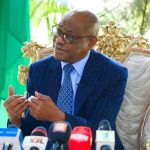
- Nigeria’s Permanent Representative to the United Nations, Dr. Jimoh Ibrahim, has reaffirmed President Bola Tinubu’s commitment to deepening global military alliances and championing institutional reforms within the UN.
- Speaking during a reception for the United States Army War College delegation in New York, Ibrahim warned that emerging technologies like Artificial Intelligence, autonomous weapons, and cyber warfare have complicated global arms regulation.
- The envoy highlighted the long-standing military partnership between Nigeria and the US, pointing to prominent Nigerian leaders and senior officers who have advanced their strategic training at the prestigious War College.
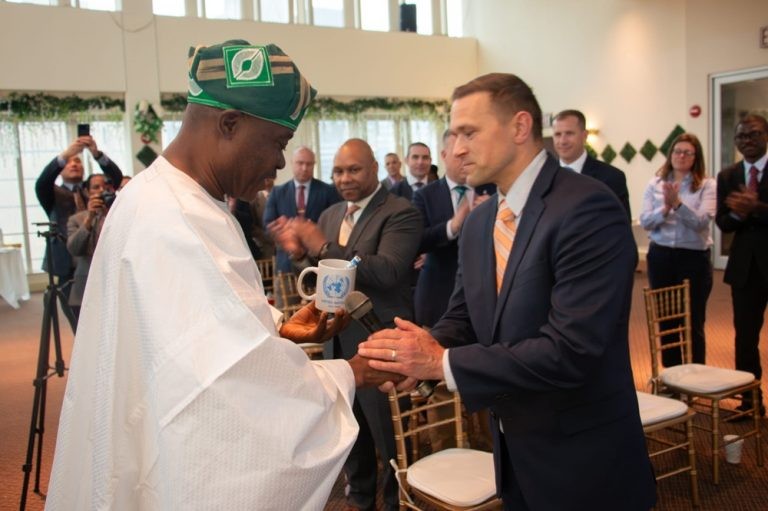
Nigeria’s commitment to multilateralism, global diplomacy, and defence cooperation took center stage in New York as the country’s Permanent Representative to the United Nations, Dr. Jimoh Ibrahim, hosted a high-level delegation from the United States Army War College.
Eko Hot Blog reports that speaking at his first official reception since assuming office, Ibrahim stated that President Bola Tinubu is actively working with international partners and the United Nations Security Council to strengthen peacebuilding mechanisms and enhance cross-border security frameworks.
EDITOR’S PICK
- Fresh Details Emerge on Death of Odomola Monarch, Oba Adebowale Adeshina
- Sanwo-Olu Applauds LASU’s Academic Excellence After JAMB Ranking
- NRC Moves 176,820 Tonnes Of Cargo Through Lagos Ports In Q1
He emphasized that in an era of major power competition, synchronization between diplomatic and defence institutions is vital for international stability.
Addressing contemporary threats, the UN envoy noted that the rapid evolution of military technologies, particularly AI-driven combat systems, drones, and automated weaponry, has significantly altered the global security landscape.
He warned that these advancements make it increasingly difficult to define and verify arms limitations, thereby requiring urgent, coordinated multilateral frameworks.
In addition to technological concerns, Ibrahim listed illicit weapons transfers and rising geopolitical friction as critical areas where Nigeria supports structural reforms, including the ongoing UN80 initiative designed to modernize the global body’s response capabilities.
The diplomat also touched on domestic progress, stating that the economic reforms implemented under the Tinubu administration are successfully repositioning Nigeria for sustainable growth, a shift already recognized by international financial institutions.
Turning back to bilateral ties, Ibrahim lauded the enduring relationship between the Nigerian Armed Forces and the US Army War College.
He noted that the institution has trained many of Nigeria’s top strategic military minds, including former President Muhammadu Buhari and the former Chief of Army Staff, General Taoreed Lagbaja, whose stellar records continue to inspire professionalism within the nation’s military hierarchy.