- US President Donald Trump and Iranian President Masoud Pezeshkian have signed a breakthrough peace agreement at a Versailles dinner hosted by Emmanuel Macron, aiming to permanently end the 5-week Middle East war.
- Following the immediate entry into force of the mediated deal, the vital Strait of Hormuz is set to reopen instantly to global shipping, triggering a sharp 3% drop in global crude oil prices.
- Despite the immediate financial relief on global markets, hardline US lawmakers have labeled the deal the “worst foreign policy blunder in decades,” criticizing the lack of immediate curbs on Iran’s ballistic missile infrastructure.
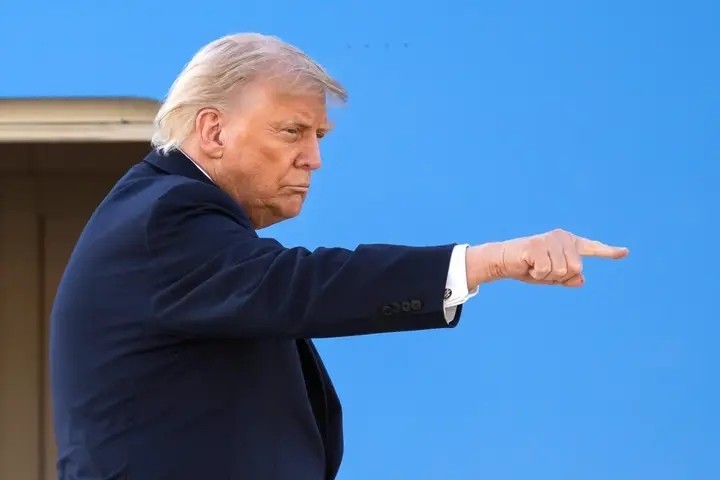
US President Donald Trump on Thursday fiercely defended his newly signed peace accord with Iran, launching a scathing social media attack against domestic and international critics who have accused his administration of offering weak concessions to halt the devastating five-week Middle East conflict.
Eko Hot Blog reports that Trump, who dismissed his political detractors as “fools” and “jealous,” pointed directly to immediate domestic economic indicators, including a record-breaking surge in the stock market and plummeting global oil prices, as definitive proof of the agreement’s strategic success.
EDITOR’S PICK
- Hamzat Appoints Obanikoro as Campaign DG Ahead of 2027 Lagos Governorship Race
- Tinubu’s State Police Plan Gains Momentum as Amendment Looms
- Residents Raise Alarm After Two Bodies Found in Lagos Waterway
The public outburst came on the eve of crucial technical implementation talks scheduled to begin in Switzerland.
The dramatic diplomatic breakthrough unfolded unexpectedly on Wednesday evening during a high-profile, candlelit dinner at the historic Palace of Versailles outside Paris, hosted by French President Emmanuel Macron following the conclusion of the G7 summit.
In a highly symbolic setting reminiscent of the treaties that concluded World War I, President Trump signed the document in thick black ink, drawing an enthusiastic “bravo” from President Macron.
Simultaneously, Iranian foreign ministry spokesperson Esmaeil Baqaei confirmed that Iranian President Masoud Pezeshkian had appended his signature to the historic text in Tehran, declaring that the international community must now test the practical implementation of the peace framework.
The sudden de-escalation has brought an immediate sigh of relief to global energy corridors, which had been severely throttled by five weeks of all-out war between US-Israeli forces and the Islamic Republic.
Pakistan’s Prime Minister, Shehbaz Sharif, whose administration played a pivotal role in mediating the complex backchannel negotiations alongside French diplomats, announced that the accord would enter into force with immediate effect.
Crucially, Sharif confirmed that Iran has committed to instantly lifting its highly restrictive blockades on the Strait of Hormuz, a move that immediately drove global crude benchmarks down by more than three percent within hours of the announcement.
The signed agreement initiates an intense 60-day technical negotiation window in Switzerland, where international stakeholders will hammer out the complex fine print regarding the rolling back of crippling American oil sanctions in exchange for verified nuclear restrictions.
According to top Washington officials, Iran has agreed to dilute its highly enriched uranium stockpiles via supervised on-site “down-blending” overseen directly by the International Atomic Energy Agency (IAEA). IAEA Chief Rafael Grossi confirmed from Geneva that inspectors stand fully prepared to establish concrete enforcement steps.
However, controversy remains highly volatile as the treaty completely omits any restrictions on Tehran’s ballistic missile program, with Iranian officials firmly stating their defensive capabilities remain non-negotiable.
Despite the economic relief, President Trump faces a swelling mutiny from hardliners within his own political camp who argue the deal gives Iran massive financial windfalls, including access to a projected $300 billion regional reconstruction fund, without completely dismantling its nuclear infrastructure.
Republican Senator Bill Cassidy publicly condemned the deal as an unprecedented foreign policy blunder, arguing that Washington has signaled to adversarial nations that disrupting global shipping lanes yields high-value diplomatic leverage.
While Trump countered by asserting he remains fully prepared to “bomb the hell” out of the region if infractions occur, regional tensions remain on a knife-edge, particularly regarding how the 60-day timeline will address the fragile ceasefire along the Lebanese border following weeks of heavy multi-front exchange.