- Former presidential candidate Omoyele Sowore has claimed that the current democratic dispensation is more repressive than the military era, citing a record number of arrests in 2025.
- Speaking on Channels Television, the activist revealed he is currently facing nine separate criminal cases filed by the Federal Government and the Nigeria Police.
- A Federal High Court in Lagos has awarded Sowore ₦30 million in damages against the Inspector-General of Police and the Lagos Commissioner of Police for unconstitutionally declaring him wanted.
Human rights activist and former presidential candidate, Omoyele Sowore, has delivered a scathing assessment of Nigeria’s current political climate, asserting that he has suffered more frequent arrests under the administration of President Bola Tinubu than he did during the country’s years of military dictatorship.
Eko Hot Blog reports that appearing on the Channels Television programme Inside Sources on Friday, February 20, 2026, the African Action Congress (AAC) leader lamented what he described as the increasing criminalisation of dissent and the weaponisation of security agencies to silence critics of the government.
EDITOR’S PICKS
- DSS Arrests El Rufai After Release From EFCC Custody
- Inside Tinubu’s Executive Order Stripping NNPCL of Oil Revenue Deduction Powers
- 5 Health Risks Men Face After Age 40
Sowore, a veteran of pro-democracy struggles since his days as a student leader at the University of Lagos in the early 1990s, drew a direct comparison between his experiences under military juntas and the current civilian rule.
He noted that despite the perceived brutality of military rule between 1989 and 1996, his encounters with state security were less frequent than they have been in recent months.
“I have suffered more arrests in 2025 than I did between 1989 and 1996, when I graduated from university,” Sowore stated, adding that even while fighting the military, he was only detained by the DSS once or twice.
He recounted being abducted during his university years and held for two weeks, and a subsequent one-week detention in Yola during his National Youth Service Corps (NYSC) programme, but argued that the democratic era has proven significantly more repressive.
The activist revealed that he is currently grappling with approximately nine separate criminal cases filed against him by the Federal Government and the Nigeria Police Force.
He cited instances of being abducted from courtrooms and spending months in the custody of the Department of State Services (DSS) as evidence of a shrinking civic space.
These remarks come at a time of heightened international and domestic concern over the use of treason charges and “cyber-stalking” laws to target journalists and political activists.
Sowore maintained that the state is intentionally using institutional power to intimidate those who hold the government accountable.
In a significant legal victory for the activist, the Federal High Court in Lagos on Friday condemned the conduct of the police leadership.
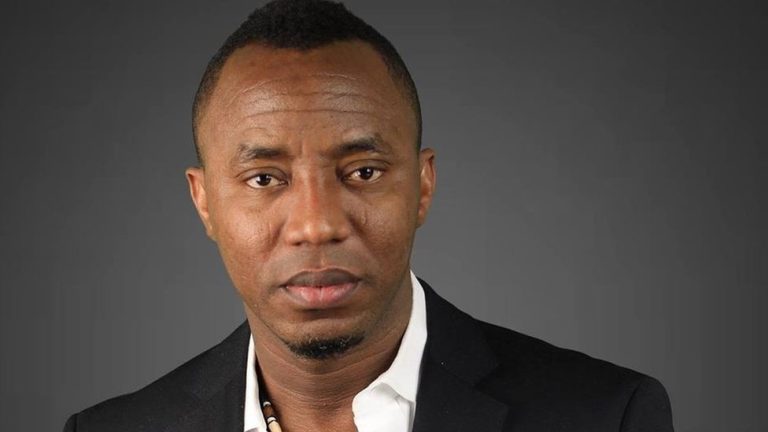
The court, presided over by Justice M. Kakaki, ruled that the actions of the Inspector-General of Police (IGP), Kayode Egbetokun, and the Lagos State Commissioner of Police were unconstitutional and arbitrary.
The ruling specifically addressed an October 2025 pronouncement by the Commissioner of Police warning Sowore to stay away from Lagos, followed by a November 3, 2025, declaration branding him a “wanted” person.
Justice Kakaki held that such a declaration was a grave abuse of power and lacked lawful authority.
The court awarded ₦30 million in damages against both the CP and the IGP, emphasizing that no Nigerian can be criminalised for the mere act of speaking, protesting, or demanding government accountability.

Justice Kakaki traced the evolution of the law, clarifying that only a court, upon the issuance of a warrant and proof of evading process, can authorize a citizen to be declared wanted.
The judge described the police action as “oppression” rather than “policing.” Counsel for Sowore, Tope Temokun, hailed the one-hour-and-thirty-minute judgment as a “constitutional rebuke” to the abuse of state power, noting that while the monetary award is significant, the true value lies in the judicial reaffirmation of fundamental freedoms.