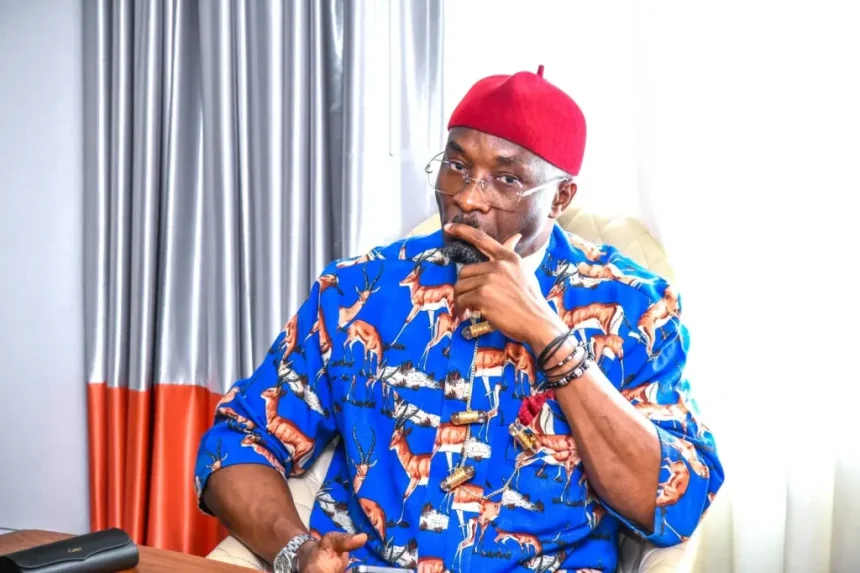
- He also advocated coordinated efforts across sectors to tackle insecurity in the country
- He urged financial institutions to clamp down on money laundering and terrorism financing
The Deputy Speaker of the House of Representatives, Benjamin Kalu, has urged Nigeria to strengthen its security architecture by investing in local arms production and reducing dependence on imported military equipment.
Eko Hot Blog gathered that he made the call on Saturday in Abuja at the Nigeria People’s Strategic Conference and Defence Exhibition 2026, which brought together stakeholders from the defence industry, financial sector, civil society organisations, technology companies, and security agencies to explore solutions to Nigeria’s evolving security challenges.
EDITOR’S PICK
- Federal Lawmaker Yaya Tongo Dies In Abuja Hospital
- Rep. Wale Raji Celebrates Alhaja Aduke Salimot Seriki on Birthday
- Nancy Isime Recalls Alex Ekubo’s Fearless Humor, Generosity at Late Actor’s Tribute
Kalu said Nigeria must build a self-reliant defence system capable of responding effectively to threats such as terrorism, banditry, kidnapping, and organised crime.
He warned that continued reliance on foreign weapons exposes the country to unnecessary risks and limits its strategic independence in security operations.
He stressed that a modern security framework must involve all sectors of society working in coordination.
According to him, the defence industry must focus on expanding local production capacity, while the technology sector should support intelligence gathering, data sharing, and early warning systems that can help prevent attacks before they happen.
Kalu also tasked financial institutions with tightening surveillance on financial transactions to block money laundering, terrorism financing, and other illicit financial flows that sustain criminal activities across the country.
He noted that without cutting off funding channels, security operations would remain incomplete.
He further explained that every sector must have clearly defined responsibilities in the national security structure, adding that the legislature will continue to support reforms through lawmaking, budgetary allocations, and oversight functions.
The Deputy Speaker also referenced the House of Representatives’ overwhelming support for the constitutional amendment on State Police, describing it as a significant step toward decentralising policing and improving local security responses across communities.
While acknowledging Nigeria’s ongoing security challenges, Kalu argued that the country should not be described as failing, but rather as a nation actively working to overcome its difficulties.
He said resilience must be matched with stronger institutions and effective policy implementation.
He concluded by calling for sustained collaboration among government agencies, the private sector, and civil society, stressing that building a modern and effective security ecosystem is a shared responsibility that requires unity, commitment, and long-term planning.
FURTHER READING