- Senate Did Not Remove Electronic Transmission – Akpabio Defends Electoral Act Amendment
- Akpabio denies removal of electronic transmission of results
- Lawmakers oppose mandatory real time transmission over legal risks
The Senate President, Godswill Akpabio, has defended the National Assembly’s ongoing amendment of the Electoral Act, insisting that critics are misjudging lawmakers based on an incomplete legislative process.
Akpabio clarified that the Senate did not remove electronic transmission of election results from the proposed amendment, stressing that lawmakers only questioned the requirement for mandatory real time transmission.
EDITOR’S PICKS
- Health Workers Warn as Antivenom Gaps Undermine Snakebite Treatment
- Tinubu Approves ₦40bn Zero-Interest Loans for University Lecturers, Staff
- 5 Health Risks Men Face After Age 40
EKO HOT BLOG reports that he spoke in Abuja as the Special Guest of Honour at the unveiling of a book titled The Burden of Legislators in Nigeria, authored by Senator Effiong Bob, according to a statement shared with Sunday Punch.
The Senate President’s remarks followed criticism from opposition parties and civil society groups over reports that the Senate had rejected mandatory real time electronic transmission of election results.
On Saturday, the Nigerian Bar Association called on the Senate to include mandatory electronic transmission in the amended Act.
In a statement shared on X, formerly Twitter, the NBA criticised the Senate’s decision to retain the current wording of the Electoral Act, which allows results to be transmitted “in a manner as prescribed by the Commission,” warning that it weakens transparency and leaves room for manipulation.
Responding to the criticism, Akpabio said the amendment process was still ongoing and that public debate was premature.
“The Electoral Act amendment is incomplete. We have not completed it, but they are already on television. They don’t understand lawmaking.
“They don’t even know that what is in the Senate is not completed until we look at the Votes and Proceedings,” he said.
He accused some commentators and civil society actors of attempting to impose their views on lawmakers.
“People have become mouth legislators. Go and contest election if you want to talk about lawmaking and go and join them and make the law. Retreats are not lawmaking; retreats are part of consultations. So why do you think that the paper you agreed on in Lagos during a retreat must be what is agreed on the floor?” he asked.
Akpabio maintained that no transmission method had been removed from the law.
“I must state clearly, without ambiguity, that the Senate has not removed any means of transmission. If you want to use a bicycle to carry your votes from one polling unit to the ward centre, do so. If you want to use your phone to transmit, do so. If you want to use your iPad, do so,” he added.
The former Akwa Ibom governor explained that lawmakers were concerned that mandating real time transmission could lead to legal disputes if network failures occur during elections.
“All we said was that we should remove the word ‘real time,’ because if you say real time and there is a grid failure and the network is not working, when you go to court, somebody will say it ought to have been real time,” he said.
According to him, the Independent National Electoral Commission should determine the mode and timing of result transmission within the limits of the law.
Akpabio warned that insisting on real time transmission could invalidate election results in areas affected by insecurity or poor network coverage.
“Real time means that in over nine states where networks are not working because of insecurity, there will be no election results. Nationally, if the national grid collapses and no network is working, no election results will be valid,” he said.
He cautioned that electoral reforms must reflect Nigeria’s legal and institutional realities, warning against imposing technology beyond existing infrastructure.
“When people do not understand their legislature, democracy is at risk. Democracy is measured not by passion alone, but by principles,” he said.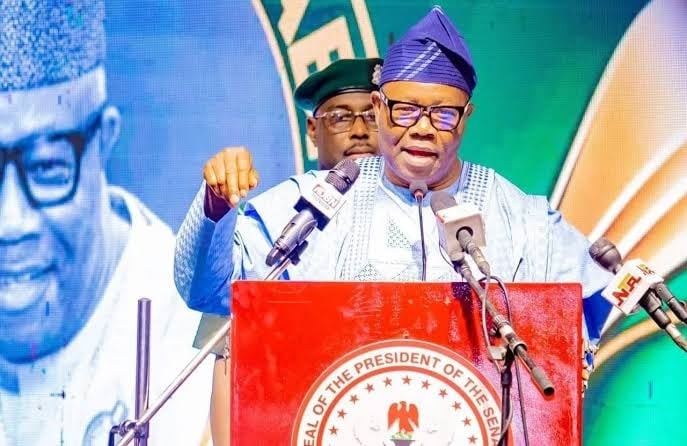
Earlier, the chairman of the occasion and National Chairman of the African Democratic Congress, David Mark, urged the National Assembly to pass the law and allow INEC to decide on implementation.
“What the ADC is saying is, pass the law. Let INEC decide whether they can do it or not. Don’t speak for INEC,” he said.
Other speakers at the event, including Akwa Ibom State Governor Pastor Umo Eno and the book reviewer, Professor Maxwell Gidado SAN, praised Senator Bob for highlighting the challenges lawmakers face.
In his remarks, the author listed challenges confronting legislators, including electoral disputes, conflicts with governors and political godfathers, court cases overturning election victories, constituency pressures, and self inflicted challenges.
FURTHER READING
- Super Eagles Still Hopeful of 2026 World Cup Qualification – Iwobi
- PHOTOS: Kaduna Governor Uba Sani Visits Tinubu in Abuja
- Tinubu Orders Safe Transit Routes to Clear Niger-Bound Cargo