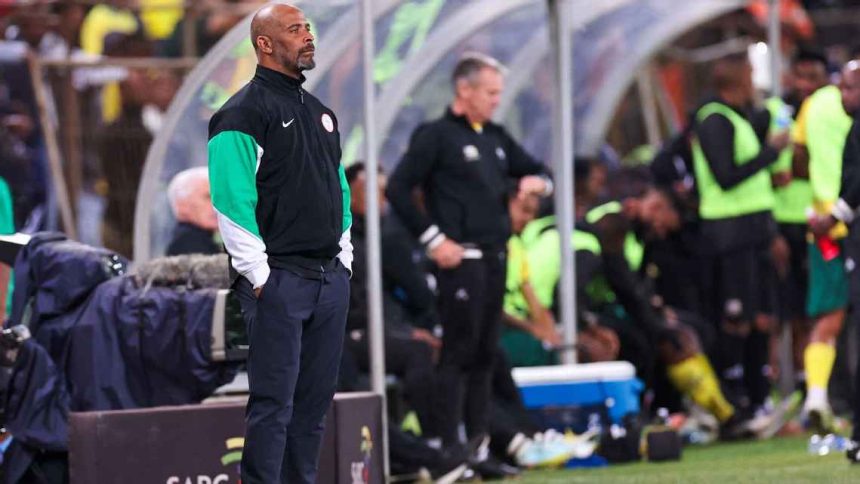
Nigeria’s Super Eagles head coach Éric Chelle’s accusation that DR Congo used “voodoo” during the decisive penalty shootout feels at once dramatic and desperate.
In his post-match comments, he claimed that he saw a member of the Congolese technical area making repeated hand gestures — possibly sprinkling “something like water” — every time Nigeria was to take a penalty.
“During all the penalties, the guy from DR Congo did some voodoo.”
Nigeria head coach Éric Chelle explains why tempers flared between him and the DR Congo staff at the end of the World Cup playoff final. pic.twitter.com/nMyTIcqlTT
— ESPN Africa (@ESPNAfrica) November 17, 2025
EDITOR’S PICKS
He claimed this distracted his players and contributed to their nervousness: “Every time … so this is why I was a little nervous after him.” That claim has grabbed headlines, but putting Chelle’s wild post-match reaction under the microscope forces us to ask: is this bitter accusation a valid explanation, or a convenient smokescreen for more damaging failings within Nigerian football?
On one hand, Chelle’s allegation touches on a deeply embedded fear: that spiritual or supernatural interference — “maraboutage,” “juju,” “voodoo” — can influence big moments in African football. Whether or not one believes in such practices, the psychological impact can be very real.
If players are convinced someone is working mystical forces against them, it could undermine their composure, especially in a high-pressure scenario like a World Cup playoff penalty shootout. Chelle was clearly shaken, and his emotional outburst — including a confrontational march to the DR Congo bench — signals that he believed he saw something more than mere gamesmanship.
https://twitter.com/AJSilverCFC/status/1990225104580870479
Yet Chelle’s claims cannot be taken as definitive proof. No independent body has verified any ritual or substance was used, and DR Congo’s camp has denied the allegations. The term “voodoo” is loaded — culturally and emotionally — and invoking it risks reducing a complex sporting loss to superstition rather than strategy, skill, or nerves. By framing the defeat as mystical sabotage, Chelle may be deflecting from more conventional explanations: missed penalties, tactical missteps, or pressure. Indeed, in that shootout Nigeria missed early kicks, and DR Congo kept their nerve to win 4–3.
But even if one entertains the possibility of ritual, it is dangerous to let supernatural explanations overshadow the more tangible, structural issues that continue to haunt the Super Eagles, especially the role of the NFF. This loss didn’t happen in a vacuum; it is layered on top of deeper dysfunction. Only recently, the team had staged a dramatic protest in camp, demanding unpaid bonuses and allowances from the NFF. That crisis required last-minute negotiations, not the kind of serene, focused preparation a World Cup-deciding match demands.
The NFF’s chronic mismanagement is arguably a far greater threat to Nigeria’s football ambitions than any alleged voodoo. When players are unsettled, underpaid, or deeply mistrustful of their administrative leaders, that erodes unity, morale, and concentration. That kind of disruption in preparation is more reliably detrimental than any mystical interference.
Looking at the match, Nigeria did score early through Frank Onyeka, but failed to maintain momentum. Their talisman, Victor Osimhen, had to be substituted at half-time due to a knock, which shifted the balance. There were missed chances, pressure moments, and, ultimately, penalties. Managing those moments is as much about psychology and preparation as it is about tactics.
To suggest that voodoo alone cost Nigeria the match skirts around the harder truth: that their systems — from federation governance to player welfare — are flawed and brittle. Chelle’s outburst is understandable in the fog of pain and frustration, but it risks enabling a dangerous narrative. If we accept his claim without scrutiny, we risk ignoring the institutional rot behind Nigeria’s failure: a football leadership that repeatedly fails to pay its players, to provide stability, and to build a professional environment.
The question is not whether DR Congo may have unsettled Nigeria with odd gestures, the question is why Nigeria’s own structures were so vulnerable in the first place. A well-led, professionally managed national team is less likely to crack under pressure, even if the opposition tries psychological games. The fact that they did suggests culpability runs deeper than Chelle’s accusations.
FURTHER READING
In the final analysis, while Chelle’s “voodoo” claim makes for dramatic headlines, the more compelling and responsible conclusion is that the NFF’s longstanding negligence is the primary architect of this disaster. Nigeria’s exit must prompt a serious reckoning: not only of the technical staff, but of the federation’s leadership, accountability, and capacity to support its team in moments that demand more than talent. A simple apology won’t fix the many problems.
The Nigeria Football Federation wishes to openly and sincerely apologise to His Excellency, President Bola Ahmed Tinubu (GCFR), to the Federal Government as a whole; and to millions of Nigerians, most especially our passionate, loyal football fans, following the .
— The NFF 🇳🇬 (@thenff) November 17, 2025
Philip Ibitoye is a Special Correspondent with EKO HOT BLOG. Click here to find daily analysis and critical insight on trending issues in Lagos and other parts of Nigeria.
Click here to watch the video of the week below: