- Warri–Itakpe Train Derails Three Days After Resuming Operations
- Stakeholders raise concerns over vandalism, poor management
- Adenikinju warned that public confidence in rail travel depends on safety
For the 189th time in six years, Nigeria has recorded yet another train derailment, casting a dark shadow over the country’s ambitious rail modernisation drive that has already consumed more than 7.3 billion dollars in borrowed funds.
Eko Hot Blog gathered that barely three days after resuming operations, the Warri–Itakpe passenger train derailed on Saturday evening, reigniting concerns about safety, maintenance, and the sustainability of Nigeria’s debt-funded transport infrastructure.
EDITOR’S PICK
- Femi Kuti Urges Young Artists to Prioritise Quality Over Quick Hits
- Osun Resident Doctors Halt Services Over Nationwide Strike
- FG to Release ₦12bn, Pays ₦10.6bn to Resident Doctors
The Nigerian Railway Corporation (NRC) confirmed the incident, stating that two out of seven coaches on the Warri–Itakpe Train Service derailed at about 7:30 p.m. near Agbor, Delta State.
The service, which had been suspended for a long period, resumed on October 29 but was shut down again just three days later, on November 1, following the latest accident.
Managing Director of the NRC, Dr Kayode Opeifa, said all passengers on board were safely evacuated and accounted for. He noted that preliminary investigations suggest the derailment may have been caused by suspected track vandalism.
Opeifa, appointed earlier this year by President Bola Tinubu to reform the struggling railway sector, said recovery teams supported by security personnel have been deployed to the site. He added that services on the corridor have been suspended pending a comprehensive safety audit.
The latest accident adds to a troubling record of derailments that have plagued Nigeria’s rail network in recent years. Between 2019 and 2025, the country has witnessed at least 189 derailments, with the National Bureau of Statistics reporting 183 cases between 2020 and 2022 alone.
In 2020, 57 derailments were recorded, followed by 61 in 2021 and 65 in 2022. In August 2025, the Abuja–Kaduna train service was suspended after another derailment left six passengers critically injured.
Over the years, several high-profile accidents have eroded public confidence. In January 2019, a Lagos-bound train derailed at Ashade, killing one passenger.
In May 2024, a Kaduna-bound train derailed near Jere, halting services for several days. A month later, another Abuja–Kaduna train derailed, overturning three coaches. In August 2024, a Lagos–Ibadan freight train also left the tracks, further raising questions about track quality and maintenance.
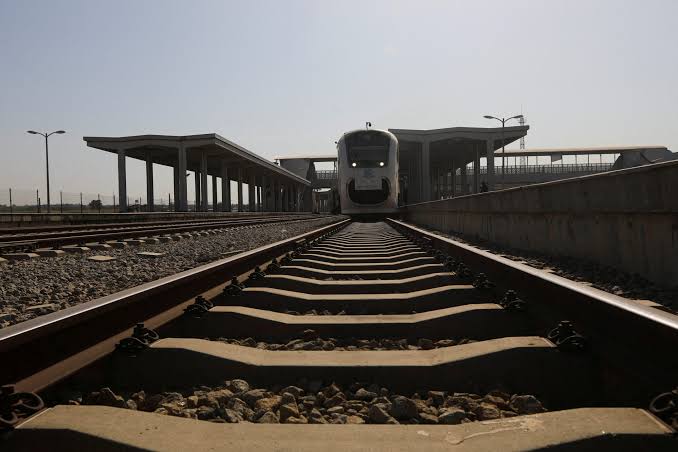
With vandalism of public infrastructure now a persistent challenge, NRC data show that between 2022 and 2023 alone, more than 150,000 rail clips were stolen nationwide. About 50,000 clips each were taken from the Lagos–Ibadan, Warri–Itakpe, and Abuja–Kaduna standard gauge lines.
Despite spending close to one billion naira on private security contracts to guard rail corridors, vandalism continues.
In August 2022, the Federal Executive Council approved 718 million naira for securing the Abuja–Kaduna route. Of this, Al-Ahali Security Guards Limited received 407 million naira to protect 27.4 kilometres of track and eight stations, while Seaguard Security and Protective Company Limited got 310 million naira to cover 18 kilometres and four stations.
Three years later, the sabotage persists, prompting questions about the effectiveness of such contracts.
Experts who spoke with The Guardian said the derailments point to deeper problems, particularly poor maintenance and weak institutional capacity.
A former railway expert with the London Underground, James Akpoviroro, said Nigeria’s rail system is failing because it lacks a structured maintenance culture.
“The way forward is maintenance and maintenance requires training,” he said. “Every major city should have a dedicated maintenance office with a clear hierarchy and procedure. Recruit local youths, train them, and make it their full-time job. That’s how you build commitment and sustain the system.”
He added that derailments often begin with minor issues such as loose clips, misaligned tracks, or eroded ballast problems that can be prevented through regular inspection and prompt repairs.
President of the Nigerian Economic Society, Professor Adeola Adenikinju, stressed that maintenance must be complemented by technology-driven security measures.
He urged the government to deploy drones and aerial surveillance to monitor rail tracks in real time, similar to systems used for oil pipelines, noting that relying solely on security personnel is ineffective given Nigeria’s vast terrain.
Adenikinju warned that public confidence in rail travel depends on safety, adding that passengers must feel secure for the system to thrive.
Since 2016, Nigeria’s railway modernisation plan has relied heavily on standard gauge rail lines funded through loans from the China Exim Bank and executed by the China Civil Engineering Construction Corporation (CCECC).
The Lagos–Ibadan line, inaugurated in 2021, cost about 2.6 billion dollars. The Abuja–Kaduna rail, completed in 2016, cost 874 million dollars about 4.7 million dollars per kilometre. The Itakpe–Abuja extension, including the Warri port link, was contracted in 2019 for 3.9 billion dollars.
Together, these projects total more than 7.3 billion dollars, most financed through foreign loans that Nigeria continues to repay amid mounting debt pressures.
Policy analyst and Managing Partner at Nextier, Dr Ndu Nwokolo, said the government must determine whether derailments are primarily caused by vandalism or substandard project execution.
“We live in a country where project monitoring and proper execution are often lacking, largely due to corruption,” he said. “The NRC could have engaged local communities to protect the lines for a fee instead of relying solely on external security firms.”
He added that adopting community-based protection models would not only improve safety but also create local employment and strengthen accountability.
FURTHER READING
- Wike’s Faction Suspends PDP Acting Chairman Damagum
- PDP Convention Will Hold Despite Court Order – Ogidi
- Dangote Refinery Promises Uninterrupted Fuel Supply Nationwide
Click here to watch video of the week