The Senate’s decision to investigate the railway projects executed under former President Muhammadu Buhari’s administration marks a crucial step toward accountability in Nigeria’s infrastructure development.
The 12-member ad hoc committee, chaired by Senator Adams Oshiomhole, has been tasked with examining the loans secured, mostly from China, for rail construction, assessing the quality of materials used, and evaluating the overall implementation of the projects.
EDITOR’S PICKS
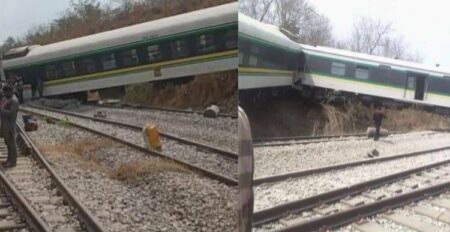
This investigation, coming after a string of train derailments across the country, is not only timely but long overdue. The Warri–Itakpe standard gauge rail line, for instance, has suffered multiple breakdowns and derailments despite being one of the most celebrated transport projects of the last administration.
Its latest incident occurred on Sunday just three days after operations resumed from months-long repairs due to track vandalism, a recurring explanation that now rings hollow in the face of persistent system failures.
The incident occurred barely two months after another derailment involving an Abuja–Kaduna train carrying over 500 passengers.
Mounting Concerns Over Quality and Oversight
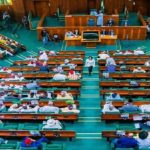
The motion to launch the probe on Tuesday, sponsored by Senator Ede Dafinone (APC, Delta Central), raised valid questions about the structural integrity and supervision of Nigeria’s modern rail network.
According to Dafinone, the frequent derailments and service interruptions have not only endangered passengers but have also eroded public confidence in the viability of rail transport, a mode once hailed as a cost-effective alternative to Nigeria’s overburdened road system.
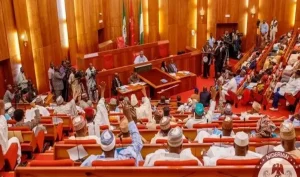
Senators from across party lines supported the motion. Abdul Ningi (PDP, Bauchi Central) described the situation as “embarrassing,” noting that rail lines constructed with billions of dollars in foreign loans are already failing just a few years after commissioning. Adeola Olamilekan (APC, Ogun West) echoed these concerns, calling for a forensic review of how the loans were secured, how funds were spent, and whether due process was followed in contract awards and project supervision.
Chinese Loans, Nigerian Questions
Much of Nigeria’s modern railway expansion under Buhari was financed by loans from China’s Exim Bank, with Abuja–Kaduna and Warri–Itakpe among the flagship projects. About 85 per cent of the $874 million Abuja–Kaduna line, for instance, was funded through Chinese credit, while the remainder came from local counterpart funding.
These projects were meant to transform Nigeria’s transportation landscape, ease pressure on the highways, and boost freight movement across regions. Yet, the technical failures now being recorded point to deeper issues, ranging from substandard construction to weak oversight and poor maintenance culture.
Babangida Hussaini (PDP, Jigawa North-West) lamented that contractors handling similar projects elsewhere in Africa delivered durable rail systems, whereas Nigeria’s own lines are already deteriorating.
This, he suggested, indicates flaws not just in construction quality but in project conception and long-term sustainability planning.
Beyond Vandalism
The Nigerian Railway Corporation (NRC), which manages the inter-state rail network, has often attributed service disruptions to vandalism, theft of rail components, and insecurity. However, the pattern of recurrent derailment, such as the recent Warri–Itakpe and Abuja–Kaduna incidents suggests a more fundamental problem.
Experts have long warned that Nigeria’s overreliance on imported technology, coupled with limited technical capacity for maintenance, makes its rail systems vulnerable to early decay.
The repeated justification of “vandalism” no longer satisfies public curiosity when incidents occur on newly built tracks that should, by design, be more resilient.
A Matter of Accountability
Senate President Godswill Akpabio, while announcing the probe, emphasised that the inquiry transcends political lines. “This is not a partisan issue,” he said. “The derailments began before this administration took office. We must find out what went wrong, from how the loans were obtained to how the projects were executed and maintained. The Nigerian people deserve answers.”
FURTHER READING
Indeed, the rail sector’s troubles highlight broader governance challenges; opaque contracting, weak supervision, and a tendency to prioritise ribbon-cutting over long-term functionality. As rail transport remains key to Nigeria’s economic diversification agenda, the findings of the Senate committee could set a precedent for how future infrastructure projects are managed and monitored.
Philip Ibitoye is a Special Correspondent with EKO HOT BLOG. Click here to find daily analysis and critical insight on trending issues in Lagos and other parts of Nigeria.
Click here to watch the video of the week below: