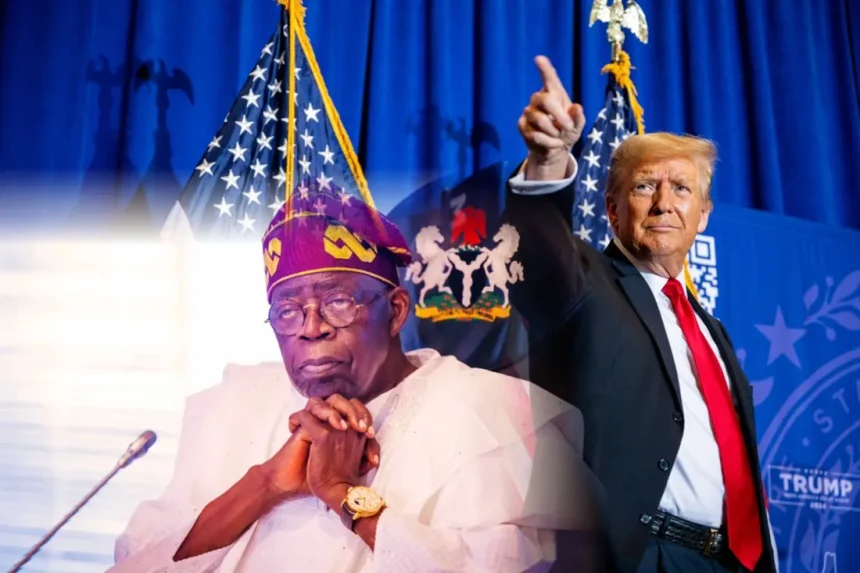
United States (US) President Donald Trump has stirred global debate after issuing a fiery warning to Nigeria, threatening military action against Islamic terrorists in the country.
In a post on his social media platform, Truth Social, the American leader accused the Nigerian government of failing to protect Christians and vowed to “wipe out” Islamic extremists if Abuja failed to act swiftly.
EDITOR’S PICKS
“If the Nigerian Government continues to allow the killing of Christians, the U.S.A. will immediately stop all aid and assistance to Nigeria, and may very well go into that now disgraced country, guns-a-blazing,” Trump declared, instructing his Department of War to prepare for “possible action.”
The remarks came a day after the US president redesignated Nigeria as a “country of particular concern,” citing alleged persecution of Christians and the government’s inability to prevent religious violence.
President Bola Tinubu quickly rejected the designation, insisting that Nigeria remains a democracy “anchored on constitutional guarantees of freedom of religion and belief.”
Trump’s comments mark a sharp escalation in rhetoric from the United States, with implications not just for Nigeria’s international image, but for broader US–Africa relations.
Constructive Engagement, Not Coercion
While concerns over attacks on Christians in Nigeria are legitimate, Trump’s tone and choice of words raise troubling questions about respect for sovereignty and diplomacy.
Nigeria, a nation of over 200 million people, is already grappling with a complex security crisis involving jihadist insurgents in the North-East, bandits in the North-West, and communal violence across several regions. These threats cut across religious and ethnic lines.
If the US truly seeks to help end such violence, it should engage with the Nigerian government constructively rather than issuing public threats. Constructive partnership could involve sharing intelligence, providing counterterrorism support, and offering humanitarian assistance to victims of violence. Diplomatic dialogue, not coercion, remains the most effective way to strengthen Nigeria’s capacity to protect its citizens.
What Nigeria needs is solidarity and partnership, not gunboat diplomacy.
Diplomatic Gaps and Missed Opportunities
Former Kano State governor and 2023 NNPP presidential candidate, Rabiu Kwankwaso, expressed concern that Trump’s remarks could “further strain Nigeria’s unity if not handled with caution.”
He stressed that insecurity in the country “does not distinguish based on religious, ethnic, or political beliefs,” and urged the United States to assist Nigeria with advanced technology to combat insecurity rather than issue threats that could deepen divisions.
However, Kwankwaso also turned his criticism inward, pointing out a major gap in Nigeria’s foreign policy machinery, the absence of a permanent ambassador to the United States. More than two years into President Tinubu’s administration, Nigeria still lacks an official envoy in Washington. That vacuum, Kwankwaso suggested, has complicated communication and weakened Nigeria’s diplomatic posture at a time when strategic engagement with global powers is most needed.
“The Nigerian government should consider appointing special envoys from its distinguished diplomats to engage the American government,” he said. “Additionally, it is necessary to appoint permanent ambassadors to represent Nigeria’s interests on the international stage.”
Indeed, diplomacy thrives on constant dialogue. A strong, credible presence in Washington could help Nigeria counter misperceptions, explain its security efforts, and attract the technical and military assistance it genuinely needs. Without that, misinformation and reactive policymaking risk defining relations between both countries.
Rational Diplomacy Is the Way Forward
For all his bravado, Trump’s threat to invade Nigeria reflects a misunderstanding of the country’s internal complexities and of the nature of global security partnerships. Nigeria’s fight against terrorism has been prolonged not only because of resource constraints but also due to governance, intelligence, and logistical challenges. Addressing those requires sustained collaboration, not unilateralism.
If the US is genuinely concerned about saving Nigerian Christians — or any Nigerian citizens facing indiscriminate violence — it should commit to rational diplomacy. That means supporting Nigeria through intelligence-sharing, counterterrorism training, and economic aid that tackles the root causes of extremism. It means engaging with both federal and state governments to ensure responses to insecurity remain inclusive and constitutional.
FURTHER READING
Trump’s “guns-a-blazing” rhetoric may appeal to his political base, but it does little to advance the cause of peace or strengthen America’s standing in Africa. Nigeria’s problems cannot be solved through threats of invasion; they demand patience, partnership, and pragmatic diplomacy.
Philip Ibitoye is a Special Correspondent with EKO HOT BLOG. Click here to find daily analysis and critical insight on trending issues in Lagos and other parts of Nigeria.
Click here to watch the video of the week below: