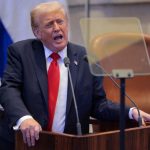
- Trump says he ended 7 wars, some of which were not officially wars.
- In some regions, fighting continues despite peace announcements.
- Trump claims all peace efforts were made without formally using “ceasefire”.
President Donald Trump has claimed he successfully ended seven conflicts around the world since returning to office, even as he intensifies efforts to bring an end to the ongoing Russia-Ukraine war.
EKO HOT BLOG reported that Trump speaking at the White House on August 18 while addressing a group of European leaders, he said, “I’ve ended six wars… all of these deals I made without even mentioning the word ‘ceasefire’.” Just a day later, that number rose to seven.
EDITOR’S PICKS
- Lagos PDP Inaugurates Screening Committee Ahead of State Congress
- North Needs Unity Not Infrastructure – APC Chieftain
- INEC Rejects ADC’s David Mark-Led Caretaker Committee
His administration now argues that it is “well past time” for Trump to receive the Nobel Peace Prize, referring to him as the “peacemaker-in-chief.” A breakdown of the conflicts shows that while some agreements did lead to temporary calm, others remain fragile or unresolved.
Israel and Iran
A sudden 12-day conflict broke out in June after Israeli airstrikes on Iranian military sites. The U.S. followed with strikes on Iran’s nuclear facilities, which contributed to ending the fighting quickly.
On June 23, Trump wrote online that both Iran and Israel had agreed to stop attacks at specific hours, marking the “official end” of the war. However, Iran claimed a “decisive victory” without acknowledging any ceasefire, and Israeli officials later hinted at possible future strikes. Analysts say there’s no permanent agreement in place, just a shaky pause in hostilities.
India and Pakistan

Violence erupted in May following an attack in Kashmir. Trump claimed his overnight talks with both sides resulted in a “full and immediate ceasefire.” Pakistan later thanked him and even recommended him for the Nobel Prize.
India, however, dismissed the claim, stating that the decision to halt strikes was made directly between both countries’ military channels, without U.S. involvement.
Rwanda and DR Congo

After rebel group M23 took control of areas in eastern DR Congo, Rwanda and Congo signed a peace agreement in Washington in June. The deal referenced an earlier ceasefire agreed in August 2024.
Despite the new agreement, fighting has continued, with both countries blaming each other for violations. The M23 group has even threatened to pull out of peace talks. Experts note the ceasefire has never truly held.
Thailand and Cambodia
Trump took to social media on July 26, saying he was calling Thailand’s acting Prime Minister to request an end to fighting with Cambodia. Within days, the two countries agreed to stop attacks.
Though Malaysia hosted the actual peace talks, Trump used trade pressure, threatening to halt tariff negotiations unless they ended the war. A formal agreement was reached on August 7.
Armenia and Azerbaijan

After decades of tension, the two countries signed a peace deal at the White House on August 8. Trump said the signing marked an official end to their conflict over Nagorno-Karabakh.
Observers believe the high-profile Oval Office ceremony helped push both sides toward a deal. Their last major conflict was in 2023, when Azerbaijan regained control of the disputed territory.
Egypt and Ethiopia

There was no war, but a longstanding dispute over Ethiopia’s Nile dam escalated this year. Egypt feared reduced water supply, and talks between both sides had stalled by June.
Trump commented: “If I were Egypt, I’d want the water in the Nile,” and promised quick U.S. mediation. Egypt welcomed his involvement, but Ethiopian officials warned his remarks could increase tensions. No resolution has been reached.
Serbia and Kosovo
Trump claimed he stopped another war before it even started, saying: “Serbia, Kosovo was going to go at it. I told them no trade with the U.S. if they do and they backed down.”
However, experts say the two countries were not engaged in active combat. Their tension stems from a longer conflict that ended years ago. While economic agreements were signed in Trump’s first term, no new fighting has broken out recently.