- Trump officially declared Antifa as a “terrorist organisation” via Truth Social.
- Antifa is a decentralized, loosely organized anti-fascist movement, not a single group.
- Legal and practical challenges exist for enforcing terrorism status on a domestic, non-hierarchical movement.
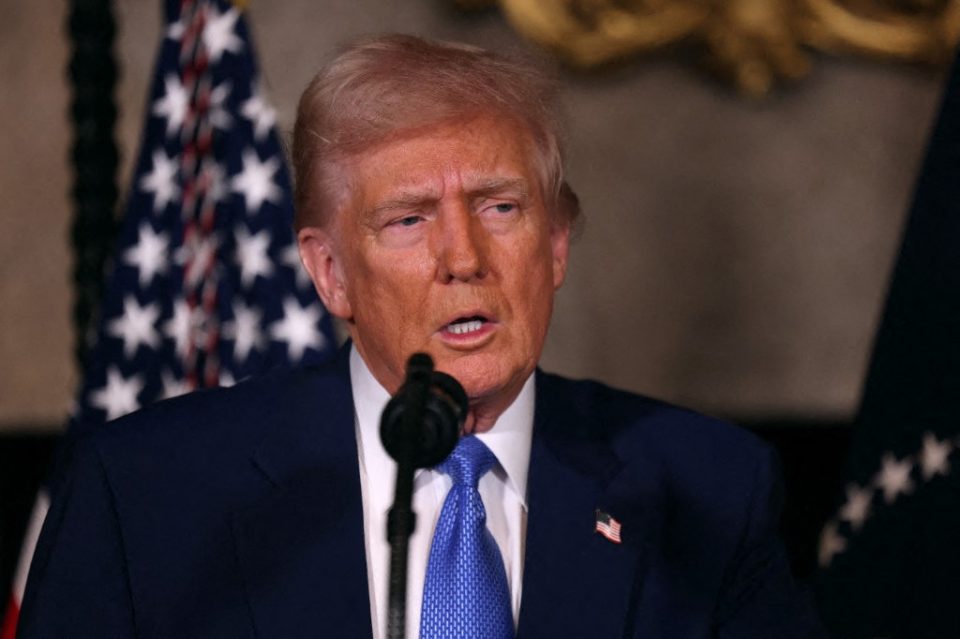
United States President Donald Trump announced late Wednesday that he is officially designating Antifa, the left-wing activist movement, as a “terrorist organisation.”
EDITOR’S PICKS
- Trump Files $15bn Lawsuit Against New York Times
- Airline Operators Commend FG for Suspending 4% Import Levy
- Lagos: UBA branch, Offices Hit as Fire Guts Building in Marina
EKO HOT BLOG reports that the move has raised questions about how such a label can be applied given Antifa’s decentralized nature.
On his social media platform Truth Social, Trump declared, “I am happy to inform all U.S. Patriots that I am naming Antifa, a dangerous and radical left-wing group, as a major terrorist organisation.” He also warned that “those funding Antifa should be investigated thoroughly following the highest legal standards.”
Who is Antifa?
Antifa, short for “anti-fascists,” is not a single organisation but rather a loosely connected network of activists and groups opposing far-right and fascist ideologies.
Historian Mark Bray, who wrote Antifa: The Anti-Fascist Handbook, described Antifa as “a political stance rather than one formal group,” similar to how feminism includes many groups without being a single entity.
The movement’s secretive nature makes it hard to know exact membership or leadership.
Antifa gained wider recognition around 2016 but has roots going back decades, with the term itself tracing back to a 1946 German anti-Nazi phrase.
What Does Antifa Oppose?
Fascism is an authoritarian far-right ideology characterized by dictatorial control, extreme nationalism, and suppression of dissent.
Historical examples include Mussolini’s Italy and Nazi Germany.
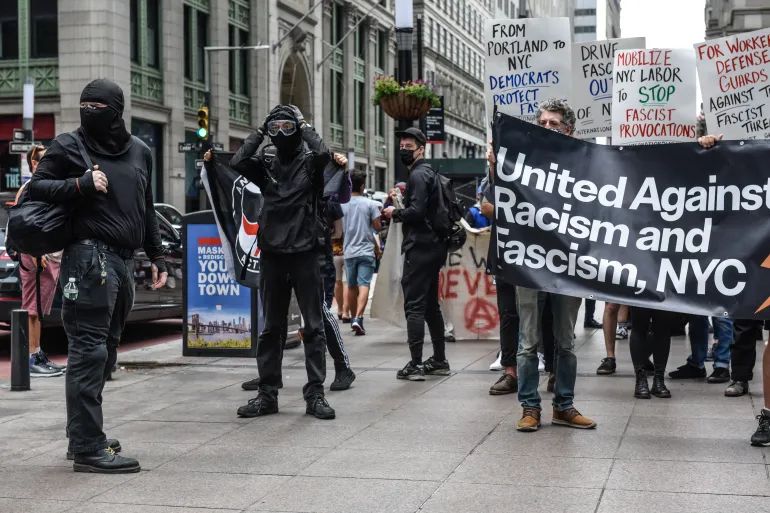
In the US, Antifa activists often dress in black and mask their identities.
Groups like Portland’s Rose City Antifa engage in tactics such as exposing personal details of right-wing figures.
Notable Antifa-Related Incidents
Chicago, 2012: A group of masked individuals attacked a restaurant they believed hosted white supremacists.
Some participants were arrested and charged with violent crimes.
Berkeley, 2017: Violent clashes erupted repeatedly between Trump supporters and Antifa activists during protests at the University of California, Berkeley.
Challenges in Designating Antifa as Terrorist
Critics question how the government can legally and practically designate Antifa as a terrorist group, given it lacks a central structure or leadership.
The FBI director during Trump’s first term noted Antifa is an ideology, not an organisation, making formal terrorism designation difficult.
Currently, US law allows foreign groups to be labeled as Foreign Terrorist Organisations (FTOs), which restricts funding and freezes assets.
However, no clear legal framework exists for designating domestic groups like Antifa as terrorist entities.
Trump’s Previous Stance
Trump has made similar declarations before, notably in May 2020 amid nationwide protests following George Floyd’s death.
At the time, he also threatened to label Antifa as a terrorist organisation while campaigning for re-election against Joe Biden.
FURTHER READING
- Arrival: Trump Begins Second UK State Visit
- Sowore Sues DSS, Meta, X Over Alleged Social Media Censorship
- Utah Student Charged With Murder of Charlie Kirk, Faces Death Penalty