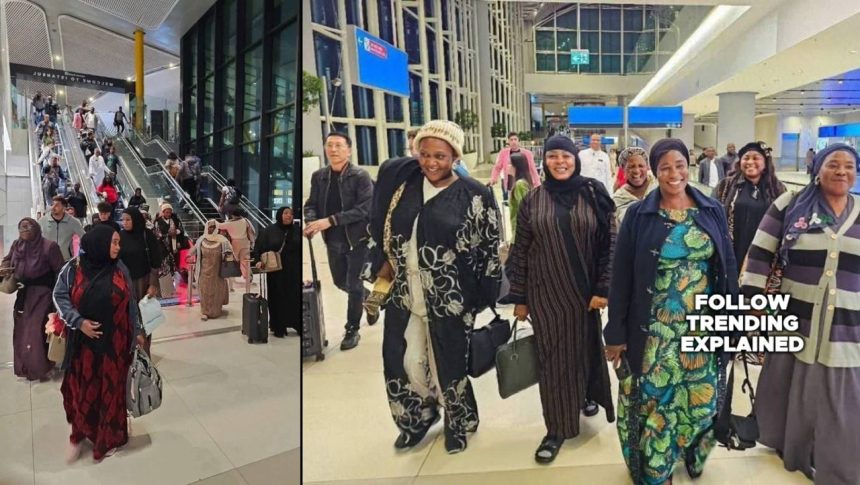
The decision by local government chairmen in Adamawa State to sponsor their wives for a “leadership training” programme in Istanbul, Turkey, has sparked unease and criticism across Nigeria.
While the chairmen, led by Suleiman Toungo of Toungo Local Government Area and chairman of the Association of Local Governments of Nigeria (ALGON) in the state, defend the trip as an exercise in building the leadership capacity of their spouses, many Nigerians perceive it as yet another example of political elites spending public funds recklessly at a time of deep economic hardship for ordinary citizens.
EDITOR’S PICKS
EKO HOT BLOG gathered that the wives of the council chairmen, accompanied by senior officials from the state ministry of local government, left Nigeria last week to attend the programme. Toungo, when questioned about the rationale, explained that the chairmen themselves had recently embarked on a similar training exercise and argued that their spouses also need exposure in order to provide useful advice on governance.
“They are our wives and we need their advice. We are looking at the importance of training them on leadership, not the cost,” Punch quoted him as saying.
It is precisely the issue of cost, however, that has drawn public anger. Nigerians are grappling with a rising cost of living, driven by inflation, fuel price hikes, and food insecurity. In such a climate, news that public funds are being used to fly elected officials’ spouses to Europe for a training of questionable necessity has struck a nerve. Citizens often measure governance not only by policy outcomes but also by the symbolism of leaders’ spending choices. In this case, the symbolism is damaging: it reinforces the perception that political elites are more concerned with personal comfort and status than with easing the burdens of the people they represent.
Experiences from other countries lay bare the dangers of such perceptions. In Nepal, youth-led protests escalated into riots earlier this month, sparked by frustration with government corruption, elite privilege, and the misuse of public resources. What began as resistance to a social media ban quickly became an outpouring of anger against a ruling class seen as wasteful and self-serving. Young people targeted symbols of power and wealth, convinced that their leaders were enriching themselves while ordinary citizens struggled. The lesson from Nepal is clear: when leaders appear detached from the suffering of their citizens, anger can accumulate and eventually explode into unrest.
For Adamawa’s local government chairmen, the Turkey trip comes at a particularly sensitive time. In July 2024, the Supreme Court ruled that local governments should receive their allocations directly from the federal government, bypassing state governors who had long controlled the flow of funds. The court also barred governors from appointing caretaker committees to run councils, directing that allocations should only go to democratically elected chairmen.
This landmark ruling was hailed as a breakthrough for grassroots governance and fiscal autonomy. However, more than a year later, the federal government has yet to fully implement the directive, leaving councils dependent on a system in transition.
In this context, the decision to commit scarce resources to sending spouses abroad undermines the credibility of the local government chairmen’s case for autonomy. Their argument has been that direct funding would allow them to deliver services more effectively to their constituents. But when the limited resources they currently control are channelled into controversial trips of questionable value, it raises doubts about whether greater autonomy will indeed translate into better governance. For many observers, the Turkey trip has already become a metaphor for misaligned priorities.
Ultimately, the controversy highlights a recurring tension in Nigerian politics: the gap between citizens’ expectations of responsible stewardship and the choices made by elected officials. Nigerians are not indifferent to the challenges of leadership development, but they are acutely sensitive to how public money is spent. A trip of this nature, taking place abroad and involving spouses rather than elected officials themselves, risks appearing frivolous rather than purposeful. In an era when citizens are demanding greater accountability and transparency, such decisions fuel cynicism about political leadership and weaken the legitimacy of the very institutions fighting for more independence.
FURTHER READING
Unless leaders at all levels recognise that symbolic acts of prudence matter as much as policy reforms, the gulf between rulers and the ruled will only widen. And as seen in Nepal, when that gulf grows too wide, the consequences can quickly move from discontent to open unrest.
Philip Ibitoye is a Special Correspondent with EKO HOT BLOG. Click here to find daily analysis and critical insight on trending issues in Lagos and other parts of Nigeria.
Click here to watch the video of the week below: