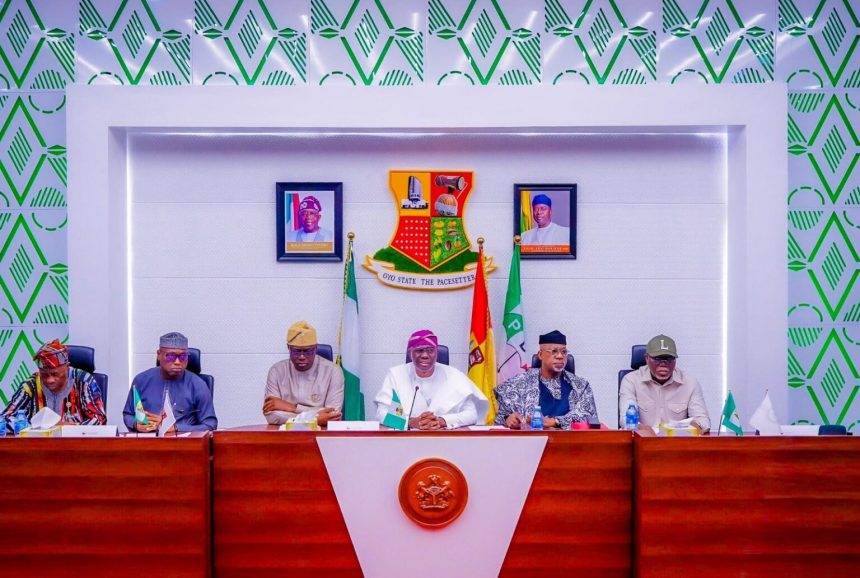
The renewed push by the South-West governors for the establishment of state police comes at a moment of deepening anxiety across the country.
With mass abductions reported in Kebbi, Niger and Kwara states within days, and communities in the South-West increasingly uneasy about unregulated migration and forest-based criminality, the region’s leaders are making a case that now feels both urgent and unavoidable.
EDITOR’S PICKS
Their Monday meeting in Ibadan — which produced a robust communique and a clear security blueprint — shows a level of regional coordination not seen since the launch of Amotekun. Crucially, it also outlines why state police, long debated at the federal level, may no longer be a matter of political preference but one of security necessity.
Stepping into a national vacuum
The governors of Lagos, Oyo, Ogun, Osun, Ondo and Ekiti gathered with one message: the centre can no longer secure the peripheries alone. The meeting acknowledged national security pressures — particularly the recent school kidnappings that have shaken Kebbi, Kwara and Niger — but also highlighted the South-West’s own vulnerabilities.
Their response was to create structures the federal security architecture has struggled to provide. The newly announced South West Security Fund (SWSF), to be managed through the DAWN Commission, lays the financial and institutional base for long-term collaboration. Unlike ad hoc responses to crises, the fund ensures predictable financing for joint security initiatives, including equipment, training and technology.
The governors are also creating a live, digital intelligence-sharing platform — a capability the federal security agencies have repeatedly been criticised for lacking. This system will carry threat alerts, incident logs, and rapid-response signals, enabling states to anticipate danger rather than simply reacting to it.
At a time when criminal groups move fluidly across state lines, such coordination is not simply desirable; it is essential.
Forests, Migration and the Realities of Localised Threats
One area where the governors’ argument for state police becomes strongest is in addressing threats that are intensely local.
The communique noted that vast forest belts across the region have become safe corridors for criminals, a challenge federal forces, stretched across dozens of conflict theatres, have struggled to monitor effectively. The governors are calling for federal deployment of forest guards but have offered to provide the personnel themselves, signalling readiness to shoulder security responsibilities if empowered to do so.
They also raised alarms about unregulated interstate migration, noting that while mobility is normal in a federation, unmanaged movement during a period of heightened insecurity creates opportunities for exploitation by criminal networks. Only a policing system with deep local knowledge, permanent community presence and accountability to the state governments can respond effectively to this kind of challenge.
This is the crux of their argument: policing that does not understand the terrain, social dynamics or local intelligence flows will always arrive late.
Why the South-West leaders now say “The Time Is Now”
The strongest political statement in the communique was the governors’ declaration that state police “can no longer be delayed.” This assertion is reinforced by wider national events.
In the past week, over 300 schoolchildren were abducted in Niger State, 25 schoolgirls in Kebbi, and worshippers and residents were attacked in multiple communities. These incidents, happening far from the South-West but sending shock waves nationwide, highlight a broader security collapse that puts pressure on regions to fortify themselves.
FURTHER READING
The South-West governors’ position aligns with a growing consensus among security analysts: that centralised policing in a federation of over 200 million people is structurally inadequate. Localised crime requires localised enforcement. Community ties, cultural familiarity and geographic understanding are not luxuries in policing, they are operational advantages.
Philip Ibitoye is a Special Correspondent with EKO HOT BLOG. Click here to find daily analysis and critical insight on trending issues in Lagos and other parts of Nigeria.
Click here to watch the video of the week below: