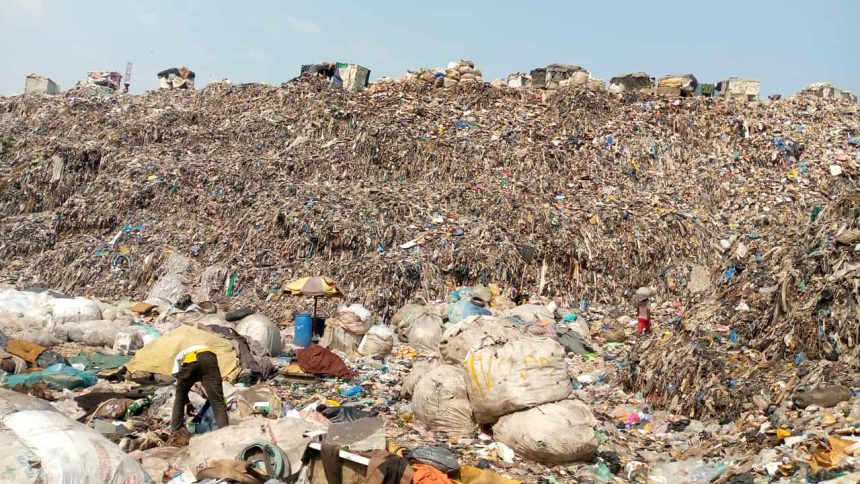
- Lagos has now given a third 18-month deadline to close Olusosun and other dumpsites.
- Similar timelines were announced in October 2024 and September 2025.
- Officials say new waste-to-resource facilities are needed before decommissioning can begin.
The Lagos State Government has again put an 18-month clock on the decommissioning of Olusosun and and Solous 3 dumpsites — a promise that has now been repeated publicly at least three times in little over a year.
EKO HOT BLOG reports that officials say the target is part of a wider shift from linear disposal to a circular, waste-to-resource system that will replace open dumping with transfer-loading stations, material recovery facilities and waste-to-energy projects.
EDITOR’S PICKS
The first public 18-month deadline was announced in October 2024, when the Lagos Waste Management Authority (LAWMA) managing director, Dr. Muyiwa Gbadegesin, told stakeholders that the closure and evacuation of the dumpsites would commence in December 2024 and run for 18 months.
At the forum in Victoria Island, Gbadegesin framed the move as part of a drive to convert the high volume of solid waste into energy and to tackle environmental and health concerns associated with the sites.

Nearly a year later, at the annual lecture and awards of the Property and Environment Writers Association of Nigeria (PEWAN) in September 2025, Gbadegesin again set an 18-month window for the decommissioning process. He used the platform to reiterate the same rationale: that moving waste management toward separation at source, material recovery and conversion of organic waste into compost or bio-methane would unlock economic value and justify shutting the legacy landfills.
“Waste is not a burden, it is value,” he said while stressing the scale of the task — Lagos generates an estimated 13,000 tonnes of waste daily, about half of it organic.
The latest reiteration came on Saturday, November 29, 2025, during an inspection of the Olusosun and Solous 3 sites when the Commissioner for Environment and Water Resources, Tokunbo Wahab, reaffirmed the 18-month timetable and outlined some of the operational steps Lagos intends to take.
Wahab said the state has engaged partners, including private sector operators and firms running material-recovery and transfer facilities, and that decommissioning must be preceded by the provision of alternative infrastructure so residual refuse has somewhere safe to go.
In May 2025, EKO HOT BLOG reported that in pursuit of that goal, Governor Babajide Sanwo-Olu and his deputy, Obafemi Hamzat, witnessed the signing of an agreement with ZoomLion Nigeria, a subsidiary of the Jospong Group, to construct a new Transfer Loading Station at the Olusosun dumpsite.
Governor @jidesanwoolu witnessed the signing of an agreement between the Lagos State Government and @ZoomlionNigeria , part of the Jospong Group of Companies @thejospongroup led by the Chairman, Dr. Joseph Siaw Agyepong @jsagyepong , that marks a significant step in managing… pic.twitter.com/9Ju8rHFuxp
— Tokunbo Wahab (@tokunbo_wahab) May 28, 2025
On Saturday, Wahab sought to reassure communities that the new transfer and landfill sites around Ikorodu, Epe and Badagry will not degenerate into the same uncontrolled dumps the state is trying to close.
Taken together, the three pronouncements form a tight, repeated public commitment — October 2024 (LAWMA), September 2025 (LAWMA) and November 2025 (Ministry of Environment) — each time anchored to an 18-month horizon, highlighting the challenge of shutting down the notorious facilities. The Olusosun dumpsite, one of Africa’s largest open landfills, has been in use for over two decades. It has raised concerns due to recurring fires, hazardous emissions, and its proximity to homes and businesses.
Past attempts at closure have stalled for similar reasons. Critics and community leaders have often pointed to the lack of readily available alternatives, poor diversion and recovery rates, and the logistical difficulty of handling huge volumes of legacy waste as the key obstacles to a smooth shutdown.
LAWMA and the state government have responded by accelerating plans for transfer loading stations, material recovery facilities, and waste-to-energy pilots — measures they say will reduce the volume arriving at landfills to a “minimal” fraction.
The Sordid History of Olusosun Dumpsite
When the Olusosun landfill started operations in 1992, it was located on the outskirts of Lagos and intended to handle waste from homes and businesses. However, as Lagos rapidly expanded, residential, commercial, and industrial developments surrounded the site.
This growth has led to serious environmental problems. Research shows that people living within five kilometres of a landfill are at risk of health issues. Many nearby residents suffer from respiratory problems due to harmful substances released from the waste. Other dangers include fire outbreaks, toxic gas exposure, injuries to children playing near the site, and the spread of diseases by mosquitoes, flies, and rats. Local plant and animal life has also been affected.
Studies have shown that residents near the dumpsite frequently suffer from waterborne diseases such as typhoid, cholera, and dysentery. Groundwater around the area was tested using samples from wells and boreholes, and the results confirmed that the landfill was the source of contamination. Surprisingly, pollution levels did not decrease with distance from the site, indicating a more complex problem that will require a comprehensive solution.
In addition to health concerns, the dumpsite has become a haven for criminals and scrap scavengers. The quality of the soil has deteriorated, and vegetation has significantly declined due to constant dumping. These issues have led to growing public concern.
In March 2018, former Governor Akinwunmi Ambode closed the landfill, declaring it unsafe for both nearby residents and businesses.
FURTHER READING
Prior to the closure, there had been a sudden fire outbreak at the site, an event common to many dumpsites globally. These fires, whether small or large, release harmful gases such as formaldehyde and hydrogen sulphide, which pose serious health risks to those living nearby.
Philip Ibitoye is a Special Correspondent with EKO HOT BLOG. Click here to find daily analysis and critical insight on trending issues in Lagos and other parts of Nigeria.
Click here to watch the video of the week below: