In January 2026, the global significance of Fela’s work received renewed affirmation when the Recording Academy honoured him with a Lifetime Achievement Award. The recognition echoed a long-held truth across Africa and the diaspora: Fela was not merely a musician, but a cultural force who reshaped African identity through sound and resistance.
Yet decades after his passing, a recurring question continues to stir intense debate, especially online: who truly holds the crown as the king of Afrobeat? The answer, many argue, cannot be found by looking at history alone.
EDITOR’S PICK
- Akande at 87: Adewole Hails Elder Statesman
- Lagos Assembly Approves ₦4.44 Trillion Budget for 2026
- NANS Mobilises Nationwide Protest Over Tax Reform Law
From Sound to Struggle: Fela’s Afrobeat Era
Following his 1969 tour of the United States, where he was influenced by the politics of Malcolm X, the Black Panthers, and other militants, Kuti’s music became increasingly politicized. He exhorted social change in such songs as “Zombie,” “Monkey Banana,” “Beasts of No Nation,” and “Upside Down.”
Fela (as he was popularly known) and his band, which was known variously as the Nigeria 70, Africa 70, and later the Egypt 80, performed for packed houses at the early-morning concerts that they staged at Fela’s often-raided nightclub in Lagos.
The firebrand singer, who gyrated over the keyboard as he sang in English and Yoruba, struck a chord among the unemployed, disadvantaged, and oppressed. His politically charged songs, which decried oppression by Nigeria’s military government, prompted authorities to routinely raid his club, looking for reasons to jail him.
Nearby, he also set up a communal compound, which he proclaimed the independent Kalakuta Republic. As head of the commune, he often provoked controversy and attracted attention by promoting indulgence in sex, polygamy (he married 27 women), and drugs, especially marijuana.
A 1977 raid on the complex by Nigerian authorities resulted in his brief incarceration and the death of his mother the following year due to complications from a fall. In exile in Ghana in 1978, he changed his name from Ransome to the tribal Anikulapo.
In 1979, Fela formed a political party, the Movement of the People, and ran unsuccessfully for the presidency of Nigeria. Five years later, he was jailed for 20 months on charges of currency smuggling.
Upon his release, he turned away from active political protest and left his son, Femi, to carry the torch of Afro-beat music. Fela was jailed again in 1993 for murder, but the charges were eventually dropped. He died in 1997 after a prolonged illness.
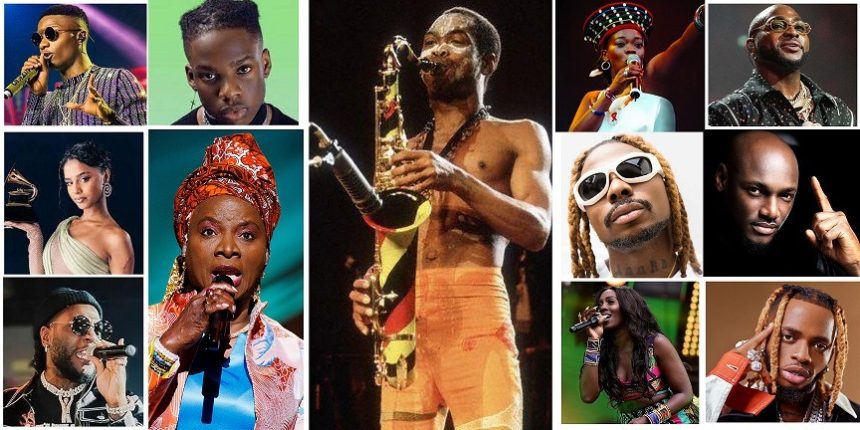
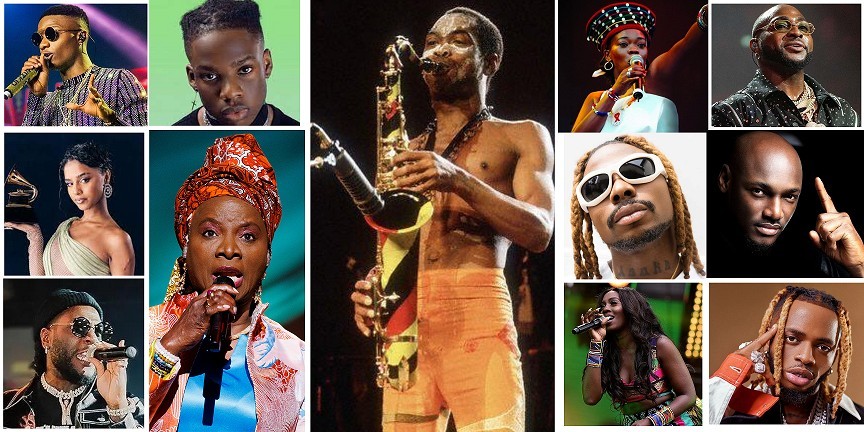
While Fela planted the seeds, modern artists like Wizkid, Burna Boy, Tiwa Savage, and Tems are cultivating them, spreading Afrobeat far beyond Nigeria and Africa itself. Wizkid, in particular, has redefined the genre for a global audience.
Modern Afrobeat stars are not mere imitators; they are innovators, pushing the genre to new frontiers. Burna Boy’s sound, for example, channels Afrobeat’s spirit of rebellion while addressing modern African identity, global politics, and societal inequities.
From Rhythm to Resistance: The Fela Era
Fela’s artistic direction took a decisive turn after his 1969 visit to the United States, where he encountered the revolutionary ideas of Malcolm X, the Black Panthers and other civil rights movements. These influences sharpened his political consciousness and transformed his music into a vehicle for activism. Songs such as Zombie, Monkey Banana, Beasts of No Nation and Upside Down openly confronted state brutality, corruption and social inequality.
Back home in Lagos, Fela and his band, known at different times as Nigeria 70, Africa 70 and later Egypt 80, performed marathon shows at his nightclub, which quickly became a hub for dissent and cultural expression. Singing in both English and Yoruba, Fela connected deeply with ordinary Nigerians, particularly the marginalised and disillusioned, whose struggles mirrored the themes in his music.
His fearless criticism of military rule drew relentless attention from authorities, leading to frequent raids, arrests and harassment. Adjacent to his club, he established the Kalakuta Republic, a self-declared autonomous commune that symbolised his defiance of state control. The commune also became a flashpoint for controversy due to Fela’s unconventional lifestyle, including his open embrace of polygamy, communal living and drug use.
In 1977, a brutal government raid on Kalakuta led to Fela’s imprisonment and injuries that later contributed to the death of his mother. The following year, while in exile in Ghana, he adopted the name Anikulapo, signifying his belief that he held his life in his own hands.
Fela’s activism extended beyond music. In 1979, he formed the Movement of the People political party and contested Nigeria’s presidency, though unsuccessfully. Despite periods of incarceration, including a 20-month sentence for alleged currency offences, his influence remained undiminished. He died in 1997 after a prolonged illness, leaving behind a legacy that would outlive him.
From Roots to the World Stage
While Fela laid the foundation, a new generation of artists has carried Afrobeat beyond Nigeria’s borders, reshaping it for a global audience. Musicians such as Wizkid, Burna Boy, Tiwa Savage and Tems have expanded the sound’s reach, blending African rhythms with contemporary global influences.
Wizkid, in particular, has played a defining role in reintroducing African music to the world in a modern form. Through collaborations, digital production and genre-blending, he has helped transform Afrobeat into Afrobeats, a global movement embraced across continents.
Burna Boy, meanwhile, channels the rebellious spirit of Afrobeat while addressing present-day African identity, diaspora consciousness and global inequality. Rather than replicating Fela’s style, these artists reinterpret its essence, proving that innovation, not imitation, sustains cultural relevance.
Afrobeat vs Afrobeats: Understanding the Difference
Though often used interchangeably, Afrobeat and Afrobeats are not the same. Afrobeat, as pioneered by Fela, is a singular genre defined by live instrumentation, extended arrangements, heavy percussion and explicit political messaging. It was designed to challenge authority and provoke thought.
Afrobeats, on the other hand, is a broader, modern soundscape. It draws from Afrobeat’s roots while incorporating pop, R&B, hip-hop, reggae and jazz. With shorter song formats and global collaborations, artists like Wizkid use Afrobeats to project African culture onto the world stage without abandoning its heritage.
Simply put, Fela created Afrobeat as a movement of resistance, while modern stars have evolved Afrobeats into a global language of African creativity.
One Legacy, Many Voices
The ongoing debate should not be framed as a contest between generations. Afrobeat is larger than any single figure; it is a living, evolving cultural force. Fela’s genius lay in daring to speak truth to power, while today’s artists amplify African excellence on a scale he could only have imagined.
Rather than pitting legends against modern icons, the narrative should acknowledge continuity. Fela planted the seed, and artists like Wizkid and Burna Boy are ensuring it flourishes.
Afrobeat is Africa’s gift to the world, a revolution that adapts, survives and continues to speak, through many voices, across generations.
FURTHER READING