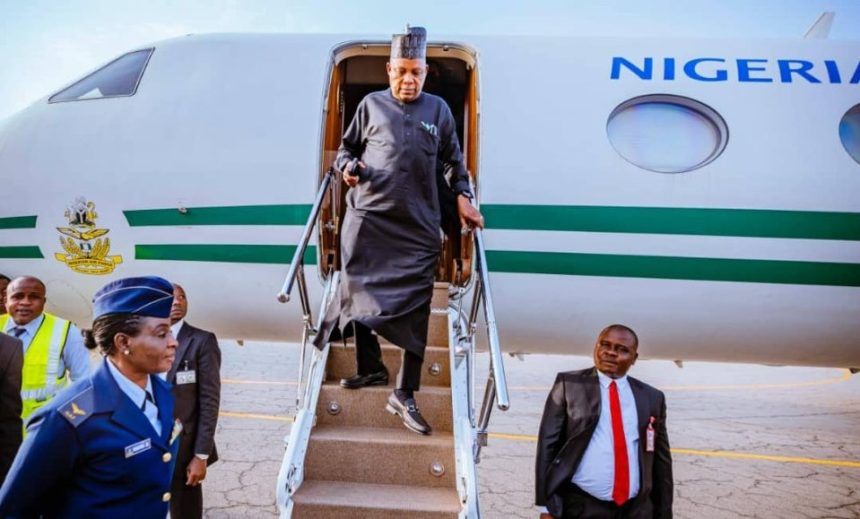
- the Vice President described the trip as a strong signal of Nigeria’s renewed diplomatic push
- He explained that Nigeria’s presence in Conakry helped reinforce its influence within the ECOWAS
- Shettima assured investors that key indicators are trending positivel
Vice President Kashim Shettima has returned to Abuja after a week-long diplomatic and economic engagement in Guinea-Conakry and Switzerland, declaring that Nigeria has re-established itself as a key player in regional and global policy discussions.
Eko Hot Blog reports that Shettima arrived at the Nnamdi Azikiwe International Airport on Saturday, having represented President Bola Ahmed Tinubu at the swearing-in ceremony of Guinea’s President, Mamadi Doumbouya, and later leading Nigeria’s delegation to the 56th World Economic Forum (WEF) in Davos.
EDITOR’S PICK
- ADC Requests INEC Postpone FCT Area Council Elections
- Tope Alabi Welcomes Grandchild
- CBN to Introduce New Policy to Regulate Debit Card Issuance, ATM Operations
Speaking after his return, the Vice President described the trip as a strong signal of Nigeria’s renewed diplomatic push and economic repositioning under the Tinubu administration’s Renewed Hope agenda.
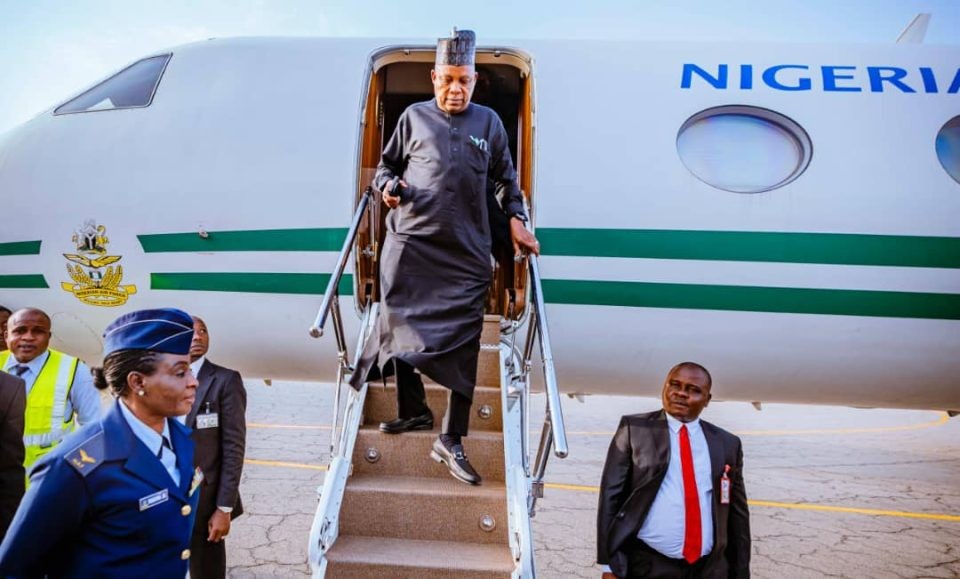
He explained that Nigeria’s presence in Conakry helped reinforce its influence within the Economic Community of West African States (ECOWAS), while also laying the groundwork for deeper cooperation with Guinea in sectors such as agriculture and manufacturing.
At the Davos summit, Shettima spearheaded Nigeria’s investment engagements and supervised the launch of Nigeria House Davos, the country’s first sovereign pavilion located on the Davos Promenade.
The facility is intended to serve as a long-term platform for showcasing Nigeria’s investment prospects in solid minerals, agriculture and the digital economy.
During a high-level discussion themed “When Food Becomes Security,” the Vice President outlined Nigeria’s evolving food security strategy, stressing that agriculture now occupies a central role in national security planning and economic resilience.
He also participated in the Accra Reset Initiative, joining former President Olusegun Obasanjo, former Vice President Yemi Osinbajo and Minister of Finance Wale Edun in discussions focused on driving Africa’s industrial growth through domestic capital mobilisation and strengthened value chains.
On Nigeria’s economic outlook, Shettima assured investors that key indicators are trending positively, citing projected GDP growth of 4.4 per cent by 2026 and a steady reduction in inflation.
He further highlighted Nigeria’s expected transition into a net exporter of refined petroleum products through the Dangote Refinery, alongside the country’s expanding footprint in global digital talent exports.
The Vice President said the mission reflects Nigeria’s strategic balance between regional diplomacy and global economic engagement, as the country seeks a more influential position in international affairs.
FURTHER READING