- He noted that Nigeria continues to battle insurgency in the North-East, banditry and kidnappings across the North-West
- The envelope budgeting system cannot adequately address the scale of insecurity facing the country
- Senators maintained that a national emergency declaration should be accompanied by exceptional funding measures
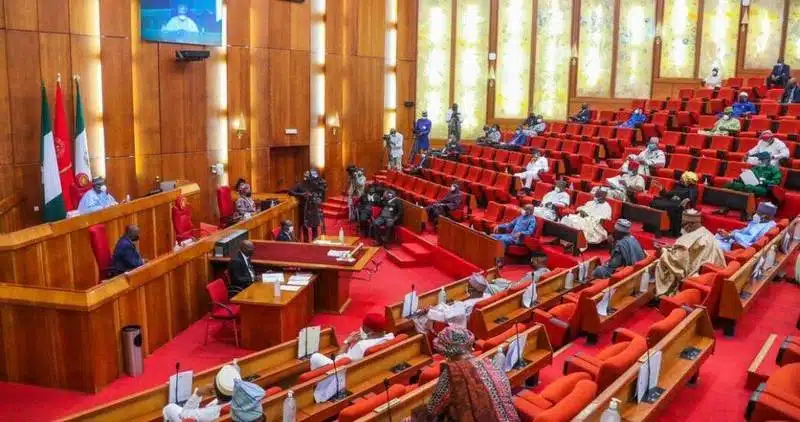
The Nigerian Senate on Wednesday criticised the Federal Government’s envelope budgeting system, saying the model is inadequate to tackle the country’s worsening security challenges despite President Bola Tinubu’s declaration of a national emergency on security.
Eko Hot Blog gathered that the position was made known during the 2026 budget defence session of the Office of the National Security Adviser (ONSA) in Abuja, where lawmakers questioned officials over funding shortfalls, delayed disbursements and stalled capital projects.
EDITOR’S PICK
- Grand Wedding Reception: Halimot, Saheed Mark Their Union
- Ikosi-Ejinrin LCDA Celebrates Former Chairman, Hon. Segun Adetola, on Birthday
- Sanwo-Olu Flags Off Free Eye Screening for 1,000 Lagos Police Officers
Chairman of the Senate Committee on National Security and Intelligence, Yahaya Abdullahi, argued that the envelope budgeting approach, which sets fixed spending limits for ministries, departments and agencies, lacks the flexibility required by security institutions confronting complex and fast-evolving threats.
He noted that Nigeria continues to battle insurgency in the North-East, banditry and kidnappings across the North-West and North-Central, separatist unrest in the South-East, and oil theft and piracy in the Niger Delta.
According to him, such realities demand a funding structure that allows swift operational responses.
“The envelope budgeting system cannot adequately address the scale of insecurity facing the country,” Abdullahi said.
“If government is determined to overcome these threats, then the funding framework must reflect that urgency. Security agencies cannot function effectively under tight ceilings and delayed releases.”
Lawmakers expressed concern that there appears to be a gap between policy pronouncements and actual financial commitments, stressing that promises to restore peace must be supported by sufficient and timely funding.
Abdullahi further lamented that late and incomplete releases, particularly capital allocations in the 2024 and 2025 budgets, have weakened security operations.
He said several initiatives aimed at enhancing intelligence, surveillance systems, logistics and mobility were either partially executed or not implemented at all.
He warned that failure to fully utilise capital votes undermines the broader security architecture, affecting equipment procurement, personnel training and deployment capacity.
Also speaking, the Permanent Secretary, Special Services, ONSA, Mohammed Sanusi, backed the committee’s concerns.
He identified envelope budgeting, inconsistent overhead releases and unimplemented capital appropriations as key obstacles limiting the office’s effectiveness.
Sanusi explained that security management requires a flexible funding system capable of responding quickly to emerging threats and intelligence-led operations, rather than one slowed by bureaucratic processes.
He added that since ONSA coordinates multiple security and intelligence agencies, its performance depends heavily on reliable and predictable funding.
The Senate’s remarks come amid sustained security pressures nationwide, including attacks on communities, mass abductions, assaults on security facilities and ongoing threats from non-state actors.
Although defence and security consistently receive significant allocations in the national budget, lawmakers questioned whether the structure and timing of fund releases align with operational demands.
Under the envelope budgeting framework, government agencies operate within predetermined expenditure limits based on projected revenues.
While the system is designed to ensure fiscal discipline, critics argue it may constrain sectors that require rapid and emergency-driven spending, such as security.
Senators maintained that a national emergency declaration should be accompanied by exceptional funding measures rather than routine fiscal controls. They cautioned that any mismatch between security threats and available resources could weaken public confidence and embolden criminal groups.
Nonetheless, the committee assured ONSA of legislative support as discussions on the 2026 budget continue.
Abdullahi indicated that lawmakers may consider adjustments to funding mechanisms to provide security agencies with greater flexibility in accessing and utilizing resources.
Following extensive debate in open session, the committee moved into a closed-door meeting to examine sensitive aspects of the proposal, including classified expenditures and operational details.
The Senate’s review is expected to play a significant role in determining how Nigeria funds its security institutions in the next fiscal year, as lawmakers seek to balance fiscal responsibility with the urgent need to restore stability across the country.
FURTHER READING