- Portugal Look Built for the 2026 World Cup
Let me ask you first, before we even go into tactics, stats, or rankings.
Who are you picking to win the 2026 World Cup?
Spain with that new generation that looks like it was built in a lab, with players like Lamine Yamal, Nico Williams, Pedri, Rodri controlling games like a system?
Or maybe France again? Because let’s be honest, when you look at their squad it almost feels unfair. Mbappé still there, Dembélé finally consistent, and now Michael Olise adding something new to that attacking mix, we are not even talking about Ryan Cherki, lEkitike. Depth everywhere. Power everywhere.
Or Brazil? Because Brazil is always Brazil. The talent never really disappears, it just sleeps until tournament time.
My guess?
I’m going with Portugal.
Now hear me out.
And I’m not saying this as a typical Ronaldo fan trying to build a fairytale ending where he lifts a World Cup and walks into retirement like a movie script. Yes, that story would be perfect. Yes, he deserves it in a historical sense. But football doesn’t work on narratives alone.
That’s not enough reason to pick a champion.
Portugal are not favourites because of emotion. They are favourites because something has quietly shifted in how this team actually functions.
First, you need to understand something very important about modern football. The World Cup is not the same tournament it was 10 or even 4 years ago.
The 2026 edition is the first expanded 48-team World Cup, with a new knockout structure that increases the number of elimination rounds. More matches. More fatigue. More tactical variation. More chaos.
And in tournaments like this, chaos does not reward the most famous squad. It rewards the most complete one.
Historically, only a handful of nations have ever won the World Cup. Brazil, Germany, Italy, Argentina, France, Spain, England, Uruguay. That’s it. Portugal are not on that list. And that alone usually ends the conversation.
But football now is not just about history anymore.
It is about squad structure; it is about balance.
It is about whether your “best 11” can survive seven high intensity knockout games without breaking shape.
And that is where Portugal suddenly starts looking different, because modern tournament football has already shown us something important. You can have a team full of stars and still fail if the structure is wrong.
We saw it at PSG. Neymar, Messi, Mbappé at one point. On paper, it felt almost illegal to lose. But in reality, it never fully worked in the Champions League because the balance wasn’t there. Too many attackers, not enough control in key moments.
Portugal is no longer that kind of team.
This is not a squad built around one man anymore. Even Cristiano Ronaldo, as massive as his presence still is, is no longer the centre of everything. At 40 plus, with 28 goals in the Saudi Pro League last season, he is now a finisher in the final phase, not the system itself.
And around him, something very complete has formed.
Bruno Fernandes, who continues to produce elite creative numbers in the Premier League, was just crowned best player in the League season after breaking the 2-decade old assist record. We would definitely see that flair at the biggest stage of them all. He remains Portugal main attacking controller. The team will rely on him to set rhythm of their attack.
Vitinha, quietly one of the most important midfielders in Europe right now, brings PSG level control into the national team. His ability to carry the ball under pressure and connect midfield to attack has changed how Portugal progress through compact defenses.
Then you add João Félix, who is finally becoming more stable in his role, operating between lines instead of drifting without structure. Not always explosive, but increasingly functional in a system that now knows where to place him.
On the wings, Rafael Leão gives Portugal something very few teams can match in open space. Pure acceleration, direct dribbling, and the ability to break a defensive block in one action.
And then there is Nuno Mendes.
Arguably one of the most complete left-backs in world football right now. At PSG, his numbers in both defensive duels and attacking progression show a rare balance. He doesn’t just defend or attack. He does both at elite intensity.
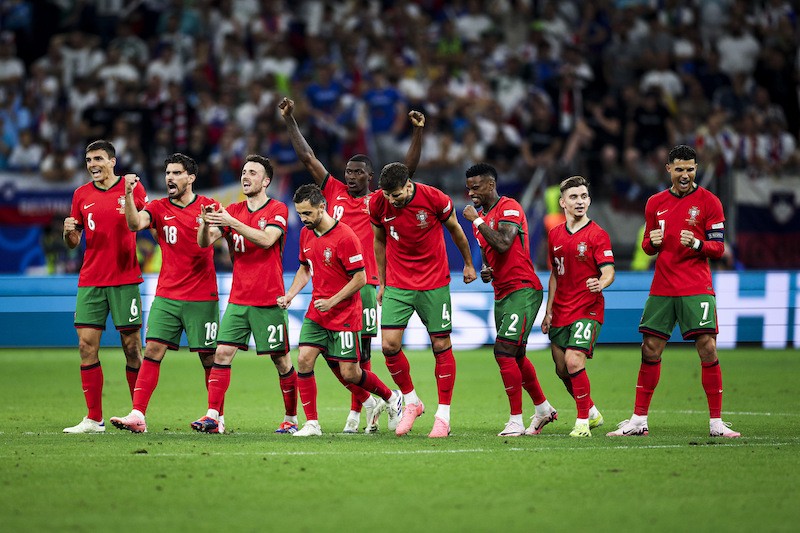
At the back, Rúben Dias anchors everything with structure, leadership, and consistency in duels.
And tactically, Portugal are no longer chaotic. They are structured. Controlled possession when needed. Fast transitions when space opens. Flexibility depending on opponent, which is exactly what wins knockout tournaments.
So when I look at 2026, I’m not asking who has the most stars.
I’m asking who can survive the tournament format.
Who can adapt in-game.
Who has balance across all phases.
Right now, Portugal appear to be a complete, well-rounded side built for tournament football.