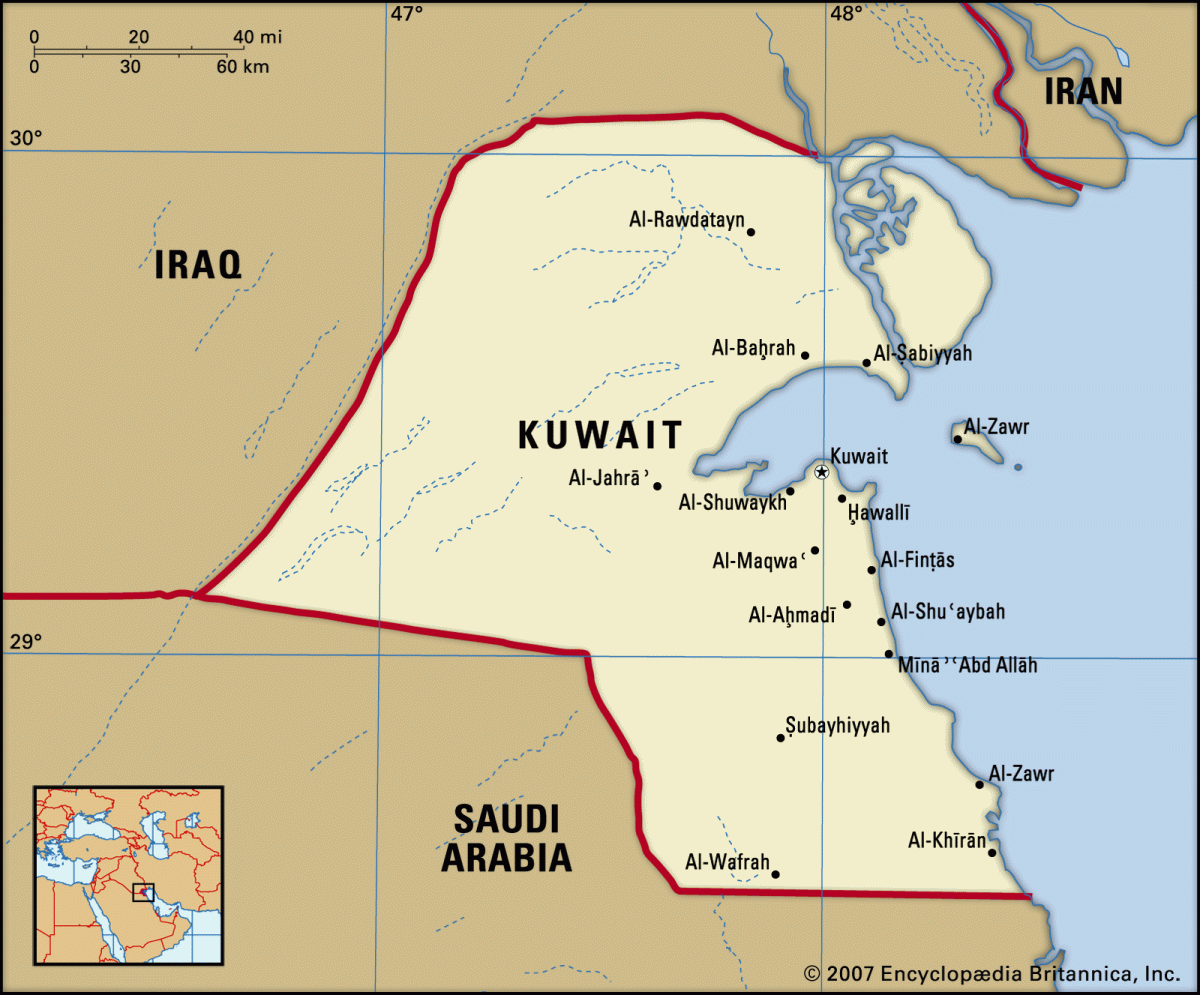
- The Kuwaiti military has activated its air defense networks to intercept incoming hostile aerial targets. This follows a massive wave of regional projectile attacks.
- The Bahraini Interior Ministry has activated emergency air raid sirens across the country. Authorities are urging all citizens and residents to immediately seek safe shelter.
- The attacks on the Gulf nations began shortly after U.S. Central Command executed another round of self-defense airstrikes inside Iran, entirely breaking the regional truce.
The Middle East conflict has escalated into a direct regional war after Kuwait and Bahrain reported incoming missile and drone strikes early Thursday morning, June 11, 2026.
Eko Hot Blog reports that the Kuwaiti army confirmed via an official statement on social media platform X that its frontline air defense systems were actively intercepting multiple hostile aerial targets in accordance with approved security protocols.
EDITOR’S PICK
- Hamzat Appoints Obanikoro as Campaign DG Ahead of 2027 Lagos Governorship Race
- Tinubu’s State Police Plan Gains Momentum as Amendment Looms
- Residents Raise Alarm After Two Bodies Found in Lagos Waterway
Military officials urged the public to stay calm and strictly adhere to safety instructions. Concurrently, neighboring Bahrain’s Interior Ministry announced the immediate activation of national air raid sirens.
The ministry ordered residents to head to the nearest secure locations and await official security updates.
The cross-border attacks came directly after the United States military launched a powerful second round of precision airstrikes inside Iran.
U.S. Central Command (CENTCOM) described the operation as a necessary self-defense measure authorized at the presidential level.
The American naval and air assault targeted sensitive Iranian surveillance, communications, and air defense sites across several coastal cities.
This was done to disable Tehran’s capability to target international waters.
Heavy explosions from the Western bombardment reportedly shook the Iranian capital of Tehran and the strategic port city of Bandar Abbas just before sunrise.
Iran’s Islamic Revolutionary Guard Corps (IRGC) claimed direct responsibility for the retaliatory strikes on the Gulf monarchies.
Iranian state media announced that the military deployed waves of suicide drones and ballistic missiles.
These weapons targeted 18 major U.S. military installations in the region. The IRGC claimed to have hit the Ali Al Salem and Ahmad Al Jaber airbases in Kuwait, alongside the Sheikh Isa airbase in Bahrain.
Furthermore, Tehran asserted that the strikes successfully destroyed communication antennas and radar facilities linked to the American Patriot defense systems at the U.S. Navy’s Fifth Fleet headquarters in Bahrain.
The rapid military escalation has thrown the entire Gulf region into total chaos and disrupted international markets.
Following the U.S. strikes, Iran’s joint military command announced the absolute closure of the strategic Strait of Hormuz.
They warned that any commercial ship or oil tanker attempting to transit the waterway would be fired upon. Although CENTCOM quickly disputed this claim, asserting that commercial shipping continues safely, global oil prices surged by over $2 a barrel on the news.
With airspace closures expanding across Kuwait and Jordan, international mediators fear that the ongoing diplomatic efforts to save the April ceasefire have completely collapsed.