- Lagos Dismisses Reports of Rising HIV Infections
- Says No Cause for Panic Over HIV Figures in Lagos
- Moves to Procure ARVs Independently
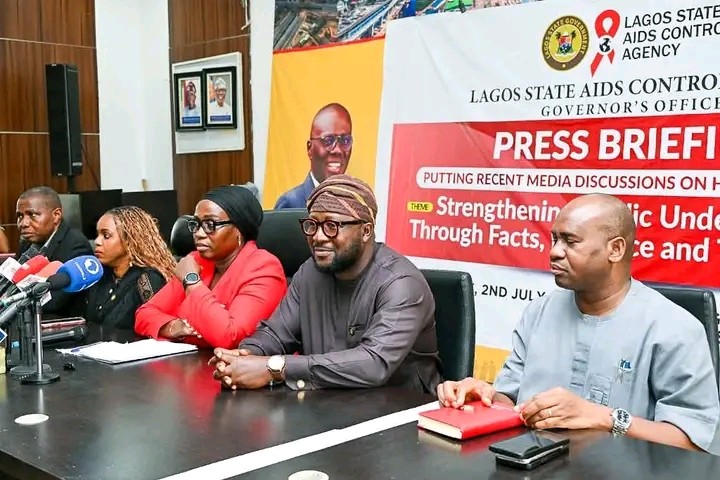
The Lagos State Government has reassured residents of its commitment to protecting public health, insisting that there is no cause for panic over recent reports suggesting the state recorded the highest number of new HIV infections in Nigeria, Eko Hot Blog reports.
Speaking during a press conference at the Bagauda Kaltho Press Centre in Alausa, Ikeja, on Thursday, the Chief Executive Officer of the Lagos State AIDS Control Agency (LSACA), Dr. Folakemi Animashaun, described the reports as misleading and based on a misinterpretation of HIV data.
EDITOR’S PICK
- MSME Awards 2026: Tinubu Announces Free Registration for 250,000 Businesses
- Sanwo-Olu Targets Cleaner Lagos, Unveils Plan for 150 Compactors
- Tinubu Signs New NIMC Act, Strengthens Nigeria’s Digital Identity System
According to her, the widely circulated figure of 10,430 does not represent new HIV infections recorded in 2025 but rather the number of people who were newly diagnosed as HIV-positive during the reporting period.
She explained that newly diagnosed cases may include individuals who contracted HIV years earlier but were only recently tested, people referred from other states, or patients who travelled to Lagos to access testing and treatment services.
Dr. Animashaun stressed that newly diagnosed HIV-positive cases should not be confused with new infections, which are determined through scientific epidemiological modelling and surveillance.
She warned that misinterpreting public health data could create unnecessary fear, increase stigma and discrimination, discourage people from getting tested and undermine ongoing HIV control efforts.
The LSACA boss noted that as Nigeria’s most populous state and a major healthcare referral centre, Lagos naturally records higher volumes of HIV testing, diagnosis and treatment than many other states.
According to her, stronger surveillance systems and expanded access to healthcare services inevitably result in higher case detection, which should not be mistaken for a worsening HIV epidemic.
Presenting the state’s latest programme data, Animashaun disclosed that Lagos conducted 504,800 HIV tests in 2025, identifying 11,940 HIV-positive cases, representing a positivity rate of 2.4 percent.

She added that between January and March 2026, the state carried out 179,229 HIV tests, with 3,390 positive cases recorded and a lower positivity rate of 1.9 percent, describing the decline as a strong indicator of improving epidemic control.
She further revealed that 147,904 people were receiving antiretroviral therapy across Lagos as of 2025, with 97 percent achieving viral suppression.
According to her, Lagos has also made significant progress in preventing mother-to-child transmission of HIV, with the Early Infant Diagnosis positivity rate dropping from 5.1 percent in 2020 to 1.5 percent in 2025.
Animashaun said the state has already commenced implementing a comprehensive HIV Response Acceleration Plan covering July to September 2026. The initiative focuses on expanding HIV testing, improving treatment access and retention, strengthening prevention programmes, enhancing data quality and ensuring sustainable HIV services across all 20 Local Government Areas and 37 Local Council Development Areas.
She disclosed that Lagos is currently scaling up HIV prevention through oral and long-acting injectable Pre-Exposure Prophylaxis (PrEP), while also pursuing long-term reforms to improve commodity security, digital health intelligence, domestic funding and health system resilience.
In a landmark move, the LSACA chief announced that Lagos State has independently procured antiretroviral medicines to ensure uninterrupted treatment services, making it the first sub-national government in Nigeria to do so.
She said the first batch of the state-funded antiretroviral drugs is expected to arrive before the end of August 2026.
According to Animashaun, the initiative demonstrates Governor Babajide Sanwo-Olu’s commitment to reducing dependence on foreign donor support while guaranteeing uninterrupted access to life-saving HIV treatment.
She added that the state is also exploring opportunities for local production of HIV medicines by drawing lessons from international best practices, including Kenya’s pharmaceutical sector, in collaboration with UNAIDS and other global partners.
Reiterating that HIV remains preventable and manageable, she encouraged residents to know their HIV status, utilise available prevention and treatment services, rely on verified public health information and reject all forms of stigma and discrimination.
Earlier, the Special Adviser to the Governor on Media and Publicity, Gboyega Akosile, said the briefing was organised to correct misinformation circulating in traditional and social media regarding HIV statistics in Lagos.
He noted that the Sanwo-Olu administration has continued to invest heavily in healthcare infrastructure, disease surveillance and HIV prevention, treatment and care programmes.
Akosile also recalled that following the suspension of some HIV-related foreign assistance by the United States earlier this year, the Lagos State Government immediately introduced measures to ensure that HIV services remained uninterrupted.
He urged journalists and members of the public to rely on verified information and avoid spreading misleading reports capable of causing unnecessary anxiety among residents.
FURTHER READING
- Alausa Commends UI, UNILAG, BUK as Nigeria Gains Ground in Global Rankings
- Tinubu Intensifies War on Drugs
- Tinubu Reassures South-West on Security
Click here to watch video of the week