- ‘I Pray One Day Christian-Christian Ticket Will Rule Nigeria’ – Sule
- Sule argues political candidates should be selected based on competence.
- Governor cites Muslim Muslim and Christian Christian tickets in Nigeria.
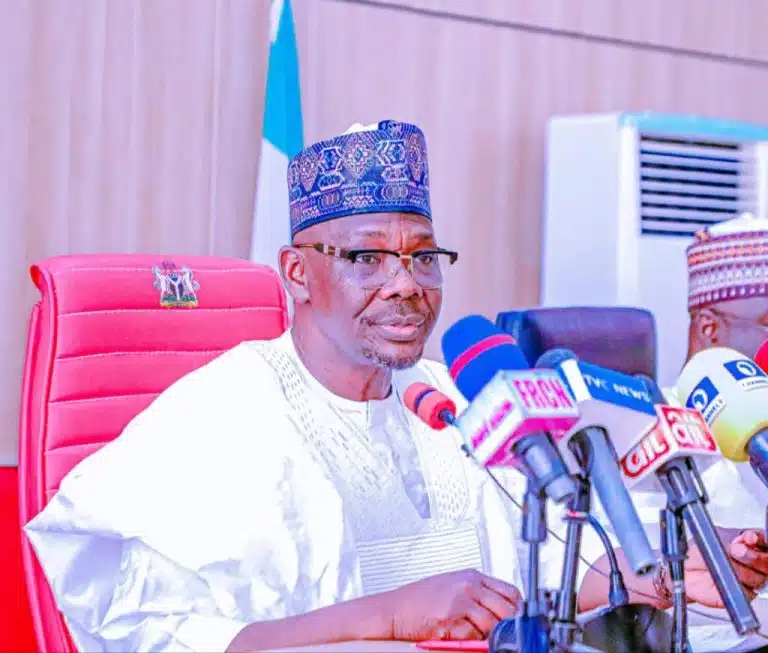
Nasarawa State Governor, Abdullahi Sule, has said the 1999 Constitution does not require political parties or governments to balance appointments and electoral tickets along religious lines.
Sule said the Constitution instead emphasises federal character, ethnic representation and inclusiveness in public appointments.
EDITOR’S PICKS
- Sanwo-Olu Unveils Climate Defence Fund to Drive Green Investments
- Competence, Not Ethnicity, Guides Appointments in Lagos – Sanwo-Olu
- List of Public Facilities Named After Tinubu Since 2023
EKO HOT BLOG reports that the governor made the remarks on Tuesday during an appearance on Channels Television’s Politics Today.
Sule was responding to comments by the 2027 vice presidential candidate of the Nigeria Democratic Congress, Rabiu Kwankwaso, on political representation and inclusion.
The governor described Kwankwaso’s position as a normal feature of opposition politics.
Sule said, “I think it is normal for Senator Kwankwaso, whom I respect a lot, to say that because he’s opposition.
“He cannot say anything good. It is expected of him to say that.”
The governor argued that constitutional provisions on inclusion were sometimes interpreted beyond their actual meaning.
According to Sule, Section 14(3) of the Constitution focuses on federal character and equitable representation, while Section 15 addresses ethnicity and national integration.
He maintained that neither provision expressly requires religious balancing in political appointments or electoral tickets.
“There is no place where it talks about religion. Section 14 didn’t talk about religion. Section 15 did not talk about religion,” Sule said.
The Nasarawa governor cited the election of President Bola Tinubu and Vice President Kashim Shettima on a Muslim Muslim ticket as an example of a same faith ticket winning a presidential election.
He also referred to the 1993 presidential election contested by the late Moshood Abiola and his running mate, Babagana Kingibe, who were both Muslims.
Sule said, “You can see both elections have been clear that the Muslim-Muslim ticket has won.
“I pray that one day Nigeria will have a Christian-Christian ticket, and it will win.”
He said the success of same faith tickets demonstrated that Nigerians could make electoral decisions based on factors other than religion.
Sule, however, explained that his decision to retain a Christian deputy governor in Nasarawa State was based on competence and the political realities of the state, rather than an attempt to comply with any constitutional requirement for religious balancing.
He said, “I have always had a Christian as a deputy, Emmanuel Akabe.
“In Nasarawa State, it has always been a Christian. We thought it was important because Emmanuel Akabe is competent and our state is different from Nigeria.”
The governor argued that the political circumstances of individual states could not always be used as a standard for determining national political arrangements.
Sule noted that some predominantly Christian states had governors and deputy governors who shared the same faith.
“You cannot take a particular state. Take Enugu, for instance; they are Christian-Christian. Take Bayelsa; it’s Christian-Christian,” he added.
The governor maintained that political parties and leaders should be free to select candidates based on competence, electoral considerations and the specific circumstances of their constituencies rather than religion alone.