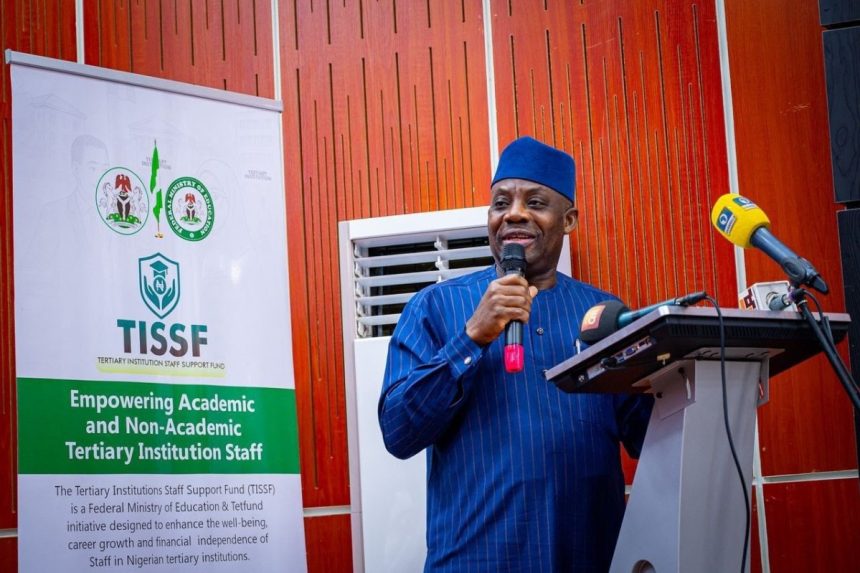
- Kodilichukwu Okelekwe says the education minister has repositioned the sector for maximum productivity.
- He hails reforms such scrapping of admission age limit, TVET, AI-in-classrooms, NEDI, and more.
- Okelekwe also commends the emphasis on vocational skills acquisition.
Dr. Kodilichukwu Okelekwe, the 2023 senatorial candidate of the All Progressives Congress (APC) for Anambra Central, has credited Minister of Education Dr. Tunji Alausa with a sweeping reform of Nigeria’s education sector, saying his tenure has been unprecedented and record-breaking.
EKO HOT BLOG reports that, in a statement issued in Abuja, the APC chieftain cited progress across admissions, student welfare and technical education since President Bola Tinubu appointed the minister in October 2024.
EDITOR’S PICKS
Okelekwe pointed to the reversal of the 18-year minimum age requirement for tertiary admission as one of the minister’s earliest actions.
He said Alausa held that “merit, ability, and readiness” — not an arbitrary calendar — should determine a child’s future, describing the reversal as a policy shift celebrated in homes, JAMB centres and secondary schools nationwide.
The politician also credited the ministry with expanding tertiary admission capacity beyond 1 million placements annually for the first time, up from roughly 750,000 amid more than 2 million qualified candidates in previous years.
The expansion followed changes to institutional carrying capacity, new academic programmes, distance learning options and a reconstitution of governing councils at federal tertiary institutions, Okelekwe said, adding that no minister had previously achieved that scale of access.
Turning to student welfare, Okelekwe described the Nigerian Education Loan Fund (NELFUND), which provides interest-free loans to students in public tertiary institutions, as one of the administration’s central achievements. He said the scheme has meant “food on a student’s table, rent paid, books bought” for beneficiaries, alongside an expanded National School Feeding Programme.

On technical education, the former senate candidate said the ministry has shifted vocational training toward a competency-based, industry-aligned framework, with instructors retrained and workshops retooled in fields such as welding, renewable energy and fashion design. He said the changes reflect a shift “from certificates to skills” for a new generation of technical workers.
Okelekwe further cited a revised basic education curriculum introduced to reduce subject overload and incorporate coding, entrepreneurship and critical thinking.
On technology, he noted the rollout of the Tertiary Institution Information Management System (TIIMS) and the launch of an Artificial Intelligence in Education Task Force, which includes a training programme for 6,000 secondary school teachers on AI use in classrooms. The APC chieftain also commended a separate ICT blueprint being supported by the French government and Agence Française de Développement.
Okelekwe also pointed to the launch of the National Education Data Initiative (NEDI), which he said is intended to consolidate fragmented education statistics to support evidence-based planning and end what he called “governance by guesswork.”
He further lauded Alausa’s transparent style of leadership in the Ministry of Education, noting that he has led with integrity.
“In an era when public trust is scarce, Dr. Alausa has discharged his duties with unimpeachable integrity. Every loan under NELFUND is traceable. Every data point under NEDI is verifiable,” he stated.
FURTHER READING
“Every council appointment, every smart school deployment, every kobo released is accounted for. He brought the ethics of a physician — do no harm, put the patient first, keep accurate records — into public service.”
Click to watch the video of the week below: