- Osun: EFCC Has Power To Freeze State Accounts – Falana
- He cites previous judgments affirming EFCC powers to investigate government finances.
- Tinubu directed EFCC to seek vacation of the order before election.
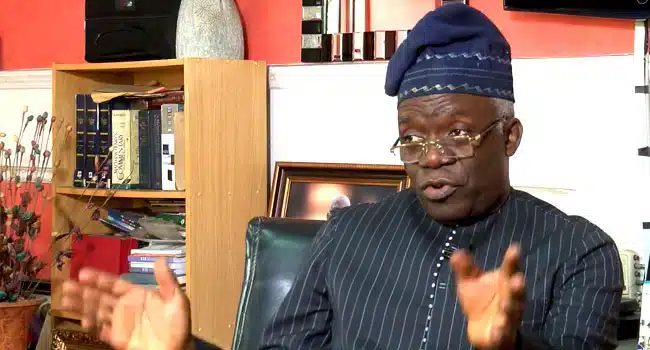
Human rights lawyer and Senior Advocate of Nigeria, Femi Falana, has said the Economic and Financial Crimes Commission did not act illegally by freezing an account belonging to the Osun State Government.
EDITOR’S PICKS
- Olodo Uprising: Sanwo-Olu Advises Youths to Embrace Knowledge, Curiosity
- BBN Season 11 Kicks Off with Unveiling of 24 Housemates Competing for ₦160m Grand Prize
- Why Africa Must Stop Exporting Raw Materials, Lessons From Benin for Nigeria
EKO HOT BLOG reports that Falana said the EFCC had the legal authority to restrict accounts belonging to federal, state and local governments, provided it obtained a court order within the required period.
The senior lawyer stated this on Friday while appearing on Channels Television’s Politics Today amid controversy over the EFCC’s restriction of an Osun State statutory allocation account.
According to Falana, previous judgments of the Court of Appeal and the Supreme Court had established the authority of anti corruption agencies to investigate the finances of government institutions.
“Well, as far as the law is concerned, the EFCC has not acted illegally,” Falana said.
He explained that the EFCC could initially place a Post No Debit restriction on an account for up to 72 hours before seeking judicial authorisation to extend the restriction.
“Under the law, the EFCC has the power to freeze the account of the Federal Government or of any state or local government in Nigeria,” he said.
Falana cited a legal dispute between the Benue State Government and the EFCC as an example.
He said the Federal High Court ruled in 2019 that the commission lacked the authority to freeze the state government’s account and awarded ₦50 million in damages against the agency.
According to him, the EFCC appealed the judgment at the Court of Appeal.
Falana said the appellate court overturned the decision in September 2022 and affirmed the commission’s power to temporarily restrict an account before obtaining a court order.
“That remains the law in Nigeria today,” he said.
The SAN also referred to a 2024 Supreme Court judgment arising from a suit filed by the Kogi State Government and joined by other states challenging the authority of federal anti corruption agencies to investigate state finances.
He said the Supreme Court examined the relevant laws and upheld the powers of the EFCC, Independent Corrupt Practices and Other Related Offences Commission and Nigerian Financial Intelligence Unit to investigate financial activities involving different levels of government.
Falana said Nigerians who wanted the existing legal framework changed should approach the National Assembly.
“If Nigerians—those who are concerned—want the law changed, they can go to the National Assembly. But for now, as of today, EFCC has the power to freeze the account of any state and, in not more than 72 hours, has to go to court,” he said.
He said the EFCC obtained judicial authorisation in the Osun case after presenting information to the Federal High Court.
“In this instance, the EFCC went to court, and the Federal High Court intervened based on information provided by the EFCC,” he said.
Falana also said the Osun State Government had taken the appropriate legal step by challenging the legality and validity of the freezing order rather than focusing solely on the timing of the EFCC’s action.
“The President referred to the order obtained by the EFCC. And as should be done, the Osun State Government has challenged the legality, the validity of the order, not the timing,” Falana said.
The senior lawyer cautioned against creating a precedent where anti corruption agencies would be expected to suspend investigations because an election was approaching.
He argued that such a precedent could create an opportunity for public funds to be moved without scrutiny during election periods.
“We must also be very careful that we don’t give a dangerous impression that when elections are 10 days away, 20 days away, 30 days away, the anti-graft agencies must turn the other eye,” he said.
Falana added that the proximity of an election should not automatically prevent anti corruption agencies from investigating suspicious movements involving large sums of public money.
The EFCC had said the restriction followed its investigation into the alleged fraudulent handling of about ₦11 billion in Ecology Funds, Intervention Funds and Federation Account Allocation Committee funds.
The commission said it acted after detecting what it described as suspicious transfers from the account beginning on August 2.
President Bola Tinubu subsequently directed the EFCC to return to court to seek the vacation of the order and discontinue the restriction, citing concerns over the timing of the action ahead of the August 15 Osun governorship election.
FURTHER READING
- Reps Probe N1.32bn Foreign Investment Council
- Abike Dabiri-Erewa Urges Nigerian Youths to Dream Big, Embrace Resilience
- Obi or Tinubu? Fresh Claims Emerge Over Obasanjo’s 2027 Political Allegiance