- Jonathan says Africa’s universities are falling behind globally
- He calls for specialised institutions to develop skilled manpower
- The former President says education is vital to Africa’s industrial growth
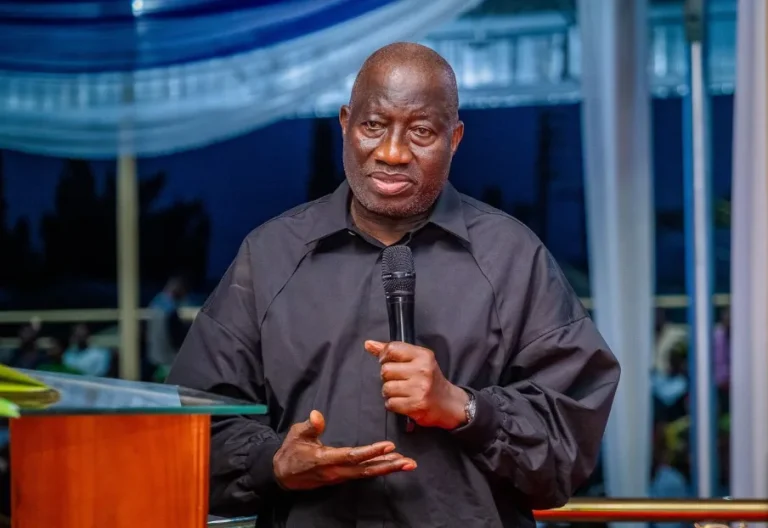
Former President Goodluck Jonathan has raised concerns about the weak global standing of African universities, warning that the continent’s education system must be strengthened if Africa is to achieve technological advancement and industrial growth.
Eko Hot Blog reports that Jonathan made the remarks on Monday in Abuja while speaking to participants of Course 34 of the National Defence College on the theme, “Harnessing Industrial Capacity for Inclusive Growth and Regional Stability in Africa.”
EDITOR’S PICK
- Tinubu Directs Installation of 3,700 Telecom Towers Across Nigeria
- Alara of Ilara Praises Sanwo-Olu, LASU Staff’s Dedication To Progress
- Burna Boy, Tems Bag Nominations at 2026 MTV VMAs
The former President argued that Africa’s inability to develop strong specialised institutions was limiting its capacity to produce the skilled professionals needed to drive modern industries.
He noted that no African university currently features among the world’s top 100 institutions, while only the University of Cape Town ranks within the top 200, describing the situation as a serious concern for the continent.
Jonathan called for a comprehensive review of Africa’s education system, from primary schools to universities, with greater emphasis on specialised institutions and advanced skills.
He said African countries must treat human capital as a major resource and invest heavily in education, science, technology, engineering and information technology.
Using Singapore as an example, Jonathan explained that the country’s economic transformation was achieved through deliberate investment in education and skills development despite its limited natural resources.
He also pointed to India, saying its decision to establish specialised institutions after independence helped produce highly skilled professionals who contributed to the country’s emergence as a major global technology hub.
According to Jonathan, Africa needs a similar approach that identifies and develops talented young people in areas critical to the continent’s future.
He warned that Africa could fall further behind if it failed to take advantage of the ongoing technological transformation.
Jonathan also stressed that the continent’s natural resources alone could not guarantee economic prosperity. He said African countries must develop the capacity to process their raw materials locally and turn them into high-value products and services.
The former President urged participants of the National Defence College to use their positions as future strategic leaders to promote policies that strengthen education, technological development and industrialisation.
He acknowledged that transforming Africa would take time but said sustained political commitment and determination could change the continent’s development trajectory.
At the event, Minister of Defence Christopher Musa also emphasised the connection between security and economic development.
Musa said sustainable economic growth could not be achieved without peace and security, while lasting stability would also be difficult to maintain without inclusive economic opportunities.
He described industrial capacity as a strategic necessity for Nigeria and Africa, noting that a strong industrial base could create jobs, improve competitiveness and strengthen national resilience.
The Defence Minister called for greater use of Africa’s natural and human resources to drive value-added production, technological innovation and sustainable development.
He also urged African countries to strengthen economic cooperation through initiatives such as the African Continental Free Trade Area.
Addressing the graduating participants, Musa encouraged them to apply the knowledge and professional networks gained at the National Defence College to policy development, national security and economic advancement.
He said effective leadership and integrated approaches to security and development were increasingly important as Nigeria and other African countries confront complex challenges.
FURTHER READING