Many Nigerians often assume that the last serious coup attempt in the country took place in the 1990s, during the dark and repressive era of General Sani Abacha.
But few remember that, barely five years into Nigeria’s Fourth Republic, an alleged plot to topple former President Olusegun Obasanjo’s government shook the nation’s young democracy in 2004.
EDITOR’S PICKS
Two decades later — in 2025 — the country once again found itself battling rumours of another coup plot, this time targeting President Bola Tinubu.
The 2004 Alleged Plot: A Missile, a Helicopter, and a Coup Speech
In April 2004, the Obasanjo administration said it was investigating allegations of serious breaches of security within the country’s armed forces. Nearly 30 officers were implicated and interrogated in the investigation.
Remi Oyo, who was then the presidential spokesperson, confirmed the arrests and expressed the President’s confidence in Nigeria’s democracy.
“President Olusegun Obasanjo trusts the security agencies and officials of government,” she said. “He believes in the Nigerian people, and he knows that they will continue to work for and with democracy.”
By October of that year, the federal government formally charged four military officers and a civilian with treason, accusing them of plotting to assassinate the President by shooting down his helicopter with a surface-to-air missile.
Those charged were Major Hamza Al-Mustapha, former chief security officer to late military ruler General Sani Abacha; Lieutenant Colonel Mohammed Umar Adeka; Navy Commander Yakubu Kudambo; Lieutenant Tijani Abdallah; and Onwuchekwa Okorie, a civilian.
According to court filings, Al-Mustapha allegedly sent money through Okorie to Abdallah between November 2002 and March 2004 to procure a Stinger surface-to-air missile “for the purpose of shooting down the President’s helicopter with the President on board.” Abdallah was said to have travelled to Togo and Côte d’Ivoire to acquire the weapon.
Meanwhile, Kudambo reportedly drafted a coup speech outlining a new regime to replace Obasanjo’s elected government.
Justice Daniel Abutu, who presided over the case, ordered the accused to be remanded in military custody. Al-Mustapha, Adeka, and Okorie pleaded not guilty, while Kudambo and Abdallah were charged in absentia.
A “Special Investigation Panel” made up entirely of military officers was later set up to decide whether the suspects would face a court-martial. Under Nigerian law, treason — including attempted coups — carries the death penalty. The case marked the Obasanjo administration’s first public confirmation of a coup plot since Nigeria’s return to democracy in 1999.
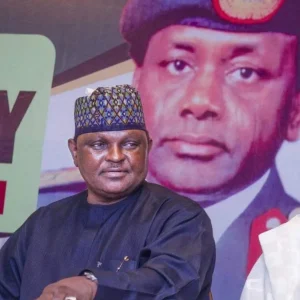
The name of Al-Mustapha, one of the co-conspirators has long been synonymous with controversy. Once a powerful aide under Abacha, he was already facing separate charges related to the assassination of Kudirat Abiola, wife of Chief MKO Abiola, and the attempted murder of Alex Ibru, publisher of The Guardian newspaper.
After over a decade in detention, he was acquitted in 2013 and later reemerged in public life as a political aspirant. Al-Mustapha has since declared his intention to contest the 2027 presidential election under the Social Democratic Party (SDP).
21 Years Later…
In October 2025, 21 years after the Obasanjo plot, reports once again surfaced claiming that there had been an alleged coup attempt — this time against President Bola Tinubu.
The speculation gained traction after the federal government abruptly cancelled the parade for Nigeria’s 65th Independence Anniversary, sparking rumours that it was connected to a foiled military coup.
However, the Defence Headquarters (DHQ) swiftly dismissed the claims. In a statement, Tukur Gusau, Director of Defence Information, said the decision to cancel the parade had nothing to do with any coup attempt.
“The decision regarding the cancellation of the 65th independence anniversary parade was to allow Mr. President to attend a strategic bilateral meeting outside the country and for members of the Armed Forces to sustain the momentum on the fight against terrorism, insurgency and banditry,” Gusau explained.
He clarified that the reported arrest of sixteen military officers was unrelated to any alleged plot, describing it as a routine internal disciplinary process.
“The claims are entirely false, malicious, and intended to cause unnecessary tension,” Gusau said. “The Armed Forces remain firmly loyal to the constitution and the federal government under President Bola Tinubu. Democracy is forever.”
FURTHER READING
Despite denying that there was no threat, Gusau added that an internal investigative panel had been constituted and that its findings would be made public in due course.
Philip Ibitoye is a Special Correspondent with EKO HOT BLOG. Click here to find daily analysis and critical insight on trending issues in Lagos and other parts of Nigeria.
Click here to watch the video of the week below: