The recent exchange between Minister of Works David Umahi and Oyo State Governor Seyi Makinde over the cost per kilometre of the Lagos–Calabar coastal highway has reignited public scrutiny of Nigeria’s most ambitious infrastructure project.
While the debate began as a technical question about road construction costs, it has since evolved into a broader conversation about transparency, governance, and the complexity of public infrastructure financing in Nigeria.
EDITOR’S PICKS
The Trigger: A Question of Cost Transparency
The controversy began after Umahi appeared on Arise Television to discuss progress on the Lagos–Calabar coastal highway, a signature initiative of President Bola Tinubu’s administration.
When asked by anchor Oseni Rufai to specify the cost per kilometre of the project, Umahi bristled at the question, describing himself as a “professor of practice in engineering” and suggesting that the figures were too technical for a lay journalist to grasp.
That response did not sit well with Governor Makinde, who, during a public event, defended the journalist’s question and criticised the minister’s handling of the inquiry.
Makinde accused Umahi of “dancing around” the figures and failing to give a straightforward answer about the project’s cost.
“How will they ask a minister how much is coastal road and you’re Dancing Around The Figures!”
– Governor Seyi Makinde Tackles Minister David Umahi Over Lagos-Calabar Coastal Highway Cost😭💔 pic.twitter.com/2qGUH5PFP8
— Oyindamola🙄 (@dammiedammie35) October 10, 2025
To make his point, the Oyo governor cited examples from his state: the 34-kilometre Oyo–Iseyin road, which reportedly cost about ₦9.99 billion (₦238 million per kilometre), and the 76-kilometre Iseyin–Ogbomoso road, built at ₦43 billion (₦500 million per kilometre), including two bridges.
By contrast, the Lagos–Calabar highway has been widely reported to cost hundreds of millions of naira per kilometre—raising concerns about transparency and value for money.
Umahi’s Defence: Technical Complexities and Cost Variables
Responding during an inspection visit to projects in Nasarawa State, Umahi said Makinde’s comments reflected a misunderstanding of technical and cost-evaluation processes in road construction. He emphasized that the Lagos–Calabar highway’s costs were computed according to international engineering standards and could not be simplified into “political soundbites.”
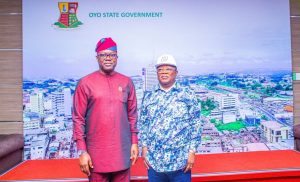
Umahi described Makinde as “a brother and friend” but advised him to seek clarification rather than make public accusations. He also asserted seniority in both governance and engineering practice, even challenging the governor to a debate if he persisted in his claim that Umahi had evaded the question.
Somebody show me what Governor Makinde of Oyo State said, I didn't want to join issues with him. I think he is an engineer, an electrician, oh sorry, they call it elect elect. This is road construction. elect elect no reach there. I’m his senior in governance.
– Dave Umahi, the… pic.twitter.com/hcw05871cT
— Imran Muhammad (@Imranmuhdz) October 11, 2025
The works minister then clarified that there is “no ambiguity” in determining cost per kilometre, explaining that two perspectives exist: estimated and average.
The estimated cost, he said, includes provisions for contingencies, price adjustments, and other variables that account for potential changes in scope or material costs during construction. The average cost, on the other hand, is derived after completion, based on the actual expenditures incurred.
In defending his position, Umahi also referenced artificial intelligence tools that reportedly corroborated his distinction between estimated and average costs. He further cited the National Universities Commission’s supposed recognition of “professors of practice” to affirm his technical expertise, asserting that his field experience qualified him as one in practical engineering.
The Need for Clarity and Public Accountability
The Umahi–Makinde exchange highlights a recurring challenge in Nigeria’s public infrastructure sector; the lack of accessible, standardised information about project costs.
While Umahi may be correct that construction costs vary based on terrain, materials, and scope, Makinde’s demand for an “average figure” reflects a legitimate public interest concern: taxpayers want clear, understandable explanations of how multi-billion-naira projects are priced.
Both leaders raise valid points. Umahi’s insistence on technical rigor points to the complexity of modern road engineering, particularly for a coastal project spanning several states and requiring extensive reclamation and reinforcement.
However, Makinde’s argument speaks to democratic accountability, that technical complexity should not be used to obscure information that citizens have a right to know.
In the end, the controversy underscores a broader tension between expertise and transparency. Technical details may be complex, but public communication about them should not be.
FURTHER READING
For a project as significant and costly as the Lagos–Calabar coastal highway, the federal government would do well to publish a breakdown of estimated costs, contract terms, and funding structures. Doing so would not only settle debates like this one but also strengthen public trust in a project positioned as a cornerstone of Nigeria’s infrastructure renewal.
Philip Ibitoye is a Special Correspondent with EKO HOT BLOG. Click here to find daily analysis and critical insight on trending issues in Lagos and other parts of Nigeria.
Click here to watch the video of the week below: