- A catastrophic pair of earthquakes, a 7.2 magnitude foreshock followed just 39 seconds later by a massive 7.5 magnitude mainshock, struck northwestern Venezuela, ranking among the strongest seismic events to hit the nation in over a century.
- The capital city of Caracas sustained heavy infrastructure damage, including the total collapse of multi-story buildings, widespread power outages, and severed communication networks, trapping residents and leaving families in deep distress.
- The powerful tremors were felt across Venezuela and triggered temporary tsunami advisories in the Caribbean, while shaking prompted high-rise building evacuations as far away as the Brazilian Amazon and parts of Colombia.
A devastating pair of back-to-back earthquakes measuring 7.2 and 7.5 in magnitude struck northwestern Venezuela on Wednesday evening, leaving a trail of severe destruction across the capital city of Caracas.
Eko Hot Blog reports that according to data released by the U.S. Geological Survey (USGS), the disaster occurred as a rare “doublet” event, where a powerful 7.2 magnitude foreshock was followed a mere 39 seconds later by an even more destructive 7.5 magnitude mainshock.
EDITOR’S PICK
- Hamzat Appoints Obanikoro as Campaign DG Ahead of 2027 Lagos Governorship Race
- Tinubu’s State Police Plan Gains Momentum as Amendment Looms
- Residents Raise Alarm After Two Bodies Found in Lagos Waterway
The epicenters of both quakes were traced to the northwest of the town of Montalbán, striking at a shallow depth of roughly 8.2 miles. The intense tremors represent some of the most violent seismic activity recorded in the South American nation in more than a hundred years.
In Caracas, the largest and most densely populated city in the country, the impact has been described as catastrophic.
Shocking video footage and images emerging from the capital show entirely collapsed buildings, buckled roadways, toppled electricity poles, and fields of heavy debris blocking major transit networks.
Entire neighborhoods have been plunged into darkness due to widespread power failures, and a near-total collapse of cellular network signals has paralyzed communication.
The lack of connectivity has deepened the anguish of millions of Venezuelan families living in diaspora who are desperately trying to contact relatives inside the crisis-hit nation.
The upscale Altamira neighborhood in Caracas has become one of the focal points of the emergency response, with local officials describing the local structural damage as alarming.
Eyewitnesses and international journalists at the scene reported the total destruction of a 22-story residential building, where frantic residents and volunteer rescue teams are currently scaling mountainous piles of smoking concrete and rubble to search for survivors.
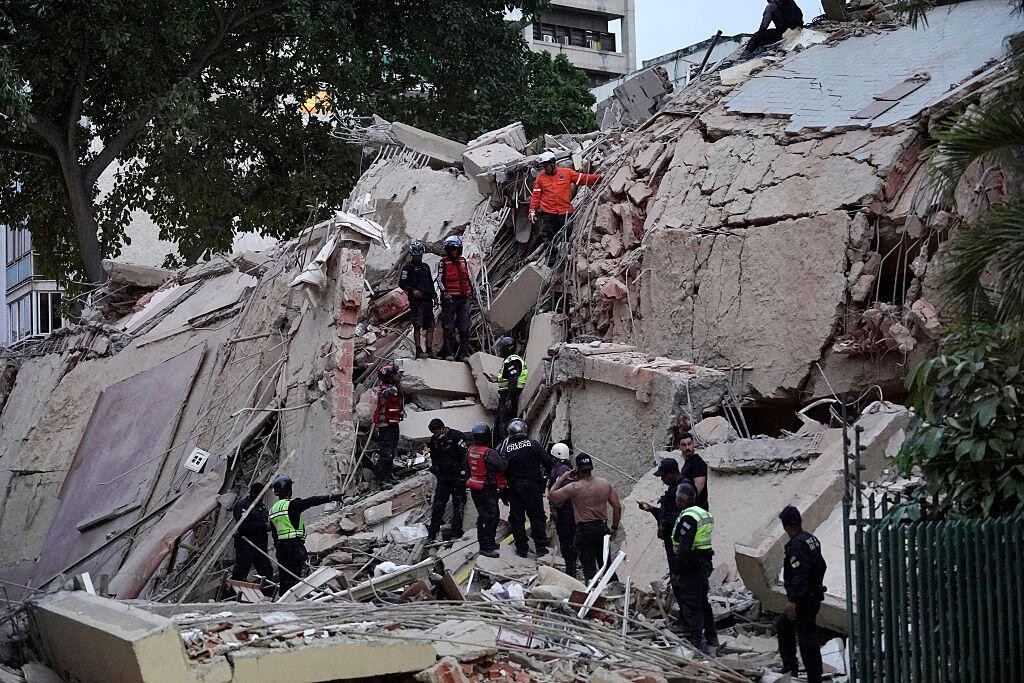
Dust columns rose over the city as citizens fled swaying structures into the streets, where thousands remained huddled late into the night, too terrified of potential aftershocks to return inland.
Venezuela’s Interior Minister, Diosdado Cabello, confirmed during an emergency broadcast on state television that the tremors vibrated across multiple states.
Cabello stated that emergency rescue protocols have been fully activated, urging the public to remain outside, maintain maximum serenity, and look after children and the elderly while official aid crews navigate the hazardous ruins.
Prominent political figures, including exiled opposition leader María Corina Machado, have publicly expressed their solidarity and prayers for the nation during this hour of deep national trauma.
While Venezuela sits near complex fault lines along the boundary of the South American and Caribbean tectonic plates, earthquakes of this magnitude are historically unusual for the country, which lies outside the highly volatile Pacific Ring of Fire.
The geopolitical ripples of the disaster were felt internationally, with high-rise corporate and residential buildings being evacuated as far away as Manaus, Belém, and Macapá in northern Brazil, as well as throughout northeastern Colombia.
Though the National Weather Service’s U.S. Tsunami Warning System briefly issued tsunami advisories for Puerto Rico and the Virgin Islands, those alerts have since been safely canceled.