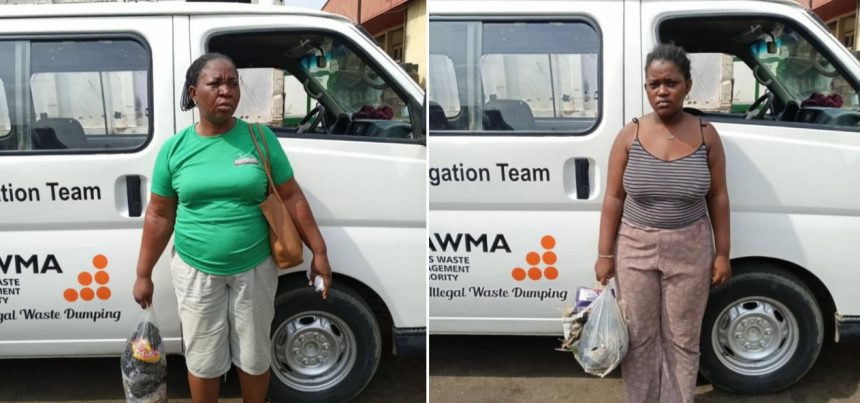
Lagos State’s latest arrests for illegal waste disposal have again highlighted the government’s increasingly aggressive approach to environmental enforcement and raised a fresh question: can sustained punishment ultimately shift public behaviour?
In a statement on Saturday, the Commissioner for Environment and Water Resources, Tokunbo Wahab, disclosed that the LAWMA Waste Infractions Surveillance and Investigation Team apprehended four individuals for indiscriminately dumping refuse around Ayobo-Ipaja Road during a pre-dawn operation.
EDITOR’S PICKS
The suspects — Okoro Stella, Abraham Oluwalogbin, Nwakego Chiyenre and Ofili Tolulope — have been handed over to the Oshodi Mobile Court for prosecution.
The LAWMA Waste Infractions Surveillance and Investigation Team apprehended four individuals for illegally disposing of refuse at an unauthorized location in the vicinity of Ayobo-Ipaja Road during a pre-dawn operation that extended into the morning of December 4, 2025. The… pic.twitter.com/UkAPnVsU0A
— Tokunbo Wahab (@tokunbo_wahab) December 6, 2025
The enforcement drive reflects a broader pattern.
Over the past year, the Lagos government has consistently issued fines, shut down non-compliant facilities, and deployed mobile courts across hotspot areas, while also scaling up public messaging campaigns urging residents to adopt responsible waste practices. Reminders, jingles, signage and advocacy through community leaders have been intensified across local councils, particularly in flood-prone neighbourhoods.

Even so, illegal dumping continues to undermine waste management, clogging drainage systems and worsening flooding during the rainy season. Hence, the state’s strategy shifted from persuasion to deterrence, a recognition that awareness campaigns alone have not led to behavioural change. Many residents are aware of the health and environmental consequences of indiscriminate dumping, but the absence of real punishment has allowed the habit to persist.
Lagos now appears determined to make consequences a visible part of public sanitation. By publicising arrests, naming offenders and ensuring mobile-court prosecutions, the state government hopes to signal that waste infractions come with tangible legal and financial costs. Such actions could strengthen deterrence if they are applied consistently and if penalties are strong enough to discourage repeat offences.
FURTHER READING
Still, enforcement must operate alongside accessible waste collection services, especially in underserved communities. But for now, the Lagos government seems convinced that continuous arrests — reinforced by sustained public sensitisation — may be the combination needed to make illegal waste disposal socially unacceptable and legally risky.
Philip Ibitoye is a Special Correspondent with EKO HOT BLOG. Click here to find daily analysis and critical insight on trending issues in Lagos and other parts of Nigeria.
Click here to watch the video of the week below: