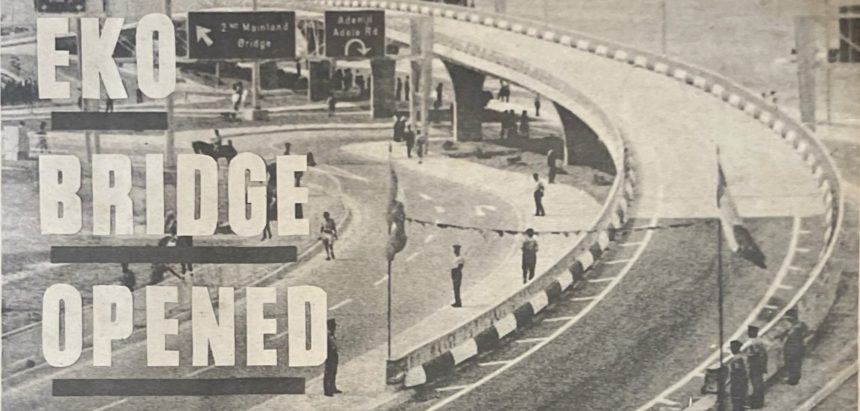
On February 8, 1969, Lagos witnessed the grand opening of the Eko Bridge, then celebrated as the city’s second link between the Island and the Mainland.
EKO HOT BLOG gathered that the event, reported by the Sunday Observer and now preserved by Archivi.ng, was a moment of national pride.
"Eko Bridge Opened" — Sunday Observer, 1969
"The second Lagos bridge, built at a cost of some £9 million, was yesterday opened with great fanfare by the Head of State, Major-General Yakubu Gowon." pic.twitter.com/5Spn7bcxY3
— archivi.ng (@StartArchiving) October 2, 2025
EDITOR’S PICKS
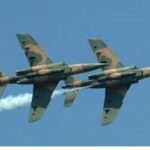
The newspaper reported that the Head of State, Major-General Yakubu Gowon, performed the opening ceremony before a massive, jubilant crowd. The event featured a fly-past by Air Force jets, thousands of balloons released into the air, and a colourful display by the armed forces and police band.
In his remarks, Gowon urged that the bridge should serve as “an instrument for national unity.”
The Eko Bridge, also known as the Second Mainland Bridge, was built by Julius Berger (Nigeria) Ltd with funds from a West German government loan, during the tenure of Alhaji Shehu Shagari as Minister of Works. The project cost about £9 million—a considerable sum at the time.
From Eko to the Third Mainland Bridge
The Carter Bridge, the city’s oldest crossing, had long served Lagos before Eko Bridge’s arrival. But as the metropolis expanded, more infrastructure became necessary.
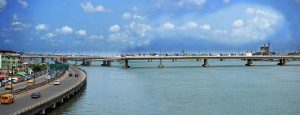
By 1980, the Third Mainland Bridge—later unofficially known as the Ibrahim Babangida Bridge—was commissioned by President Shehu Shagari, with construction completed under General Ibrahim Babangida in 1990.
At 11.8 km, the Third Mainland Bridge dwarfed Eko Bridge in scale and became not only Lagos’ but also one of Africa’s longest bridges. Despite being officially named after IBB, Lagosians simply preferred calling it the Third Mainland Bridge—a name that has since stuck.
The Wait for the Fourth Mainland Bridge
Today, attention has shifted to the Fourth Mainland Bridge, a 38-kilometre mega-project conceived by the Lagos State Government. First announced with great optimism, the bridge has endured repeated delays, with actual construction yet to commence.
If completed, however, it is expected to be transformative. At 38 km, it will become the second longest bridge in Africa. Plans include three toll plazas, nine interchanges, a 4.5 km Lagoon Bridge, and eco-friendly features designed to fit into Lagos’ urban and environmental future. The bridge will connect Lagos Island through Langbasa and Baiyeku in Ikorodu, stretching across the Lagoon to Itamaga in Ikorodu.
FURTHER READING
Though initially estimated in 2021 to cost $2.5 billion, the Fourth Mainland Bridge remains more of a promise than a reality. Still, like its predecessors, it embodies the ambition of Lagos to match its infrastructure with its bustling population and global city status.
Philip Ibitoye is a Special Correspondent with EKO HOT BLOG. Click here to find daily analysis and critical insight on trending issues in Lagos and other parts of Nigeria.
Click here to watch the video of the week below: