- The Stockholm International Peace Research Institute (SIPRI) has warned that global nuclear-armed states are actively moving weapons out of storage and integrating them onto active delivery systems.
- Although overall global warhead inventories dropped marginally to an estimated 12,187, researchers project this post-Cold War downward trend is set to reverse as dismantlement slows and new deployments accelerate.
- Driven by intense geopolitical competition, China is expanding its nuclear arsenal faster than any other nation, with projections suggesting its intercontinental ballistic missile (ICBM) count could match those of the US or Russia by 2030.
Leading global security researchers warned on Monday, June 8, 2026, that weapons of mass destruction are playing a significantly amplified role in international politics as nuclear-armed states increasingly move warheads out of long-term storage facilities and onto active delivery systems.
Eko Hot Blog reports that according to the annual report released by the Stockholm International Peace Research Institute (SIPRI), the world’s combined nuclear powers hold an estimated total of 12,187 warheads, with roughly 9,745 maintained in stockpiles for active operational use.
EDITOR’S PICK
- Fresh Details Emerge on Death of Odomola Monarch, Oba Adebowale Adeshina
- Sanwo-Olu Applauds LASU’s Academic Excellence After JAMB Ranking
- NRC Moves 176,820 Tonnes Of Cargo Through Lagos Ports In Q1
While this represents a marginal year-on-year decline, primarily due to the ongoing dismantlement of obsolete Cold War-era weapons, SIPRI Director Karim Haggag warned that nuclear dangers and structural risks are rising sharply.
The institute explicitly projects that the decades-long trend of shrinking global nuclear inventories is on the verge of reversing due to the slowing pace of dismantlement and an acceleration in the manufacturing and deployment of modernized nuclear weapons.
This heightened state of global risk is exacerbated by a severe breakdown in international strategic arms control agreements alongside intensifying competition among major superpowers.
Currently, the United States and Russia control approximately 83 percent of the world’s entire nuclear stockpile, with each country holding more than 5,000 warheads.
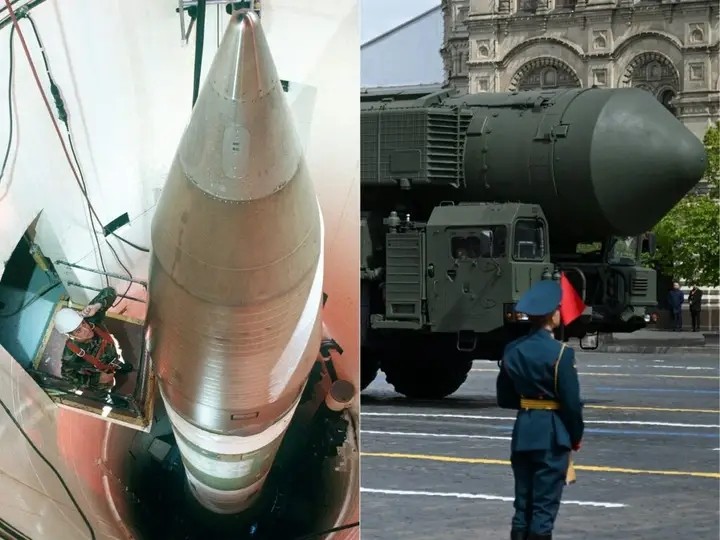
While both nations are executing extensive modernization programs for their respective arsenals, both have run into significant internal constraints.
The United States’ modernization efforts face profound planning and funding challenges that are highly likely to trigger further operational delays and steep budget overruns.
Conversely, Russia’s nuclear program has been undermined by failed intercontinental ballistic missile (ICBM) tests, heavy international economic sanctions, and competing military demands directly linked to the ongoing war in Ukraine.
Geopolitical friction is also driving an aggressive nuclear expansion in Asia, led predominantly by China. SIPRI estimates that China’s arsenal has expanded to 620 warheads, and depending on its structural force configurations, Beijing could field as many operational ICBMs as Washington or Moscow by the turn of the decade.
Even if China reaches its projected goal of 1,000 warheads by 2030, its total inventory will still only amount to a quarter of the independent capacities of the US or Russia.
Elsewhere in Asia, India has expanded its stockpile to an estimated 190 warheads, while its neighbor Pakistan holds steady at 170 warheads while actively accumulating fissile material for long-term expansion.
North Korea continues to aggressively pursue its stated state directive to “exponentially” grow its nuclear capability, reaching an estimated 60 warheads, while Israel, which officially maintains a policy of ambiguity regarding its nuclear status, is believed to be actively modernizing its estimated 90-warhead arsenal.
Within Europe, France and the United Kingdom maintain steady counts of 290 and 225 warheads respectively, though the UK’s stockpile is projected to increase under revised defense ceilings, and French President Emmanuel Macron formally ordered an expansion of the French stockpile earlier this year.