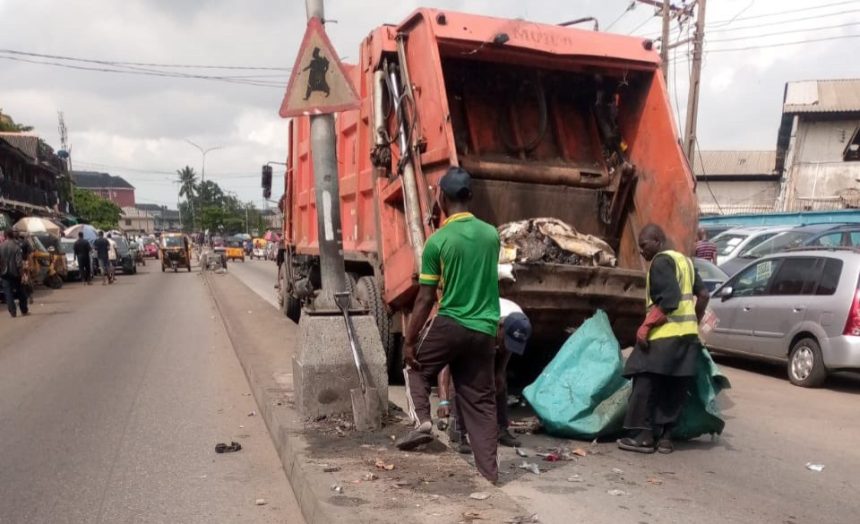
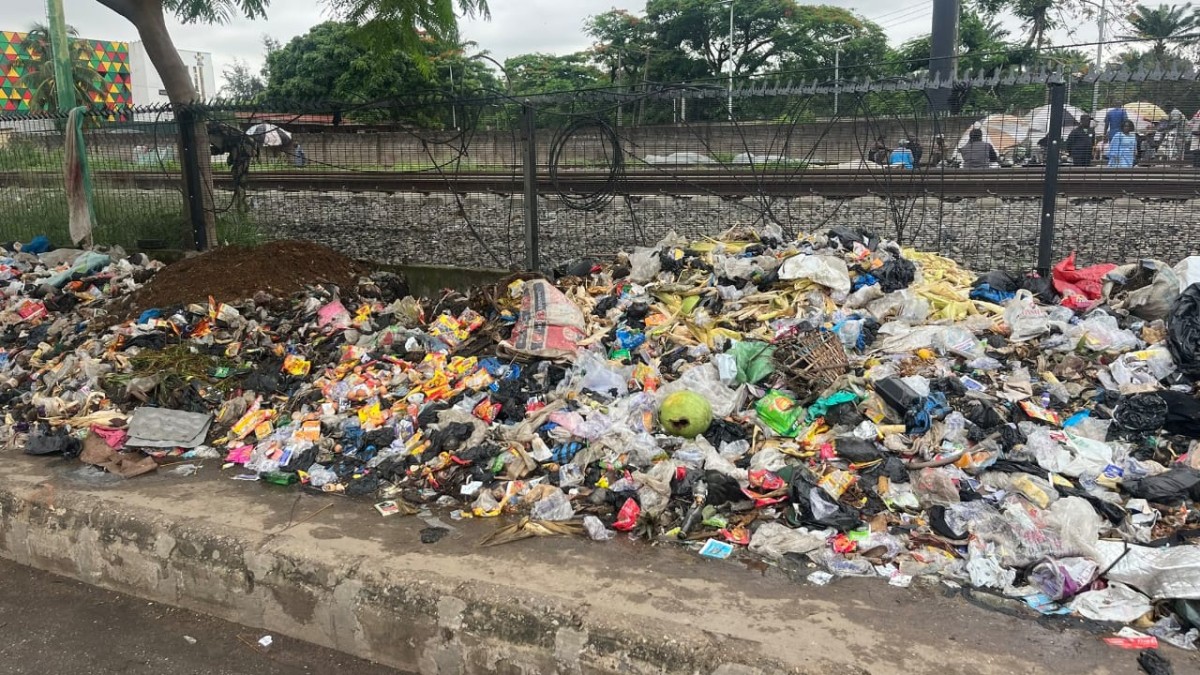
For the better part of the last month, Lagos has looked like a city at war with its own garbage. Road medians buried under refuse. Drainage channels choked with waste. Pavements turned into dumpsites. From Mushin to Surulere, from Ketu to Iyana Isolo, the story was the same: mountains of uncollected trash and frustrated residents who had been waiting weeks for PSP operators that never came.
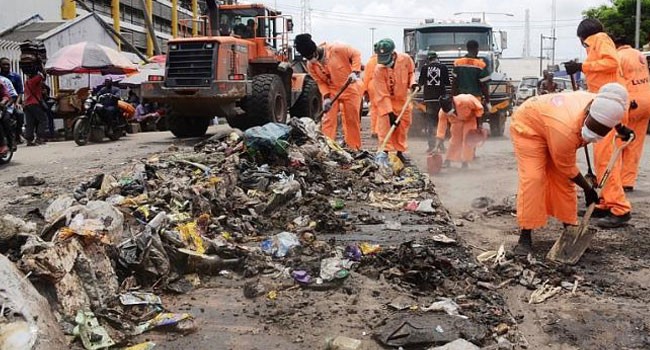
The Lagos State Government eventually responded. Governor Babajide Sanwo-Olu ordered emergency evacuation of waste across the state’s road network. LAWMA trucks returned to the streets. The heaps began to disappear. And then, last Saturday, the government announced its plan to prevent a repeat: a “Waste Police” made up of transport union members who would patrol motor parks and surrounding communities to deter indiscriminate dumping.
EDITOR’S PICKS
It is a response. But is it a solution? EKO HOT BLOG takes a closer look at the dynamics in play.
What the Government Is Getting Wrong
The “Waste Police” announcement, and the broader strategy it represents, is built on a flawed diagnosis. It assumes that Lagos’s waste crisis is primarily a behavioural problem; that residents are dumping refuse on roads because they are undisciplined and need monitoring. Enforce harder, the thinking goes, and the problem goes away.
But consider what residents have actually been saying. A Surulere resident reported that his PSP operator had not visited in three weeks despite collecting ₦10,000 monthly. Others across the state described waiting over a month for collection that never came. These are not people who chose to dump refuse irresponsibly. These are people who had no other option. Deploying Waste Police against them is punishing residents for a system that failed them first.
The government’s own numbers tell the story.
LAWMA and its 442 licensed PSP operators evacuated 418,500 tonnes of waste in May 2026 — roughly 13,200 tonnes daily — and the system was still visibly overwhelmed. LAWMA itself runs only 77 compactor trucks across the entire state. For a megacity of nearly 27 million people generating 13,000 tonnes of waste every single day, that is not a fleet. It is a drop in the ocean.
The Structural Problem Nobody Wants to Name
Here is what the government has been reluctant to say plainly: Lagos’s waste management crisis is not primarily an operational failure. It is a structural one.
The Nigerian Constitution is straightforward on who should take care of this problem. The Fourth Schedule assigns waste collection and disposal to local governments. Not the state. Not LAWMA. Local governments. Lagos has 20 of them and 37 Local Council Development Areas; 57 administrative units whose constitutional purpose includes managing waste for their communities.
Instead, that function has been absorbed by a single state agency trying to cover 1,171 square kilometres of one of the most densely populated cities on earth.
The result is what we have seen in the past two weeks: a system that cannot cope, periodically collapses, and then scrambles to recover through emergency measures that buy time without fixing anything.
What a Real Fix Looks Like
A sustainable solution to Lagos’s waste crisis has three components.
The first is decentralisation. Each local government and LCDA must be properly funded and empowered to manage waste collection within its own jurisdiction. The residents of Alimosho do not have the same needs as those of Eti-Osa. Community-level waste management, run by people who know the terrain and answer directly to the community, is the only model that scales appropriately across a city this size.
The third is accountability and this is where enforcement legitimately belongs. Once the system works, once residents have reliable collection and accessible disposal infrastructure, then a “Waste Police” makes sense. Chase the recalcitrant ones. Prosecute the midnight dumpers. Apply the law. But enforcement built on a broken system does not fix the system. It just adds pressure to people already failed by it.
The Bigger Picture
Lagos is the most visible example of a problem that exists across Nigeria. State governments have consistently neutered local councils, reducing them to political appendages rather than functional governance units. Residents across the country are paying the price in uncollected waste, in flooded streets, in communities that feel abandoned.
The fix for Lagos’s trash crisis is not more trucks for LAWMA or more muscle for enforcement. It is giving the right tier of government the power, the funding, and the mandate to do the job the constitution always intended them to do.
FURTHER READING
Everything else is just managing the symptoms.
Philip Ibitoye is a Special Correspondent with EKO HOT BLOG. Click here to find daily analysis and critical insight on trending issues in Lagos and other parts of Nigeria.
Click to watch the video of the week below: