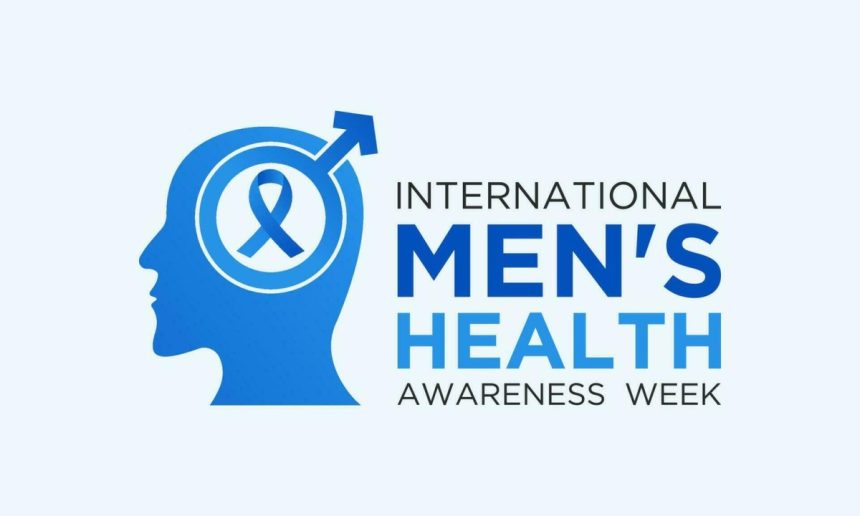
The 2026 Men’s Health Week ended today, Sunday, June 21, the same day Nigerians mark Father’s Day.
The convergence is not accidental. Men’s Health Week is observed globally every year in the week leading up to and including Father’s Day, with the aim of drawing attention to the health challenges men face and encouraging them to seek medical help.
EDITOR’S PICKS
In Nigeria, that message carries particular weight. Nigerian men are among the least likely in the world to visit a doctor until a condition has become critical, arriving at emergency wards with advanced organ failure or late-stage disease, having managed symptoms for months or years. Economic pressure, physical and occupational stress, and a cultural reluctance to show vulnerability are well-documented drivers of this pattern.
To mark the occasion, EKO HOT BLOG spoke with Ayokunle Badmus, a Nigerian musculoskeletal physiotherapist based in the United Kingdom (UK), on what Nigerian fathers can do, within real constraints of time, money, and access, to protect their health.
Water first
Dehydration compounds fatigue, strains kidney function, and impairs circulation, problems that are invisible until they are not. In Nigeria’s heat, the standard adult recommendation of 1.5 to 2 litres of water per day is a starting point. “You can’t go wrong, you can never go wrong with water,” he says.
Move deliberately, not just frantically
For men doing physical labour, the instinct is to count work as exercise. Badmus says that is a mistake. “There’s a difference between stress and exercise,” he says.
A short leisure walk after the day’s work lowers stress hormones and supports cardiovascular health in ways that labour cannot. For men at home, he recommends squats, spot jogging, skipping ropes, and makeshift weights. “You can do a squat in the home,” he says. “It doesn’t have to be a barbell.”
Fix the diet where you can
Badmus acknowledges that rising food costs have squeezed Nigerian households. He is not asking for a diet overhaul. “If one can take oranges with whatever one takes, or carrots, that would be great,” he says. Affordable fruits provide micronutrients the body draws on daily for immune function and cell repair, small additions with meaningful returns.

Sleep is not optional
Rest is where the body recovers. Badmus describes it plainly: “You shut down and restart it, and you feel refreshed again.” Adults need six to eight hours. Men who consistently sleep less accumulate fatigue that the body eventually collects as chronic illness. Hormonal disruption, weakened immunity, and cardiovascular strain are all downstream effects of sustained sleep deprivation.
Check your blood pressure
Hypertension is silent until it is catastrophic. Badmus recommends monthly blood pressure checks for all men, using the affordable electronic monitors available in most Nigerian pharmacies. His message sharpens with age: “The moment you clock 40, try and make it a habit. If you are beyond 50, don’t joke with it.”
Take mental health seriously
Badmus is direct about the relationship between mind and body. “If your mental health is not great, the body just feels tired the moment the mind is tired,” he says. Socialising — at church, a mosque, or simply with friends — is a clinically meaningful intervention. It lowers stress hormones and improves cardiovascular outcomes. It also costs nothing.
Cut alcohol and cigarettes
Both are more destructive than most men treat them. “Smoking is entirely terrible for your physical health — for your lungs, for your physique, for your cardiovascular health,” Badmus says. Alcohol disrupts sleep quality and stresses the liver progressively. Reducing either, or stopping entirely, is among the highest-return health decisions a man can make.
Know your body’s warning signs
Badmus lists the red flags no man should walk off: persistent headaches that do not respond to medication; sustained elevated blood pressure; body pain that does not ease with rest; numbness or tingling in the limbs; changes in bowel or bladder function; recurring fever; and unexplained weight loss. Each one is the body asking to be heard. “Please be sensitive as men,” he says. “Be sensitive to your own body.”
FURTHER READING
The instruction that ties everything together, Badmus says, is the simplest and the most ignored: “Please see a doctor when you notice a change in your body.” Not when it becomes unbearable.
Philip Ibitoye is a Special Correspondent with EKO HOT BLOG. Click here to find daily analysis and critical insight on trending issues in Lagos and other parts of Nigeria.
Click to watch the video of the week below: