- Iran’s Islamic Revolutionary Guard Corps has officially claimed responsibility for a series of coordinated missile and drone strikes targeting strategic United States military installations located within Kuwait and Bahrain.
- The targeted installations include the prominent Ali al-Salem air base in Kuwait and the highly critical U.S. Fifth Fleet naval headquarters situated at Port Salman in Bahrain, which serves as the core of American naval operations in the region.
- Preliminary tactical reports released by defense officials indicate that while air defense systems were heavily engaged during the cross-border assault, there are currently no reported American casualties or major structural damages at either deployment site.
The fragile security architecture of the Middle East has slid deeper into a volatile confrontational phase following an official announcement by Iran’s Islamic Revolutionary Guard Corps on Sunday confirming it launched direct military strikes against multiple United States military bases in Kuwait and Bahrain.
Eko Hot Blog reports that according to an official communique broadcast across Iranian state networks, the joint missile and drone operations were executed in direct retaliation for recent American aerial bombardments conducted on Iranian coastal positions.
EDITOR’S PICK
- Hamzat Appoints Obanikoro as Campaign DG Ahead of 2027 Lagos Governorship Race
- Tinubu’s State Police Plan Gains Momentum as Amendment Looms
- Residents Raise Alarm After Two Bodies Found in Lagos Waterway
The high-stakes military maneuver represents a significant breaking point in regional stability, threatening to completely dissolve the fragile interim ceasefire agreement that had previously been brokered between Washington and Tehran.
In a strongly worded statement detailing the operational objectives, the Revolutionary Guards asserted that their aerospace and naval forces successfully targeted and neutralized eight vital American military installations.
The strikes specifically zeroed in on the expansive Ali al-Salem air base in Kuwait and the deeply strategic U.S. Fifth Fleet naval installation located at Port Salman in Bahrain.
Iranian military commanders framed the aggressive cross-border operation as a defensive response to what they labeled as continued American aggression on their sovereign territory, warning that any further deployment of force or military provocation by Western allies would be met with an immediate and crushing response that would expand across the entire Gulf region.
Despite the highly alarming rhetoric emerging from Tehran, initial battlefield damage assessments provide a less severe picture of the immediate tactical impact.
United States defense officials speaking anonymously confirmed that while regional air defense systems were actively deployed to intercept incoming hostile targets, there are currently no reported casualties among American service personnel.
Furthermore, initial assessments indicate no major infrastructure damage or significant operational impacts at either the Kuwaiti airfield or the Bahraini naval headquarters.
Local military authorities in Kuwait confirmed that their domestic air defense units actively engaged multiple hostile drones and incoming projectiles, urging the public to remain calm and closely adhere to safety protocols.
Simultaneously, warning sirens were activated across parts of Bahrain as defensive measures were accelerated to guard against subsequent waves of aerial attacks.
This latest round of direct military friction comes on the heels of intense multi-day skirmishes near the vital Strait of Hormuz, which has once again transformed into a dangerous geopolitical flashpoint.
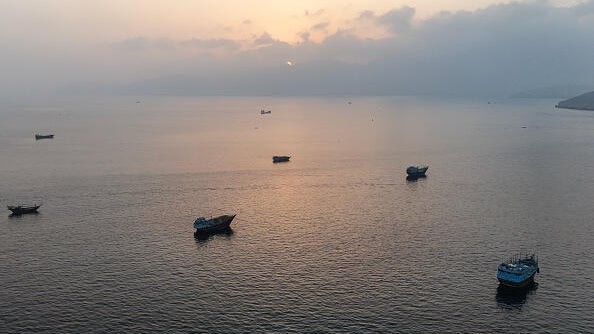
The United States military had previously launched a wave of retaliatory airstrikes targeting Iranian drone storehouses, surveillance infrastructure, and coastal radar installations following an alleged drone strike on a Panama-flagged commercial oil tanker transiting the strategic shipping corridor.
With both global superpowers now trading direct military blows and accusing one another of violating the terms of the mid-June Islamabad Memorandum of Understanding, diplomatic channels are rapidly locking up.
As the Revolutionary Guards tighten their maritime traffic controls around the Persian Gulf, international community observers fear that this sudden breakdown in deterrence could inadvertently trigger a full-scale, uncontainable regional conflict involving multiple neighboring Gulf states.