- Local resident Joel Lonza Makumbu detailed the brutal reality of the current Ebola outbreak in Bunia, burying his mother just 24 hours after laying his father to rest, alongside four other close relatives.
- World Health Organization experts and anthropologists are working closely with mourning communities to replace traditional, fluid-heavy funeral practices with virus-safe protocols without stripping families of their dignity.
- To respect local ancestral beliefs and provide comfort, humanitarian teams are deploying modified, transparent coffins and clear-view body bags so families can physically see their deceased loved ones before burial.
The Nyamurongo cemetery in Bunia, a city located in the northeastern province of Ituri within the Democratic Republic of Congo, is witnessing an unprecedented influx of fresh graves as the area grapples with a severe outbreak of Ebola.
Driven by the rare Bundibugyo species of the virus, which exhibits a mortality rate of approximately 25 percent, Eko Hot Blog reports that health officials are facing the dual challenge of stopping rapid transmission and managing widespread misinformation.
EDITOR’S PICK
- Hamzat Appoints Obanikoro as Campaign DG Ahead of 2027 Lagos Governorship Race
- Tinubu’s State Police Plan Gains Momentum as Amendment Looms
- Residents Raise Alarm After Two Bodies Found in Lagos Waterway
For residents like Joel Lonza Makumbu, who has visited the cemetery six times in a matter of weeks to bury his father, mother, three sisters, and a brother-in-law, the tragedy is an undeniable reality he is desperate to make his community understand.
Because the virus spreads aggressively through direct contact with infected bodily fluids, including blood, sweat, and secretions, standard burial practices have been completely halted.
Traditionally, communities in Ituri engage in elaborate multi-day funeral rites where family members wash, dress, and apply makeup to the deceased, particularly pregnant women or brides, to ensure they look their best as they transition into the world of the ancestors.
However, to prevent catastrophic outbreaks driven by post-mortem fluid contact, the World Health Organization (WHO) and the International Federation of Red Cross and Red Crescent Societies (IFRC) have mandated that victims must be immediately sealed into leak-proof body bags.
To balance strict infection controls with deep communal grief, public health coordinators have introduced creative, culturally conscious modifications to the safety equipment.
The IFRC is currently utilizing specialized coffins fitted with transparent glass panels on the sides, alongside body bags featuring clear film over the face, allowing relatives to view their loved ones from a safe distance before final interments.
UN anthropologists, including Julienne Anoko, play an invaluable role by using their extensive knowledge of local folklore to gently negotiate with grieving families, helping them accept these highly distressing modifications by reframing safety as a form of ancestral protection.
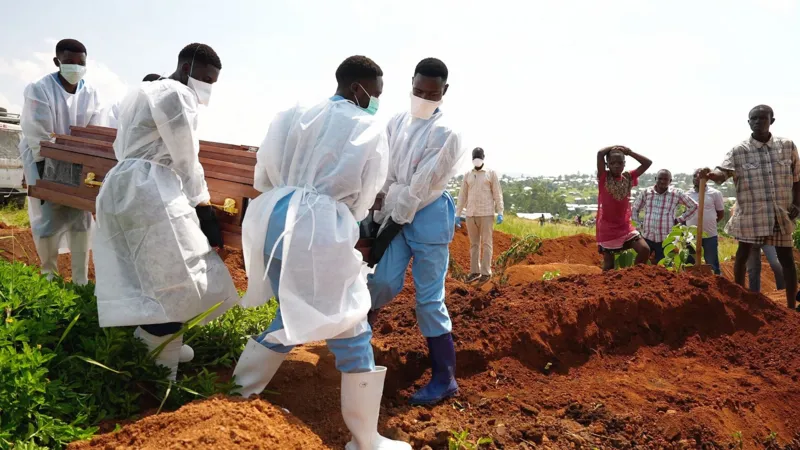
The logistical process of these safe burials is a tense, highly structured operation designed to isolate the pathogen at every step.
At the Bunia General Reference Hospital, medical personnel encapsulated in heavy, personal protective equipment (PPE) prepare and seal the deceased in a designated transit zone before transferring the coffin to dedicated IFRC transport teams.
At the graveside, the entire burial is completed in under ten minutes by a small group of volunteers, avoiding the massive, singing crowds typical of Congolese funerals.
While medical aid organizations have donated tens of thousands of pounds to bolster the local supply of protective gear, local workers warn that the crisis will persist until the gap between community tradition and epidemiological science is completely bridged.