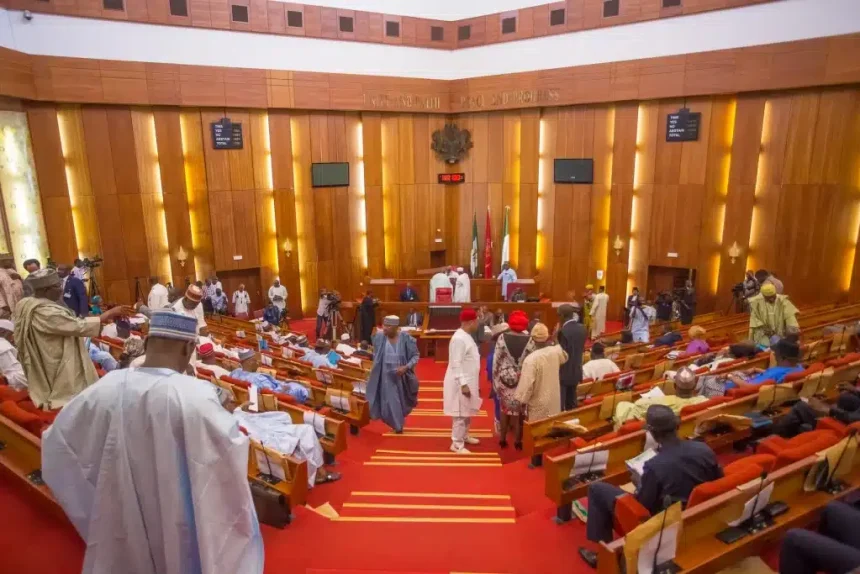
The Senate has begun debate on a landmark amendment to the Banks and Other Financial Institutions Act (BOFIA) 2020 seeking to give the Central Bank of Nigeria (CBN) expanded powers to designate and supervise non-bank financial institutions.
At the heart of the proposal is a national conversation about how far fintechs should go without being brought under stricter regulatory control, especially as they now serve tens of millions of Nigerians and process volumes that rival mid-tier banks.
EDITOR’S PICKS
Lawmakers argue that as fintechs — mobile money operators, payment service banks, digital lenders, wallet providers and switching companies — become central to daily commerce, they also pose risks previously associated only with conventional banks.
The big question is whether the Senate’s new move is timely enough, or whether it signals a regulatory overcorrection.
A Rapidly Changing Financial System and an Outdated Framework
Sponsor of the bill, Tokunbo Abiru, who chairs the Senate Committee on Banking, Insurance and Other Financial Institutions, described the amendment as an urgent response to Nigeria’s evolving financial landscape. Fintechs, he said, now hold vast amounts of sensitive data and facilitate transactions at a scale that the current regulatory framework has not fully accounted for.
“The reality today is that a non-bank institution, because of its market dominance, data concentration, customer reach or technological capacity, may pose risks equal to or even greater than those posed by a traditional bank,” Abiru warned.
That warning calls back to April 2024, when the CBN temporarily halted onboarding by major fintechs over KYC breaches, suspicious transactions and money-laundering concerns — a move that exposed how rapidly the sector had outgrown existing tools.
Abiru argues that leaving these institutions outside the highest tier of statutory oversight leaves the system vulnerable to data insecurity, foreign control of critical infrastructure, and even national-security risks. Many operate on foreign-owned networks and offshore servers, making it difficult for regulators to know where financial and behavioural data is stored or who can access it.
New Powers for CBN: A Necessary Step or Overreach?
The bill proposes five broad reforms: creating a statutory framework to designate systemically important fintechs, establishing a national registry for traceability, empowering the CBN to impose enhanced supervision, strengthening data sovereignty and improving consumer protection.
Abiru dismissed suggestions for a standalone fintech regulator, arguing that oversight of payments, systemic-risk monitoring and prudential supervision already sit naturally with the CBN.
“International best practice overwhelmingly favours integrating fintech oversight within existing regulators, not creating new bureaucracies,” he said.
For some lawmakers, the case for tougher regulation is personal.
Senator Adams Oshiomhole told the chamber that his bank accounts were hacked through a fintech platform, raising concerns about opaque ownership structures. “I know the directors of our regular banks, but I can’t say the same of these fintech banks; I don’t know the directors of MoniePoint, Opay and all others,” he said, urging that online institutions be held to the same standard of accountability as traditional banks.
The Senate also fears that some large fintechs, because of their scale, market dominance and control of data, could eventually destabilise the economy if unsupervised. But over-regulation could also stifle growth of fintechs.
Impact on Digital Workers and the Wider Economy
Beyond systemic risk, the debate also touched on global inequalities affecting Nigeria’s digital workforce.
Senator Natasha Akpoti-Uduaghan cited “huge discrepancies” in earnings for Nigerian content creators, who sometimes get as low as 50 cents per 1,000 views, compared with $10–$30 for creators in the US. She argued that regulation must also consider the economic realities of young Nigerians whose livelihoods depend on global platforms.
Ultimately, the presiding deputy Senate president, Barau Jibril, referred the bill to the Senate Committee on Banking for further legislative work after it scaled second reading.
FURTHER READING
The political momentum signals that the proposal is likely to advance, but its success will depend on balancing consumer protection with innovation. For now, the Senate appears convinced that the risks of a largely unregulated digital financial space outweigh fears of stifling growth. Whether the amendment will modernise oversight without slowing Nigeria’s fintech success story will be the true test when the bill returns for final consideration.
Philip Ibitoye is a Special Correspondent with EKO HOT BLOG. Click here to find daily analysis and critical insight on trending issues in Lagos and other parts of Nigeria.
Click here to watch the video of the week below: