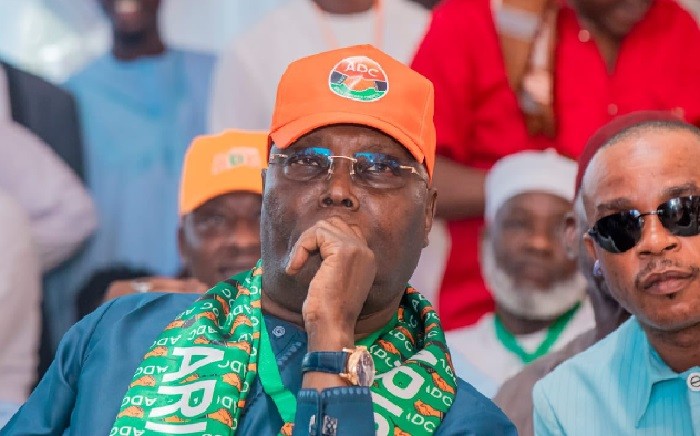
Former Vice-President Atiku Abubakar says he will pursue a constitutional amendment to establish rotational presidency if elected president in 2027.
Speaking on Arise Television’s Prime Time on Wednesday, he declared that the arrangement would provide the most equitable framework for power-sharing in Nigeria and admitted he regretted blocking a similar proposal decades ago.
During the constitutional conference, late Alex Ekueme proposed a rotational presidency, but I opposed it, and Ekueme's proposal didn't go through because we had the majority (70%) of the delegates then. When Alex Ekueme died, I attended his burial, and I admitted that I should… https://t.co/U2s4YdoCkr pic.twitter.com/TzDijvX5Hw
— Nigerian Affairs Journal (@NigAffairs) April 15, 2026
EDITOR’S PICKS
Many political observers see it as a commendable position. But it was also a curious one, given his own record.
A Convenient Conversion
Atiku acknowledged that he opposed the late Alex Ekwueme’s push for constitutional rotational presidency during earlier national debates. “In hindsight,” he said, “I admitted that I made a mistake.”
In 2023, Atiku sought the presidency on the PDP platform, a party he himself acknowledged is the only one with a zoning clause in its constitution. That clause, at the time, pointed firmly to the South. Goodluck Jonathan had served out the North’s turn; Muhammadu Buhari had completed two full terms. The gentlemen’s agreement, however informal, was clear.
Yet Atiku contested, fractured the PDP’s southern coalition, and contributed directly to an outcome many in the South still view as a circumvention of the spirit of zoning. His 2023 candidacy was, in effect, the clearest possible argument against the very principle he now wants written into law.
The Arithmetic He Chose
On Wednesday, Atiku asked pointedly: “The South has governed for 18 years and the North for 10, so who is in the deficit?” It is a legitimate question in the abstract. But context matters enormously.
When he ran in 2023, Buhari, a Northerner, had just completed eight years in office. By any reasonable interpretation of rotational logic, that was a north-to-south handover moment. Atiku ran anyway.
Now, with Tinubu, a Southerner, barely four years into his first term, Atiku is running again. The very arithmetic he cites to justify rotation is the same arithmetic that indicts his 2023 decision and complicates his 2027 one.
If the South has governed longer, part of that tally exists precisely because Northern candidates, Atiku among them, contested cycles that were widely understood as Southern turns.
Principle or Positioning?
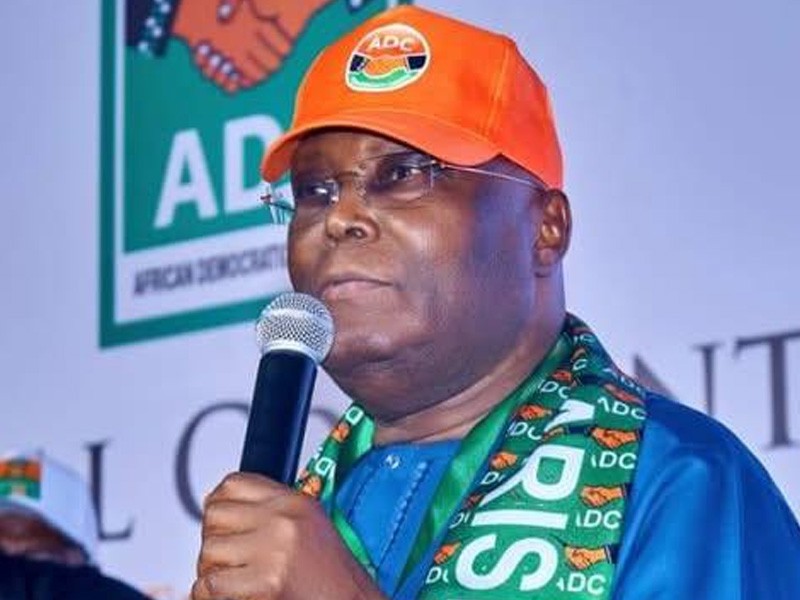
None of this is to say that constitutional rotational presidency is a bad idea. Many constitutional scholars and political watchers have long argued it is the most durable solution to Nigeria’s perennial power-sharing tensions. Atiku’s support for it, if translated into legislative action, could outlast any single administration.
But the value of a principle lies partly in the consistency with which it is applied. A man who blocked Ekwueme’s amendment, contested a cycle widely seen as the south’s turn, and now seeks to unseat a Southern president after only one term, carries a particular burden of proof when presenting himself as the face of equitable rotation.
The irony is not that Atiku is wrong about rotational presidency. He may well be right. The irony is that his own career has been among the more consequential arguments against trusting informal zoning arrangements and that his solution to that problem is to constitutionalise the very principle his ambitions have repeatedly tested.
FURTHER READING
Whether 2027 voters, North or South, see this as evolution or convenience may well shape how that election unfolds.
Philip Ibitoye is a Special Correspondent with EKO HOT BLOG. Click here to find daily analysis and critical insight on trending issues in Lagos and other parts of Nigeria.
Click to watch the video of the week below: