- Vice President Kashim Shettima has urged African nations to take control of their natural resources by ending raw material exports and establishing local processing hubs to maximize global trade value.
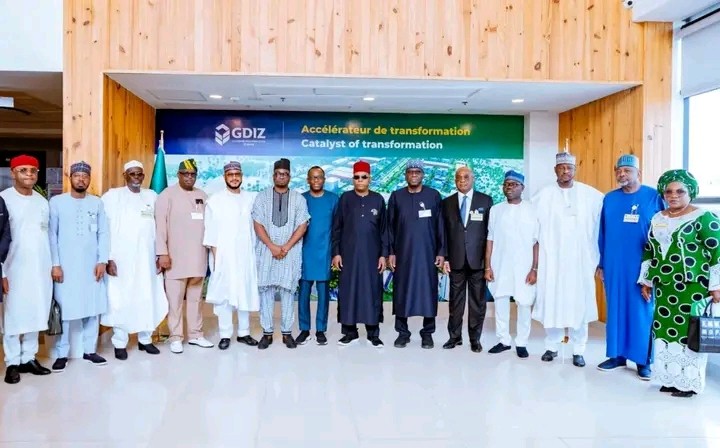
- Leading a delegation of six state governors, Shettima toured the Glo-Djigbé Industrial Zone (GDIZ) in Cotonou to study integrated processing models for cotton, cashew, and soya beans.
- Under President Bola Tinubu’s Renewed Hope Agenda, Nigeria plans to set up eight special agro-industrial processing zones using lessons drawn from Benin’s manufacturing ecosystem.
Vice President Kashim Shettima has called on African nations to take charge of their resources and secure a stronger position in global trade by transitioning from raw material exports to local value addition.
Eko Hot Blog reports that speaking in Cotonou, Republic of Benin, during an assessment tour of the Glo-Djigbé Industrial Zone (GDIZ), Shettima emphasized that the continent can no longer afford to export primary commodities while missing out on multi-billion-dollar processing industries.
EDITOR’S PICKS
- FG Partners With Chinese Investors To Secure Land For 10,000-Home Mass Housing Project
- Intelligence Materials Were Shared With US, Not Seized – DHQ
- Man Arraigned in Adamawa Over Alleged Abuse Involving Daughter
Accompanied by the governors of Kwara, Imo, Katsina, Plateau, Zamfara, and Jigawa states, as well as Minister of Agriculture Abubakar Kyari, the Vice President noted that Nigeria’s industrialization drive would extend across all regions through close collaboration between federal and subnational governments.
Inspecting cotton, textile, cashew, and soya bean oil production facilities across the 1,640-hectare industrial hub, Shettima expressed concern over Africa’s minimal share in global processing markets.
He highlighted that reviving Nigeria’s domestic textile value chain, linking local cotton farmers directly to ginneries and garment manufacturing, holds the potential to create millions of jobs, boost non-oil exports, and stimulate economic activity nationwide.
During the tour, Benin’s Minister of Tourism and Foreign Trade, Olushegun Adjadi Bakari, briefed the Nigerian delegation on GDIZ’s infrastructure, production capacity, and public-private partnership structure.
The delegation observed operations where raw cotton is spun into yarn, woven into fabric, and tailored into finished apparel for export.
Shettima reaffirmed that the Federal Government will leverage lessons from the Cotonou facility to advance its own Special Agro-Industrial Processing Zones (SAPZ) project.