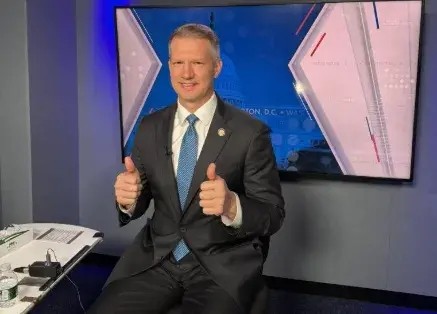
- United States Representative Riley Moore has strongly welcomed the Nigerian Senate’s historic passage of the Constitution Alteration Bill, stating that the decentralization of the nation’s security architecture will empower local authorities to adequately defend vulnerable communities.
- The American lawmaker, who represents West Virginia’s 2nd Congressional District, emphasized that establishing state-level law enforcement is a vital structural reform needed to address insecurity and curb targeted violence against persecuted Christians across the federation.
- While praising President Bola Ahmed Tinubu for throwing his political weight behind the decentralization policy, Moore reminded stakeholders that the amendment must still win ratification from at least two-thirds of the 36 State Houses of Assembly to officially become law.
A United States lawmaker, Representative Riley Moore, has formally lauded the Nigerian Senate following its landmark legislative passage of the Constitution Alteration Bill aimed at establishing state police forces across the country.
Eko Hot Blog reports that Moore asserted that the long-awaited security overhaul will drastically enable individual state governments to protect their own citizens, particularly vulnerable and persecuted Christian populations who have frequently faced targeted attacks by armed groups in rural regions.
EDITOR’S PICK
- Hamzat Appoints Obanikoro as Campaign DG Ahead of 2027 Lagos Governorship Race
- Tinubu’s State Police Plan Gains Momentum as Amendment Looms
- Residents Raise Alarm After Two Bodies Found in Lagos Waterway
The American congressman, who represents West Virginia’s 2nd Congressional District in the U.S. House of Representatives, shared his perspective via his official X handle on Wednesday.
His high-profile reaction came hours after a clear majority of federal lawmakers in the upper legislative chamber voted to support the bill through a manual division process, paving a clear constitutional path toward ending Nigeria’s decades-long reliance on an exclusively centralized federal policing framework.
Moore, who has previously raised international concerns regarding humanitarian issues and security deficits across West Africa, revealed that he has consistently pushed for this specific structural devolution in both diplomatic and private circles.
“I’m encouraged to see Nigeria’s Senate approve legislation to establish state-level police forces, a reform I’ve called for publicly and privately since I first started investigating the genocide against Christians in Nigeria,” the U.S. lawmaker stated, adding that reducing local dependence on executive decision-makers located far away in Abuja is an essential prerequisite to achieving absolute safety.
The proposed policing framework is structured to run concurrently alongside the existing Nigeria Police Force (NPF).
Under the newly passed guidelines, state governors will hold the statutory authority to appoint independent Commissioners of Police for their respective domains, subject to structural confirmation hearings before their state Houses of Assembly.
To calm widespread public anxiety over potential political manipulation by local executives, the bill integrates specific legal safeguards explicitly prohibiting the deployment of state security outfits against peaceful citizens or civil groups merely for criticizing a sitting state administration.
While giving notable credit to President Bola Tinubu for maintaining an active administrative push for the decentralized framework, Moore noted that the hard work is not yet finished.
Under Section 9 of the 1999 Constitution, the bill cannot be transmitted for executive assent until it is officially ratified by at least 24 of the 36 state parliaments.
Security experts across the country continue to monitor the legislative progression closely, viewing it as the most significant operational shift in Nigeria’s domestic defense strategy since the return to democratic governance.