- Tinubu Signals More Economic Reforms Ahead of Possible Second Term
- Says Naira Now More Stable and Predictable
- Says Painful Reforms Necessary for Nigeria’s Future
President Bola Ahmed Tinubu has indicated that his administration will continue with ongoing economic reforms ahead of a possible second term, insisting that the difficult decisions already taken are beginning to stabilise Nigeria’s economy and create a foundation for long-term growth, Eko Hot Blog reports.
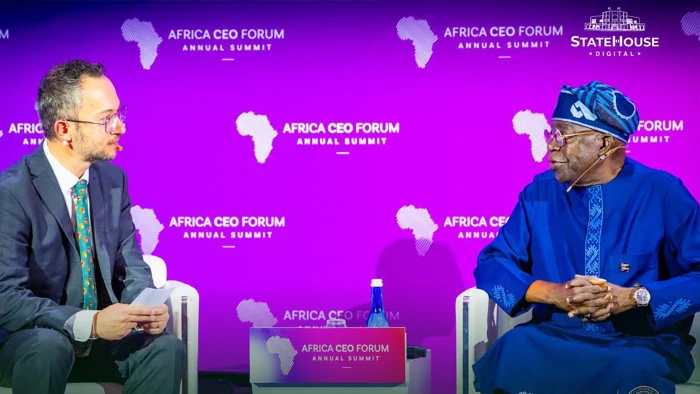
Speaking during an interview session at the Africa CEO Forum in Kigali, Rwanda, the President said his government remains committed to policies aimed at resetting the economy and improving governance despite the challenges involved.
EDITOR’S PICK
- Fresh Details Emerge on Death of Odomola Monarch, Oba Adebowale Adeshina
- Sanwo-Olu Applauds LASU’s Academic Excellence After JAMB Ranking
- NRC Moves 176,820 Tonnes Of Cargo Through Lagos Ports In Q1
Asked what his focus would be if re-elected, Tinubu replied, “Do more work. More challenges are there. The world won’t wait for anybody. You have to continue to reset and rethink, challenge our intellectual curiosity as a government.”
The President described decisive leadership as necessary for national development, stressing that leaders must be willing to take difficult decisions in the interest of the people even when such actions are unpopular.
According to him, the removal of fuel subsidy and the unification of the foreign exchange market were unavoidable steps needed to prevent deeper economic problems.
“It is a fake life to think you can continue a wasteful subsidy in a global economy. It encouraged corruption, falsification of documents and smuggling,” Tinubu said.
He recalled that before the reforms were introduced, many state governments struggled to pay workers’ salaries and meet financial obligations.
“Out of 36 states, 27 could not pay salaries. We are an oil-producing country, yet our refineries were not functioning. That trend could not continue,” he stated.
While acknowledging the hardship experienced by Nigerians following the reforms, Tinubu compared the situation to the pains of childbirth, saying the country would eventually reap the benefits.
“It is painful, but just like labour before childbirth, there will be joy at the end,” he added.
The President also defended taxation as an important tool for development, noting that citizens demanding quality infrastructure and public services must be willing to contribute through taxes.
“Nobody wants to pay taxes ordinarily, but development must be funded,” he said.
Tinubu maintained that the reforms were already producing positive results, claiming that the economy and the naira had become more stable and predictable.
“Today, there is light at the end of the tunnel. The economy is stable, the naira is stable and predictable. People can now plan better,” he said.
He further disclosed that the government had expanded direct cash transfers to vulnerable Nigerians while supporting indigent students with grants and allowances.
The President also reaffirmed support for indigenous industries capable of creating jobs and reducing import dependence, citing the Dangote Refinery and BUA Group as examples of local businesses deserving government backing.
According to him, the administration approved the sale of crude oil to the Dangote Refinery in naira to ease operational challenges and reduce pressure on foreign exchange demand.
Tinubu equally defended the Lagos-Calabar Coastal Highway project, describing it as part of efforts to strengthen national integration, improve tourism and attract investment opportunities.
“My philosophy is Nigeria first,” he declared.
Speaking on national unity, the President urged Nigerians to see the country’s diversity as a strength rather than a source of division.
“This country is ours. We must build it together,” he said.
He also stressed the importance of regional cooperation and diplomacy, noting that Nigeria remains a major force within ECOWAS and across Africa.