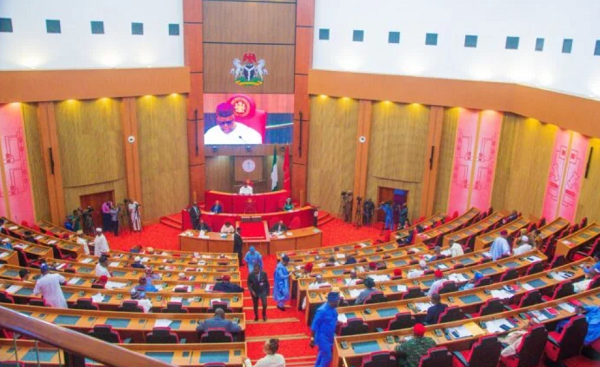
The ruling All Progressives Congress (APC) has tightened its grip on the National Assembly, securing a powerful two-thirds majority in the Senate — a milestone that could reshape legislative politics and policymaking in Nigeria.
The development followed the defection of Senator Samaila Kila, who represents Bauchi North Senatorial District, from the opposition Peoples Democratic Party (PDP) to the APC. His defection was formally announced in a letter read by Senate President Godswill Akpabio during Tuesday’s plenary.
EDITOR’S PICKS
With Kila’s move, the APC now controls 73 out of the 109 seats in the upper chamber — exactly the two-thirds majority prescribed by the Constitution for passing certain critical laws and resolutions. The PDP now holds 27 seats, the Labour Party (LP) has four, while the All Progressives Grand Alliance (APGA) and the Social Democratic Party (SDP) have two each. The New Nigeria Peoples Party (NNPP) retains one seat.
This marks the first time since 2015, when the APC came to power, that it has achieved a two-thirds supermajority in the Senate — a threshold that allows the ruling party to push through key legislation or policies with minimal resistance from the opposition.
EKO HOT BLOG breaks down what that means.
What a Two-Thirds Majority Means
In Nigeria’s 109-member Senate, a two-thirds majority equals 73 votes. This figure is not arbitrary; it is explicitly referenced in several sections of the 1999 Constitution (as amended) as the voting requirement for major constitutional and political decisions.
Ordinary bills can be passed by a simple majority — that is, more votes for than against — but constitutional amendments, presidential veto overrides, and impeachments require a higher bar of two-thirds support.
What APC Senators Can Now Do
With their new numerical strength, APC senators are now in a stronger position to influence the direction of national policy and governance. Here are some of the key powers that a two-thirds majority enables them to exercise under the Constitution:
1. Amend the Constitution
Section 9(2) of the 1999 Constitution states that any amendment must be approved by at least two-thirds of all members of each House of the National Assembly, and by resolutions of not less than two-thirds of all State Houses of Assembly.
Having the required number in the Senate gives the APC a clear advantage in initiating constitutional changes, though success still depends on support from the House of Representatives and state assemblies.

2. Override a Presidential Veto
If the President withholds assent to a bill, the National Assembly can override the veto by re-passing the bill with a two-thirds majority in both chambers. This means the Senate alone cannot make a vetoed bill become law, but APC senators can now easily fulfill their part of that requirement.
3. Approve Impeachment Proceedings Against the President or Vice President
Sections 143 of the Constitution stipulate that removing a sitting President or Vice President requires the backing of two-thirds of all senators and representatives. While this is a drastic measure rarely used, the APC’s Senate majority makes such a process procedurally feasible from the upper chamber’s side.
4. Approve Constitutional Actions Like State Creation or Boundary Adjustments
Section 8 provides that proposals to create new states or alter boundaries must pass each chamber by at least two-thirds. APC’s majority now gives it an easier path in the Senate if such sensitive matters arise.
5. Remove Certain Office Holders
For specific federal officials — such as members of the Code of Conduct Tribunal — their removal requires a resolution of both chambers supported by not less than two-thirds of all members.
What APC Senators Cannot Do Alone
The Senate’s two-thirds strength does not extend to powers belonging exclusively to the states or requiring joint votes with the House of Representatives.
For instance, the removal of a state governor falls strictly under Section 188, which gives the power only to the State House of Assembly, not to the National Assembly.
Similarly, for constitutional amendments, impeachment of the President, or overriding a presidential veto, the House of Representatives must also meet the same two-thirds threshold.
Why It Matters
The APC’s Senate dominance means smoother passage of executive bills, fewer procedural bottlenecks, and stronger control of the legislative agenda. It also limits the opposition’s ability to block or delay government policies through coordinated voting.
FURTHER READING
The Catch
However, note that to do those things, APC needs two-thirds majority in the House of Representatives as well. Even though they are close to it, they don’t currently have it.
Philip Ibitoye is a Special Correspondent with EKO HOT BLOG. Click here to find daily analysis and critical insight on trending issues in Lagos and other parts of Nigeria.
Click here to watch the video of the week below: