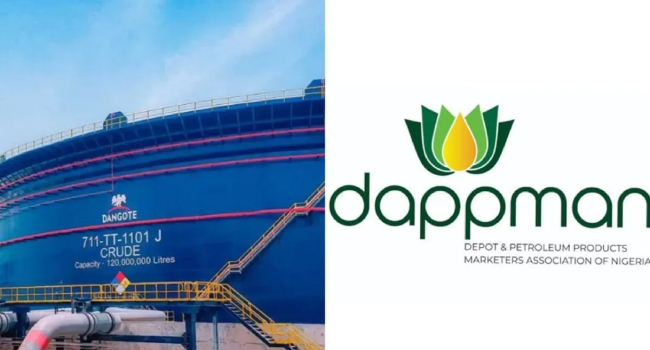
The Depot and Petroleum Products Marketers Association of Nigeria (DAPPMAN) says its members did not demand an annual subsidy of ₦1.5 trillion from the Dangote Petroleum Refinery.
Speaking during Channels Television’s Sunrise Daily on Wednesday, the association’s spokesperson, Nkem Ohia, dismissed the refinery’s claims, describing them as “completely ridiculous.”
EDITOR’S PICKS
He stressed that what marketers want is not subsidy but partnership, particularly in wholesale lifting of products in bulk quantities. “We are not asking for anything like a subsidy,” he said. “We went into negotiations and are still in negotiations with him to see whether he can bridge that gap.”
Beyond Subsidy Politics
EKO HOT BLOG reports that the flare-up over the alleged subsidy demand highlights how sensitive Nigeria’s downstream petroleum sector has become since the 650,000-barrels-per-day Dangote Refinery began operations. For decades, marketers relied on imports through multiple sources. Now, with a single dominant supplier, every pricing dispute carries wider national implications.
But framing the issue as a subsidy war is misleading. What marketers are pushing for is access to products in bulk—using vessels of at least 30,000 metric tonnes—rather than being treated like retail buyers at the refinery’s gantry.
The business case is simple: large-scale lifting allows marketers to distribute products faster and more efficiently, reducing costs across the supply chain. For Dangote, it ensures steady evacuation of refined products, freeing space for continuous crude intake and refining.
A Clash of Business Models
Dangote’s current strategy favours working with a limited circle of distributors, a model the company believes guarantees control and stability in the early stages of production. DAPPMAN, however, views this as unnecessarily restrictive, arguing that broader participation would speed up market penetration and prevent accusations of monopolistic control.

This friction mirrors the refinery’s separate clash with the National Union of Petroleum and Natural Gas Workers (NUPENG) over union rights for CNG truck drivers. Both disputes point to a common theme: Nigeria’s most ambitious private investment is testing the balance between corporate control and the wider ecosystem of workers, marketers, and consumers.
Why Collaboration Is a Win-Win
For marketers, partnership with Dangote means access to bulk supplies, better margins, and business continuity in a post-import era. It would also prevent a few players from dominating distribution channels, thereby protecting jobs and sustaining the thousands of independent filling stations that depend on DAPPMAN members.
For Dangote Refinery, collaboration reduces operational risks. Relying on a small number of offtakers can slow evacuation, tie down working capital, and expose the refinery to accusations of hoarding or price manipulation. A broader distribution network makes the refinery’s operations more resilient and eases public perception that one private player is controlling Nigeria’s entire fuel economy.
For Nigeria, cooperation ensures smoother supply, reduces the likelihood of scarcity-induced price spikes, and creates a transparent environment where multiple stakeholders share responsibility for energy security.
The Road Ahead
Nigeria’s downstream sector is in transition. Subsidy removal, refinery revival efforts, and the Dangote plant’s dominance all intersect in a highly charged environment. Instead of trading accusations, marketers and Dangote need to embrace an open-door policy that prioritises efficiency, transparency, and national interest.
FURTHER READING
As DAPPMAN rightly pointed out, this is not about subsidy but about building a collaborative structure. In the end, it is only through partnership, not rivalry, that the refinery can meet its ambitious targets and marketers can safeguard their relevance in the new energy landscape.
Philip Ibitoye is a Special Correspondent with EKO HOT BLOG. Click here to find daily analysis and critical insight on trending issues in Lagos and other parts of Nigeria.
Click here to watch the video of the week below: