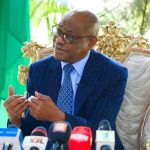
When World Trade Organisation (WTO) director-general Ngozi Okonjo-Iweala said on Thursday that President Bola Tinubu deserved credit for stabilising Nigeria’s economy, her remarks stirred debate.
Many Nigerians quickly asked: if the economy is stable, why are families still struggling to buy food, pay rent, and afford transport?
EDITOR’S PICKS
Yemi Kale, former statistician-general of the National Bureau of Statistics (NBS) and now chief economist at the African Export-Import Bank (Afreximbank), stepped in on Saturday to clarify the difference between economic stability and citizens’ daily hardship.
EKO HOT BLOG dissects Kale’s explanation to unpack why both realities can exist at the same time.
What Economists Mean by “Stability”
Kale explained that when economists say an economy is stable, they are referring to a period when major disruptions or fluctuations have eased.
“When economists say ‘an economy is now stable,’ they usually mean that the economy has reached a point where it is no longer experiencing major fluctuations or disruptions,” he said.
This kind of stability shows up in macroeconomic indicators—such as inflation, exchange rates, and GDP growth—which are no longer swinging wildly. For example, if inflation drops from 25 percent to 12 percent and stays steady, economists may call that stability.
“In practical terms, it suggests macroeconomic indicators are steady; predictability and confidence where businesses, investors, and consumers feel more confident making long-term plans and there are no immediate crisis,” Kale added.
Stability does not eliminate hardship
But Kale was quick to point out that stability does not mean citizens suddenly stop struggling. Prices may remain very high compared to previous years, even if inflation is no longer climbing at the same rate.
“However, prices may still be very high compared to past years, meaning people continue to struggle,” he explained. “Citizens experience the economy differently through cost of food, housing, transport, healthcare, and wages.”

Even in a “stable” economy, families can still face enormous hardship if wages remain low and essential goods unaffordable. Stability, Kale stressed, might only mean the situation is not getting worse quickly, not that it has improved enough to ease daily struggles.
Why Investors Feel Stability Before Citizens
Another key part of Kale’s explanation is the lag effect of reforms. Economic stability, he said, tends to benefit investors and businesses first.
“Investors and businesses might start posting great results,” he noted. “It can take months or even years before stability eases hardship and translates into job creation, higher wages, or cheaper goods for citizens—assuming the stability holds long enough.”
This time gap explains why the stock market or foreign investment figures may improve while ordinary Nigerians still feel little relief.
Stability as the “First Step”
Kale described stability as a necessary but insufficient step toward easing hardship.
“So both stability which is good can coexist with hardship which is bad for several reasons: After a crisis, stability may mean the bleeding has stopped. But citizens may still be hurting from the high cost of living established during the crisis,” he said.
Using a vivid metaphor, he compared the economy to a boat:
“Economic stability is like stopping a boat from rocking wildly but hardships persist if the boat is still far from shore. For citizens, stability may only mean less new hardship is being added, not that life has become easier yet. But the first step to reversing hardship is stability and stopping the bleed. It’s a necessary not sufficient condition.”
A Technical, Not Political, Clarification
Kale was careful to emphasise that his intervention was strictly technical and not political. By breaking down the meaning of stability, he highlighted the gap between macroeconomic improvements and lived experiences.
FURTHER READING
In summary, Nigeria’s economy may indeed be stabilising in technical terms—exchange rates are less volatile, inflation is moderating, and investor confidence is slowly returning. But for citizens, hardship remains the dominant reality until stability translates into cheaper goods, better wages, and improved living standards.
Philip Ibitoye is a Special Correspondent with EKO HOT BLOG. Click here to find daily analysis and critical insight on trending issues in Lagos and other parts of Nigeria.
Click here to watch the video of the week below: