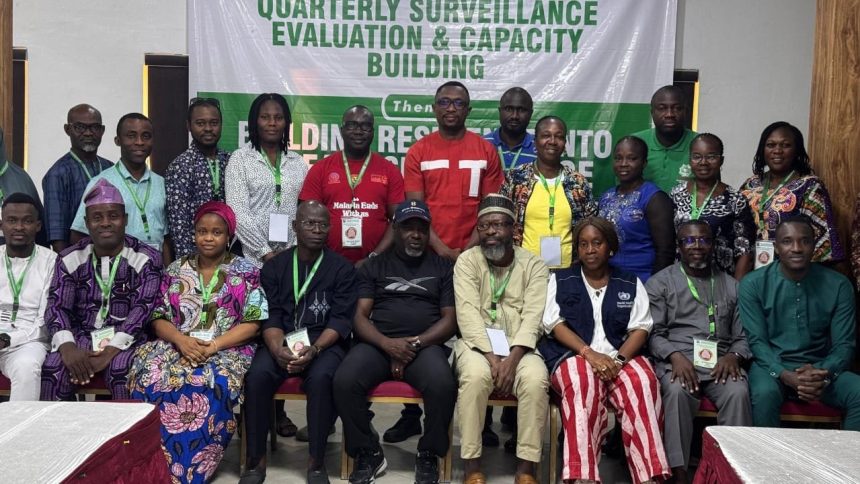
Last week, in a well-lit conference room at the Orchid Hotel in Lekki, 86 Disease Surveillance Notification Officers (DSNOs) gathered for what could be described as a workshop and a critical mission briefing.
Over four days, these public health workers, drawn from across Lagos State, immersed themselves in practical sessions, peer learning, and deep reflection.
- Last week, in a well-lit conference room at the Orchid Hotel in Lekki, 86 Disease Surveillance Notification Officers (DSNOs) gathered for what could be described as a workshop and a critical mission briefing.
- EDITOR’S PICKS
- Late-Night Exam: Why Did WAEC Punish Students for Its Own Failure?
- After Decades of Pollution, Relief in Sight for Communities Near Olusosun Dumpsite
- ANALYSIS: What Moody’s Upgrade of Nigeria’s Credit Rating Means for Economy
- A Lifesaving Duty, Not Just a Job
- Bridging the Gap Between the Field and the Lab
EDITOR’S PICKS
The theme, “Building Resilience into Disease Surveillance Practices in Lagos State”, spoke to the gravity of their task: identifying, reporting, and responding to disease threats before they spiral out of control.
In June 2024, the state government declared a cholera outbreak when 436 suspected cases were reported. Six days later, there were more than 500 suspected and 43 confirmed cases, with a 5.4% case fatality rate among the suspected cases reported.
For a megacity of over 20 million people, the latest cholera shows that the margin for error in public health surveillance is razor-thin. And the Lagos government says it is determined to narrow that margin further.
A Lifesaving Duty, Not Just a Job
Addressing the disease surveillance officers at the closing session, Dr Olusegun Ogboye, Permanent Secretary at the Lagos State Ministry of Health, charged them to treat their role as a lifesaving mission.
“If you don’t detect early, if you don’t report promptly, if you don’t investigate thoroughly, the disease could spread beyond our control,” he warned.
Dr Ogboye acknowledged the participants’ dedication but stressed that vigilance must go hand in hand with speed and accuracy. He decried the troubling trend of alerts reaching the ministry via unofficial channels and called for a more responsive, streamlined surveillance network.
“You are not just working for your LGA or institution. You are contributing to the health security of the entire state and, by extension, the nation,” he said.
The message was reinforced by Dr Ismail Abdus-Salam, Director of Epidemiology, Biosecurity and Global Health, who noted that Lagos remains on a cholera alert and cannot afford delays or gaps in reporting.
“We want DSNOs not just collecting data, but asking: Why are certain areas silent? Are we underreporting?” Abdus-Salam charged.

Participants were trained in practical tools (Excel, QGIS, situational awareness dashboards) and tested through simulations of real-world outbreaks. But just as important was the mindset shift: from routine record-keeping to proactive, data-informed problem-solving.
Bridging the Gap Between the Field and the Lab
Dr Bamidele Mutiu, Director of the Lagos Biobank, underscored the critical role DSNOs play in ensuring laboratory accuracy. In his session on specimen collection and transport logistics, he stressed that even the best laboratories are only as good as the samples they receive.
“Every specimen is a potential biohazard,” he said. “A mislabelled or poorly stored sample could lead to misdiagnosis or delayed response during outbreaks.”
From PPE protocols to proper packaging and temperature controls, participants learned the meticulous process of ensuring sample integrity. “DSNOs are the bridge between field surveillance and laboratory confirmation,” Dr Mutiu emphasised.
In a similarly technical session, Dr Modinat Akiolu of the Lagos State Primary Health Care Board trained officers on the surveillance of Adverse Events Following Immunisation (AEFI). She highlighted frequent documentation errors that affect case tracking and called for stronger collaboration between DSNOs and Local Immunisation Officers.
“AEFI data must be detailed, timely, and reliable to ensure public trust and effective intervention,” she said.
The call for community engagement ran through the entire retreat. DSNOs were encouraged to involve MOHs, local informants, and even caregivers in building a culture of health vigilance.
A Network of People, Not Just a System
For Mr Akindele Abdulsalam, DSNO for Alimosho LGA and Chairman of the Local Government DSNOs Forum, the workshop offered more than skills; it fostered solidarity.
“This is our first review meeting for the year, and we had practical sessions, tabletop scenarios, and peer learning that deepened our understanding,” he said. “It wasn’t just theoretical; we saw how inter-pillar coordination improves real-time outbreak response.”
Indeed, the Lagos disease surveillance system is only as strong as its people. While digital tools, predictive analytics, and laboratory capabilities are vital, it is the eyes, ears, and judgement of officers in the field that will determine how fast, and how well, the state can respond to the next threat.
FURTHER READING
Because in Lagos, where population density, urban mobility, and environmental risks converge, disease does not wait. But now, neither will the response, according to the state government.
Watch Our Video Of The Week