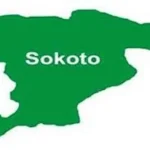
The United States Africa Command (AFRICOM) has issued two differing public statements on a recent US air strike against Islamic State (ISIS) fighters in Nigeria, specifically in Sokoto State.
The conflicting statements have raised questions about the chain of authority behind the operation and the diplomatic sensitivities surrounding US military action on Nigerian soil.
EDITOR’S PICKS
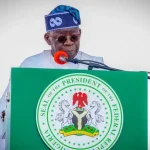
The strike was first announced by US President Donald Trump, who said on his Truth Social platform that he ordered the operation as commander in chief. Trump described the attack as a “powerful and deadly strike” against ISIS fighters, whom he accused of killing Christians, and framed the action as the fulfilment of earlier threats he had made if such violence did not stop.
🚨NEW from President Trump: pic.twitter.com/U4J5yv5MF4
— Karoline Leavitt (@PressSec) December 25, 2025
Shortly after Trump’s announcement, AFRICOM released an initial statement on social media saying the strike was carried out “at the request of Nigerian authorities” in Sokoto State and resulted in the killing of multiple ISIS terrorists.
“AFRICOM conducted a strike at the request of Nigerian authorities in Soboto State killing multiple ISIS terrorists. Lethal strikes against ISIS demonstrate the strength of our military and our commitment to eliminating terrorist threats against Americans at home and abroad,” it read.
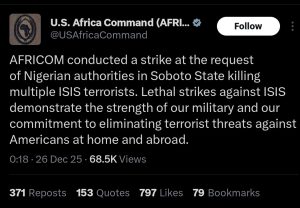
That post was, however, deleted and replaced with a revised version stating that the strike was conducted “at the direction of the President of the United States and the Secretary of War, and in coordination with Nigerian authorities.”
At the direction of the President of the United States and the Secretary of War, and in coordination with Nigerian authorities, U.S. Africa Command conducted strikes against ISIS terrorists in Nigeria on Dec. 25, 2025, in Sokoto State.
— U.S. Africa Command (AFRICOM) (@USAfricaCommand) December 26, 2025
The US Secretary of War Pete Hegseth also said he was “grateful for Nigerian government support & cooperation.”
The President was clear last month: the killing of innocent Christians in Nigeria (and elsewhere) must end.
The @DeptofWar is always ready, so ISIS found out tonight — on Christmas. More to come…
Grateful for Nigerian government support & cooperation.
Merry Christmas! https://t.co/k5Q3Qd4ClE
— Pete Hegseth (@PeteHegseth) December 25, 2025
But the change in language from AFRICOM immediately drew attention, coming amid heightened scrutiny of US–Nigeria relations following Trump’s earlier rhetoric and Nigeria’s firm rejection of claims that violence in the country amounts to targeted persecution of Christians.
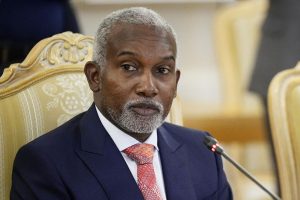
Nigeria’s Ministry of Foreign Affairs, in a detailed statement issued after the strike, confirmed that Nigerian authorities remain engaged in “structured security cooperation” with international partners, including the US.
The ministry said this cooperation, which includes intelligence sharing, strategic coordination and other forms of support, had led to “precision hits on terrorist targets in Nigeria by air strikes in the North West.” It stressed that all counter-terrorism efforts are guided by respect for sovereignty, international law and the protection of civilians, regardless of faith or ethnicity.
— Ministry of Foreign Affairs, Nigeria 🇳🇬 (@NigeriaMFA) December 26, 2025
Did Nigeria Request the Strike or Was It Coordinated After the Fact?
AFRICOM’s initial assertion that the strike was carried out “at the request of Nigerian authorities” implied a clear and formal Nigerian invitation for US kinetic action — a significant detail in a country where sovereignty concerns around foreign military involvement remain highly sensitive.
The deletion of that statement and its replacement with language emphasising presidential direction in Washington, while downgrading Nigeria’s role to “coordination,” raises questions about whether such a request was ever made in the first place.
The revised wording suggests a scenario in which the decision to strike originated primarily in Washington, consistent with Trump’s public claim that he personally ordered the attack, with Nigerian authorities involved through coordination rather than initiation.
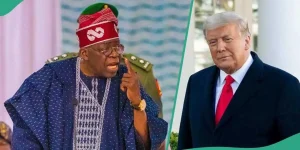
This ambiguity is reinforced by Nigeria’s own diplomatic language. The Ministry of Foreign Affairs carefully framed the operation within the context of ongoing cooperation, intelligence sharing and bilateral understandings, but stopped short of saying Nigeria asked the United States to conduct air strikes on its territory. That omission appears deliberate, allowing the federal government to acknowledge collaboration without explicitly endorsing or owning a US-led military action that had already been publicly justified by Trump using religious persecution claims Nigeria disputes.
The evolving AFRICOM narrative may reflect an effort to correct an initial overstatement that risked overstating Nigerian consent, or to avoid placing the Nigerian government in a politically awkward position domestically and diplomatically.
Before now, one of the major fears among Nigerian officials and security observers had been that the US could carry out military operations in Nigeria unilaterally, without coordination with the Nigerian government.
FURTHER READING
Despite the conflicting statements and unresolved questions about who requested the strike, all available indications suggest that this operation involved coordination with Nigerian authorities — a factor that is likely to calm some nerves, even as the debate over consent, control and precedent continues.
Philip Ibitoye is a Special Correspondent with EKO HOT BLOG. Click here to find daily analysis and critical insight on trending issues in Lagos and other parts of Nigeria.
Click here to watch the video of the week below: