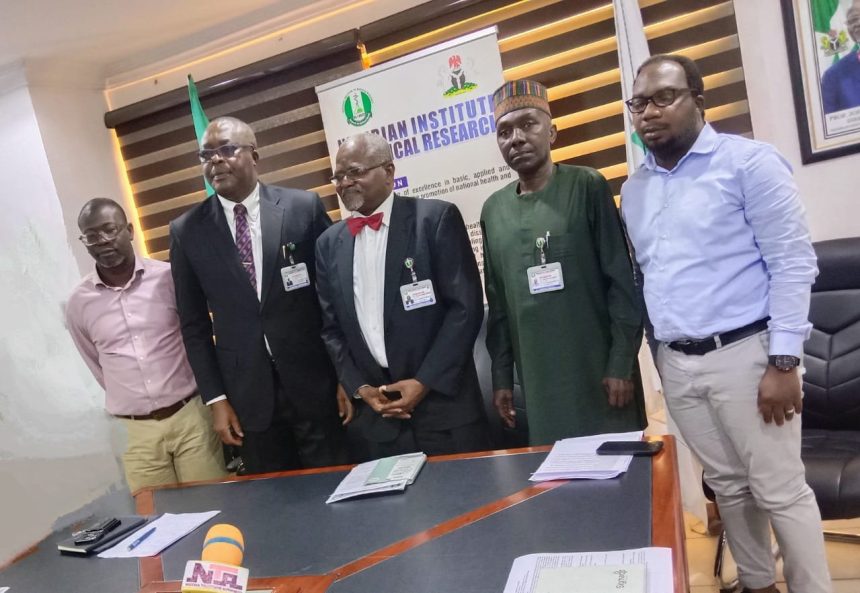
- The May edition of the Nigerian Institute of Medical Research Media Chat featured a groundbreaking research findings discussion on Safety and Antimicrobial Resistance of Mass Administration of Azithromycin among children in Nigeria (SARMAAN).
- Prof. Oliver Ezechi led the research procedures and sampled two different age ranges – among children from ages 1 to 11 months old and ages 1 to 59 months old.
- The Center for Reproduction and Population Health Studies in NIMR conducted the research to determine the effect of mass administration of azithromycin among children in child mortality endemic areas.
NIMR Media Chat is a monthly boardroom health talk with media practitioners about emerging health trends and discourse about medical research findings conducted by the Nigerian Institute of Medical Research, as ideated by the present Director General, Prof. John Oladapo Obafunwa.

EDITOR’S PICKS
- Natasha Speaks On Her Relationship With Tinubu’s Govt
- Chelsea Sign Portuguese Midfielder Dario Essugo in €22.3m Deal
- Mother of Six Resists Leaving Home After Divorce Ruling
The Director General of the Nigerian Institute of Medical Research hosted several media practitioners for the May edition of the NIMR monthly Media Chat to discuss the findings of the SARMAAN research conducted by the Center for Reproduction and Population Health Studies on Tuesday, June 3, 2025.
EKOHOTBLOG gathered that the World Health Organization (WHO) issued a guideline in 2022, tasking countries with high infant mortality to adopt mass administration of azithromycin to children aged 1 to 11 months as an additional child survival strategy.

Thus, the Nigerian Institute of Medical Research has since embarked on crucial research to ascertain the safety of mass administration of azithromycin, particularly in relation to antimicrobial resistance and cost-effectiveness of the initiative.
Moreso, the research initially set out to determine the cost , cost-effectiveness, feasibility, and acceptability of delivering azithromycin across the selected areas prone to high child mortality rates in the country.
Therefore, the scope of the SARMAAN 1 study covered platforms such as neglected tropical diseases, the polio eradication initiative, the national program for immunization, and seasonal malaria chemoprevention.

Prof. Oliver Ezechi, a research fellow at NIMR, anchored the discussion of the SARMAAN research findings, revealing that the objectives of the research were to determine the effect of mass administration of azithromycin among children from ages 1-11 months old and ages 1-59 months old.
The research team chose states across the northwestern, core north, and southeastern part of Nigeria as the most reliable sample population, including Kebbi, Sokoto, Jigawa, Kano, Abia and Akwa-Ibom respectively.
Following the successful administration of Azithromycin across the selected sample population with an average coverage rate of over 93%, the findings revealed a 98% safety ratio as against 2% mild side effects, including vomiting and stooling.

Furthermore, the NIMR team conducted SARMAAN II research using an implementation framework to measure its reach, effectiveness, adoption, implementation, and maintenance (RE-AIM), with a view to evaluating the coverage and equity of mass administration of azithromycin.
Also, the SARMAAN II aimed at evaluating and determining child health outcome, safety of AZM administration to children aged 1 to 59 months, ascertaining Nigeria’s readiness for adoption, and the best practices for monitoring the safe batched administration of AZM over a period of time.

Prof. Oliver revealed that NIMR conducted SARMAAN II across some northwestern and northeastern states, including Sokoto, Kebbi, Kastina, Jigawa, Kaduna, Kano and Bauchi.
According to Prof. Oliver, a total of 2,467,196 doses of AZM out of 5,767,083 were administered to children in Kebbi (858,696 doses) and Kaduna (1,608,500 doses) and 44 local government areas.
FURTHER READING
- PHOTO GALLERY: NIJ INTERFACE 101 Book Donation, Interactive Session In Frames
- Otunba T.J Abass Gives Back to Alma-mater, Donates African Timeless Proverbs Book to NIJ
- NPC Fed. Commissioner, Oladunjoye Mourns Olu-Epe Oba Adewale

The merits of the research revealed that the community demonstrated acceptance of mass AZM administration, boosting its reach and range, leading to successful integration of the project into existing child survival platforms.
However, the demerits include poor recognition of the importance of research, security challenges in some states limiting the reach of the research, and a weak healthcare system.
Also, poor laboratory infrastructure, poor road network cutting off hard-to-reach rural areas, and shortage of skilled personnel trained in research methodologies, were enumerated among a few other mitigating challenges.
NIMR noted that SARMAAN II research is still an ongoing project, as efforts are being put in place to ensure the effectiveness of the phase two of the project.